The POWER Procedure

Analyses in the MULTREG Statement

Type III F Test in Multiple Regression (TEST=TYPE3)

Maxwell (2000) discusses a number of different ways to represent effect sizes (and to compute exact power based on them) in multiple regression. PROC POWER supports two of these, multiple partial correlation and upper R squared in full and reduced models.

Let p denote the total number of predictors in the full model (excluding the intercept), and let Y denote the response variable. You are testing that the coefficients of p 1 greater-than-or-equal-to 1 predictors in a set upper X 1 are 0, controlling for all of the other predictors upper X Subscript negative 1, which consists of p minus p 1 greater-than-or-equal-to 0 variables.

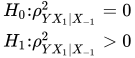
The hypotheses can be expressed in two different ways. The first is in terms of rho Subscript upper Y upper X 1 vertical-bar upper X Sub Subscript negative 1 Subscript, the multiple partial correlation between the predictors in upper X 1 and the response Y adjusting for the predictors in upper X Subscript negative 1:

StartLayout 1st Row 1st Column upper H 0 colon 2nd Column rho Subscript upper Y upper X 1 vertical-bar upper X Sub Subscript negative 1 Subscript Superscript 2 Baseline equals 0 2nd Row 1st Column upper H 1 colon 2nd Column rho Subscript upper Y upper X 1 vertical-bar upper X Sub Subscript negative 1 Subscript Superscript 2 Baseline greater-than 0 EndLayout

The second is in terms of the multiple correlations in full (rho Subscript upper Y vertical-bar left-parenthesis upper X 1 comma upper X Sub Subscript negative 1 Subscript right-parenthesis) and reduced (rho Subscript upper Y vertical-bar upper X Sub Subscript negative 1 Subscript) nested models:

StartLayout 1st Row 1st Column upper H 0 colon 2nd Column rho Subscript upper Y vertical-bar left-parenthesis upper X 1 comma upper X Sub Subscript negative 1 Subscript right-parenthesis Superscript 2 Baseline minus rho Subscript upper Y vertical-bar upper X Sub Subscript negative 1 Subscript Superscript 2 Baseline equals 0 2nd Row 1st Column upper H 1 colon 2nd Column rho Subscript upper Y vertical-bar left-parenthesis upper X 1 comma upper X Sub Subscript negative 1 Subscript right-parenthesis Superscript 2 Baseline minus rho Subscript upper Y vertical-bar upper X Sub Subscript negative 1 Subscript Superscript 2 Baseline greater-than 0 EndLayout

Note that the squared values of rho Subscript upper Y vertical-bar left-parenthesis upper X 1 comma upper X Sub Subscript negative 1 Subscript right-parenthesis and rho Subscript upper Y vertical-bar upper X Sub Subscript negative 1 Subscript are the population upper R squared values for full and reduced models.

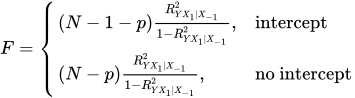
The test statistic can be written in terms of the sample multiple partial correlation upper R Subscript upper Y upper X 1 vertical-bar upper X Sub Subscript negative 1 Subscript,

upper F equals StartLayout Enlarged left-brace 1st Row 1st Column left-parenthesis upper N minus 1 minus p right-parenthesis StartFraction upper R Subscript upper Y upper X 1 vertical-bar upper X Sub Subscript negative 1 Subscript Superscript 2 Baseline Over 1 minus upper R Subscript upper Y upper X 1 vertical-bar upper X Sub Subscript negative 1 Subscript Superscript 2 Baseline EndFraction comma 2nd Column intercept 2nd Row 1st Column left-parenthesis upper N minus p right-parenthesis StartFraction upper R Subscript upper Y upper X 1 vertical-bar upper X Sub Subscript negative 1 Subscript Superscript 2 Baseline Over 1 minus upper R Subscript upper Y upper X 1 vertical-bar upper X Sub Subscript negative 1 Subscript Superscript 2 Baseline EndFraction comma 2nd Column no intercept EndLayout

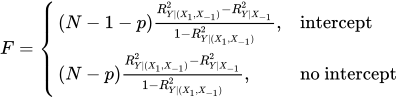
or the sample multiple correlations in full (upper R Subscript upper Y vertical-bar left-parenthesis upper X 1 comma upper X Sub Subscript negative 1 Subscript right-parenthesis) and reduced (upper R Subscript upper Y vertical-bar upper X Sub Subscript negative 1 Subscript) models,

upper F equals StartLayout Enlarged left-brace 1st Row 1st Column left-parenthesis upper N minus 1 minus p right-parenthesis StartFraction upper R Subscript upper Y vertical-bar left-parenthesis upper X 1 comma upper X Sub Subscript negative 1 Subscript right-parenthesis Superscript 2 Baseline minus upper R Subscript upper Y vertical-bar upper X Sub Subscript negative 1 Subscript Superscript 2 Baseline Over 1 minus upper R Subscript upper Y vertical-bar left-parenthesis upper X 1 comma upper X Sub Subscript negative 1 Subscript right-parenthesis Superscript 2 Baseline EndFraction comma 2nd Column intercept 2nd Row 1st Column left-parenthesis upper N minus p right-parenthesis StartFraction upper R Subscript upper Y vertical-bar left-parenthesis upper X 1 comma upper X Sub Subscript negative 1 Subscript right-parenthesis Superscript 2 Baseline minus upper R Subscript upper Y vertical-bar upper X Sub Subscript negative 1 Subscript Superscript 2 Baseline Over 1 minus upper R Subscript upper Y vertical-bar left-parenthesis upper X 1 comma upper X Sub Subscript negative 1 Subscript right-parenthesis Superscript 2 Baseline EndFraction comma 2nd Column no intercept EndLayout

The test is the usual Type III F test in multiple regression:

Reject upper H 0 if StartLayout Enlarged left-brace 1st Row 1st Column upper F greater-than-or-equal-to upper F Subscript 1 minus alpha Baseline left-parenthesis p 1 comma upper N minus 1 minus p right-parenthesis comma 2nd Column intercept 2nd Row 1st Column upper F greater-than-or-equal-to upper F Subscript 1 minus alpha Baseline left-parenthesis p 1 comma upper N minus p right-parenthesis comma 2nd Column no intercept EndLayout

Although the test is invariant to whether the predictors are assumed to be random or fixed, the power is affected by this assumption. If the response and predictors are assumed to have a joint multivariate normal distribution, then the exact power is given by the following formula:
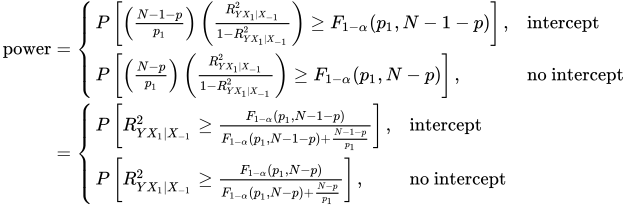
StartLayout 1st Row 1st Column normal p normal o normal w normal e normal r 2nd Column equals StartLayout Enlarged left-brace 1st Row 1st Column upper P left-bracket left-parenthesis StartFraction upper N minus 1 minus p Over p 1 EndFraction right-parenthesis left-parenthesis StartFraction upper R Subscript upper Y upper X 1 vertical-bar upper X Sub Subscript negative 1 Subscript Superscript 2 Baseline Over 1 minus upper R Subscript upper Y upper X 1 vertical-bar upper X Sub Subscript negative 1 Subscript Superscript 2 Baseline EndFraction right-parenthesis greater-than-or-equal-to upper F Subscript 1 minus alpha Baseline left-parenthesis p 1 comma upper N minus 1 minus p right-parenthesis right-bracket comma 2nd Column intercept 2nd Row 1st Column upper P left-bracket left-parenthesis StartFraction upper N minus p Over p 1 EndFraction right-parenthesis left-parenthesis StartFraction upper R Subscript upper Y upper X 1 vertical-bar upper X Sub Subscript negative 1 Subscript Superscript 2 Baseline Over 1 minus upper R Subscript upper Y upper X 1 vertical-bar upper X Sub Subscript negative 1 Subscript Superscript 2 Baseline EndFraction right-parenthesis greater-than-or-equal-to upper F Subscript 1 minus alpha Baseline left-parenthesis p 1 comma upper N minus p right-parenthesis right-bracket comma 2nd Column no intercept EndLayout 2nd Row 1st Column Blank 2nd Column equals StartLayout Enlarged left-brace 1st Row 1st Column upper P left-bracket upper R Subscript upper Y upper X 1 vertical-bar upper X Sub Subscript negative 1 Subscript Superscript 2 Baseline greater-than-or-equal-to StartStartFraction upper F Subscript 1 minus alpha Baseline left-parenthesis p 1 comma upper N minus 1 minus p right-parenthesis OverOver upper F Subscript 1 minus alpha Baseline left-parenthesis p 1 comma upper N minus 1 minus p right-parenthesis plus StartFraction upper N minus 1 minus p Over p 1 EndFraction EndEndFraction right-bracket comma 2nd Column intercept 2nd Row 1st Column upper P left-bracket upper R Subscript upper Y upper X 1 vertical-bar upper X Sub Subscript negative 1 Subscript Superscript 2 Baseline greater-than-or-equal-to StartStartFraction upper F Subscript 1 minus alpha Baseline left-parenthesis p 1 comma upper N minus p right-parenthesis OverOver upper F Subscript 1 minus alpha Baseline left-parenthesis p 1 comma upper N minus p right-parenthesis plus StartFraction upper N minus p Over p 1 EndFraction EndEndFraction right-bracket comma 2nd Column no intercept EndLayout EndLayout

The distribution of upper R Subscript upper Y upper X 1 vertical-bar upper X Sub Subscript negative 1 Subscript Superscript 2 (for any rho Subscript upper Y upper X 1 vertical-bar upper X Sub Subscript negative 1 Subscript Superscript 2) is given in Chapter 32 of Johnson, Kotz, and Balakrishnan (1995). Sample size tables are presented in Gatsonis and Sampson (1989).

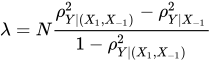
If the predictors are assumed to have fixed values, then the exact power is given by the noncentral F distribution. The noncentrality parameter is
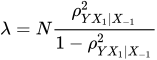
lamda equals upper N StartFraction rho Subscript upper Y upper X 1 vertical-bar upper X Sub Subscript negative 1 Subscript Superscript 2 Baseline Over 1 minus rho Subscript upper Y upper X 1 vertical-bar upper X Sub Subscript negative 1 Subscript Superscript 2 Baseline EndFraction

or equivalently,

lamda equals upper N StartFraction rho Subscript upper Y vertical-bar left-parenthesis upper X 1 comma upper X Sub Subscript negative 1 Subscript right-parenthesis Superscript 2 Baseline minus rho Subscript upper Y vertical-bar upper X Sub Subscript negative 1 Subscript Superscript 2 Baseline Over 1 minus rho Subscript upper Y vertical-bar left-parenthesis upper X 1 comma upper X Sub Subscript negative 1 Subscript right-parenthesis Superscript 2 Baseline EndFraction

The power is

StartLayout 1st Row 1st Column normal p normal o normal w normal e normal r 2nd Column equals StartLayout Enlarged left-brace 1st Row 1st Column upper P left-parenthesis upper F left-parenthesis p 1 comma upper N minus 1 minus p comma lamda right-parenthesis greater-than-or-equal-to upper F Subscript 1 minus alpha Baseline left-parenthesis p 1 comma upper N minus 1 minus p right-parenthesis right-parenthesis comma 2nd Column intercept 2nd Row 1st Column upper P left-parenthesis upper F left-parenthesis p 1 comma upper N minus p comma lamda right-parenthesis greater-than-or-equal-to upper F Subscript 1 minus alpha Baseline left-parenthesis p 1 comma upper N minus p right-parenthesis right-parenthesis comma 2nd Column no intercept EndLayout EndLayout

The minimum acceptable input value of N depends on several factors, as shown in Table 36.

Table 36: Minimum Acceptable Sample Size Values in the MULTREG Statement

Predictor Type Intercept in Model? p 1 equals 1? Minimum N
Random Yes Yes p + 3
Random Yes No  p + 2
Random No  Yes p + 2
Random No  No  p + 1
Fixed Yes Yes or No p + 2
Fixed No  Yes or No p + 1


Last updated: December 09, 2022