The POWER Procedure

Analyses in the TWOSAMPLESURVIVAL Statement

Rank Tests for Two Survival Curves (TEST=LOGRANK, TEST=GEHAN, TEST=TARONEWARE)

The method is from Lakatos (1988) and Cantor (1997, pp. 83–92).

Define the following notation:
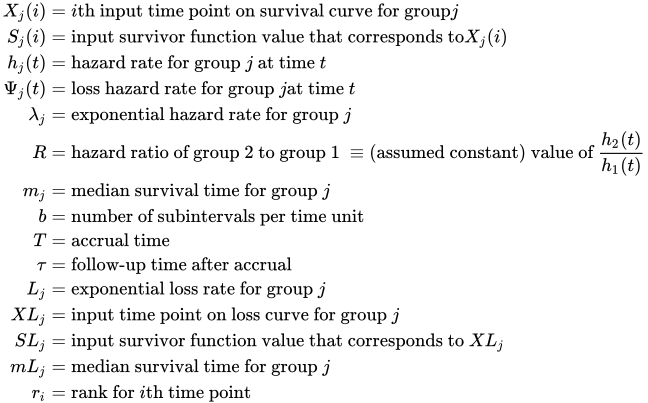
StartLayout 1st Row 1st Column upper X Subscript j Baseline left-parenthesis i right-parenthesis 2nd Column equals i th input time point on survival curve for group j 2nd Row 1st Column upper S Subscript j Baseline left-parenthesis i right-parenthesis 2nd Column equals input survivor function value that corresponds to upper X Subscript j Baseline left-parenthesis i right-parenthesis 3rd Row 1st Column h Subscript j Baseline left-parenthesis t right-parenthesis 2nd Column equals hazard rate for group j at time t 4th Row 1st Column normal upper Psi Subscript j Baseline left-parenthesis t right-parenthesis 2nd Column equals loss hazard rate for group j at time t 5th Row 1st Column lamda Subscript j 2nd Column equals exponential hazard rate for group j 6th Row 1st Column upper R 2nd Column equals hazard ratio of group 2 to group 1 identical-to left-parenthesis assumed constant right-parenthesis value of StartFraction h 2 left-parenthesis t right-parenthesis Over h 1 left-parenthesis t right-parenthesis EndFraction 7th Row 1st Column m Subscript j 2nd Column equals median survival time for group j 8th Row 1st Column b 2nd Column equals number of subintervals per time unit 9th Row 1st Column upper T 2nd Column equals accrual time 10th Row 1st Column tau 2nd Column equals follow hyphen up time after accrual 11th Row 1st Column upper L Subscript j 2nd Column equals exponential loss rate for group j 12th Row 1st Column upper X upper L Subscript j 2nd Column equals input time point on loss curve for group j 13th Row 1st Column upper S upper L Subscript j 2nd Column equals input survivor function value that corresponds to upper X upper L Subscript j Baseline 14th Row 1st Column m upper L Subscript j 2nd Column equals median survival time for group j 15th Row 1st Column r Subscript i 2nd Column equals rank for i th time point EndLayout

Each survival curve can be specified in one of several ways.

  • For exponential curves:

    • a single point left-parenthesis upper X Subscript j Baseline left-parenthesis 1 right-parenthesis comma upper S Subscript j Baseline left-parenthesis 1 right-parenthesis right-parenthesis on the curve

    • median survival time

    • hazard rate

    • hazard ratio (for curve 2, with respect to curve 1)

  • For piecewise linear curves with proportional hazards:

    • a set of points StartSet left-parenthesis upper X 1 left-parenthesis 1 right-parenthesis comma upper S 1 left-parenthesis 1 right-parenthesis right-parenthesis comma left-parenthesis upper X 1 left-parenthesis 2 right-parenthesis comma upper S 1 left-parenthesis 2 right-parenthesis right-parenthesis comma ellipsis EndSet (for curve 1)

    • hazard ratio (for curve 2, with respect to curve 1)

  • For arbitrary piecewise linear curves:

    • a set of points StartSet left-parenthesis upper X Subscript j Baseline left-parenthesis 1 right-parenthesis comma upper S Subscript j Baseline left-parenthesis 1 right-parenthesis right-parenthesis comma left-parenthesis upper X Subscript j Baseline left-parenthesis 2 right-parenthesis comma upper S Subscript j Baseline left-parenthesis 2 right-parenthesis right-parenthesis comma ellipsis EndSet

A total of upper M plus 1 evenly spaced time points StartSet t 0 equals 0 comma t 1 comma t 2 comma ellipsis comma t Subscript upper M Baseline equals upper T plus tau EndSet are used in calculations, where

upper M equals normal f normal l normal o normal o normal r left-parenthesis left-parenthesis upper T plus tau right-parenthesis b right-parenthesis

The hazard function is calculated for each survival curve at each time point. For an exponential curve, the (constant) hazard is given by one of the following, depending on the input parameterization:

h Subscript j Baseline left-parenthesis t right-parenthesis equals StartLayout Enlarged left-brace 1st Row  lamda Subscript j Baseline 2nd Row  lamda 1 upper R 3rd Row  StartFraction minus log left-parenthesis one-half right-parenthesis Over m Subscript j Baseline EndFraction 4th Row  StartFraction minus log left-parenthesis upper S Subscript j Baseline left-parenthesis 1 right-parenthesis right-parenthesis Over upper X Subscript j Baseline left-parenthesis 1 right-parenthesis EndFraction 5th Row  StartFraction minus log left-parenthesis upper S 1 left-parenthesis 1 right-parenthesis right-parenthesis Over upper X 1 left-parenthesis 1 right-parenthesis EndFraction upper R EndLayout

For a piecewise linear curve, define the following additional notation:

StartLayout 1st Row 1st Column t Subscript i Superscript minus 2nd Column equals largest input time upper X such that upper X less-than-or-equal-to t Subscript i Baseline 2nd Row 1st Column t Subscript i Superscript plus 2nd Column equals smallest input time upper X such that upper X greater-than t Subscript i Baseline EndLayout

The hazard is computed by using linear interpolation as follows:

h Subscript j Baseline left-parenthesis t Subscript i Baseline right-parenthesis equals StartFraction upper S Subscript j Baseline left-parenthesis t Subscript i Superscript minus Baseline right-parenthesis minus upper S Subscript j Baseline left-parenthesis t Subscript i Superscript plus Baseline right-parenthesis Over left-bracket upper S Subscript j Baseline left-parenthesis t Subscript i Superscript plus Baseline right-parenthesis minus upper S Subscript j Baseline left-parenthesis t Subscript i Superscript minus Baseline right-parenthesis right-bracket left-bracket t Subscript i Baseline minus t Subscript i Superscript minus Baseline right-bracket plus upper S Subscript j Baseline left-parenthesis t Subscript i Superscript minus Baseline right-parenthesis left-bracket t Subscript i Superscript plus Baseline minus t Subscript i Superscript minus Baseline right-bracket EndFraction

With proportional hazards, the hazard rate of group 2’s curve in terms of the hazard rate of group 1’s curve is

h 2 left-parenthesis t right-parenthesis equals h 1 left-parenthesis t right-parenthesis upper R

Hazard function values StartSet normal upper Psi Subscript j Baseline left-parenthesis t Subscript i Baseline right-parenthesis EndSet for the loss curves are computed in an analogous way from StartSet upper L Subscript j Baseline comma upper X upper L Subscript j Baseline comma upper S upper L Subscript j Baseline comma m upper L Subscript j Baseline EndSet.

The expected number at risk upper N Subscript j Baseline left-parenthesis i right-parenthesis at time i in group j is calculated for each group and time points 0 through M – 1, as follows:

StartLayout 1st Row 1st Column upper N Subscript j Baseline left-parenthesis 0 right-parenthesis 2nd Column equals upper N w Subscript j Baseline 2nd Row 1st Column upper N Subscript j Baseline left-parenthesis i plus 1 right-parenthesis 2nd Column equals upper N Subscript j Baseline left-parenthesis i right-parenthesis left-bracket 1 minus h Subscript j Baseline left-parenthesis t Subscript i Baseline right-parenthesis left-parenthesis StartFraction 1 Over b EndFraction right-parenthesis minus normal upper Psi Subscript j Baseline left-parenthesis t Subscript i Baseline right-parenthesis left-parenthesis StartFraction 1 Over b EndFraction right-parenthesis minus left-parenthesis StartFraction 1 Over b left-parenthesis upper T plus tau minus t Subscript i Baseline right-parenthesis EndFraction right-parenthesis 1 Subscript StartSet t Sub Subscript i Subscript greater-than tau EndSet Baseline right-bracket EndLayout

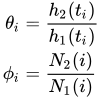
Define theta Subscript i as the ratio of hazards and phi Subscript i as the ratio of expected numbers at risk for time t Subscript i:

StartLayout 1st Row 1st Column theta Subscript i 2nd Column equals StartFraction h 2 left-parenthesis t Subscript i Baseline right-parenthesis Over h 1 left-parenthesis t Subscript i Baseline right-parenthesis EndFraction 2nd Row 1st Column phi Subscript i 2nd Column equals StartFraction upper N 2 left-parenthesis i right-parenthesis Over upper N 1 left-parenthesis i right-parenthesis EndFraction EndLayout

The expected number of deaths in each subinterval is calculated as follows:

upper D Subscript i Baseline equals left-bracket h 1 left-parenthesis t Subscript i Baseline right-parenthesis upper N 1 left-parenthesis i right-parenthesis plus h 2 left-parenthesis t Subscript i Baseline right-parenthesis upper N 2 left-parenthesis i right-parenthesis right-bracket left-parenthesis StartFraction 1 Over b EndFraction right-parenthesis

The rank values are calculated as follows according to which test statistic is used:
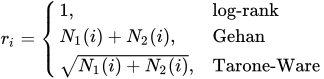
r Subscript i Baseline equals StartLayout Enlarged left-brace 1st Row 1st Column 1 comma 2nd Column log hyphen rank 2nd Row 1st Column upper N 1 left-parenthesis i right-parenthesis plus upper N 2 left-parenthesis i right-parenthesis comma 2nd Column Gehan 3rd Row 1st Column StartRoot upper N 1 left-parenthesis i right-parenthesis plus upper N 2 left-parenthesis i right-parenthesis EndRoot comma 2nd Column Tarone hyphen Ware EndLayout

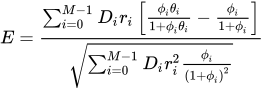
The distribution of the test statistic is approximated by upper N left-parenthesis upper E comma 1 right-parenthesis where

upper E equals StartStartFraction sigma-summation Underscript i equals 0 Overscript upper M minus 1 Endscripts upper D Subscript i Baseline r Subscript i Baseline left-bracket StartFraction phi Subscript i Baseline theta Subscript i Baseline Over 1 plus phi Subscript i Baseline theta Subscript i Baseline EndFraction minus StartFraction phi Subscript i Baseline Over 1 plus phi Subscript i Baseline EndFraction right-bracket OverOver StartRoot sigma-summation Underscript i equals 0 Overscript upper M minus 1 Endscripts upper D Subscript i Baseline r Subscript i Superscript 2 Baseline StartFraction phi Subscript i Baseline Over left-parenthesis 1 plus phi Subscript i Baseline right-parenthesis squared EndFraction EndRoot EndEndFraction

Note that upper N Superscript one-half can be factored out of the mean E, and so it can be expressed equivalently as
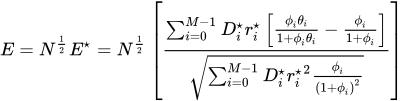
upper E equals upper N Superscript one-half Baseline upper E Superscript star Baseline equals upper N Superscript one-half Baseline left-bracket StartStartFraction sigma-summation Underscript i equals 0 Overscript upper M minus 1 Endscripts upper D Subscript i Superscript star Baseline r Subscript i Superscript star Baseline left-bracket StartFraction phi Subscript i Baseline theta Subscript i Baseline Over 1 plus phi Subscript i Baseline theta Subscript i Baseline EndFraction minus StartFraction phi Subscript i Baseline Over 1 plus phi Subscript i Baseline EndFraction right-bracket OverOver StartRoot sigma-summation Underscript i equals 0 Overscript upper M minus 1 Endscripts upper D Subscript i Superscript star Baseline r Subscript i Superscript star Baseline squared StartFraction phi Subscript i Baseline Over left-parenthesis 1 plus phi Subscript i Baseline right-parenthesis squared EndFraction EndRoot EndEndFraction right-bracket

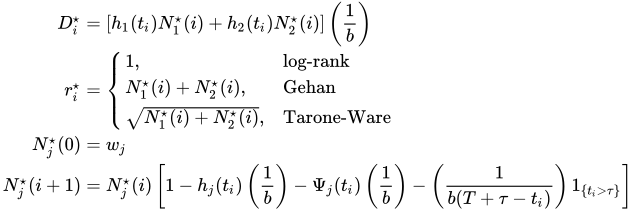
where upper E Superscript star is free of N and

StartLayout 1st Row 1st Column upper D Subscript i Superscript star 2nd Column equals left-bracket h 1 left-parenthesis t Subscript i Baseline right-parenthesis upper N 1 Superscript star Baseline left-parenthesis i right-parenthesis plus h 2 left-parenthesis t Subscript i Baseline right-parenthesis upper N 2 Superscript star Baseline left-parenthesis i right-parenthesis right-bracket left-parenthesis StartFraction 1 Over b EndFraction right-parenthesis 2nd Row 1st Column r Subscript i Superscript star 2nd Column equals StartLayout Enlarged left-brace 1st Row 1st Column 1 comma 2nd Column log hyphen rank 2nd Row 1st Column upper N 1 Superscript star Baseline left-parenthesis i right-parenthesis plus upper N 2 Superscript star Baseline left-parenthesis i right-parenthesis comma 2nd Column Gehan 3rd Row 1st Column StartRoot upper N 1 Superscript star Baseline left-parenthesis i right-parenthesis plus upper N 2 Superscript star Baseline left-parenthesis i right-parenthesis EndRoot comma 2nd Column Tarone hyphen Ware EndLayout 3rd Row 1st Column upper N Subscript j Superscript star Baseline left-parenthesis 0 right-parenthesis 2nd Column equals w Subscript j Baseline 4th Row 1st Column upper N Subscript j Superscript star Baseline left-parenthesis i plus 1 right-parenthesis 2nd Column equals upper N Subscript j Superscript star Baseline left-parenthesis i right-parenthesis left-bracket 1 minus h Subscript j Baseline left-parenthesis t Subscript i Baseline right-parenthesis left-parenthesis StartFraction 1 Over b EndFraction right-parenthesis minus normal upper Psi Subscript j Baseline left-parenthesis t Subscript i Baseline right-parenthesis left-parenthesis StartFraction 1 Over b EndFraction right-parenthesis minus left-parenthesis StartFraction 1 Over b left-parenthesis upper T plus tau minus t Subscript i Baseline right-parenthesis EndFraction right-parenthesis 1 Subscript StartSet t Sub Subscript i Subscript greater-than tau EndSet Baseline right-bracket EndLayout

The approximate power is

normal p normal o normal w normal e normal r equals StartLayout Enlarged left-brace 1st Row 1st Column normal upper Phi left-parenthesis minus upper N Superscript one-half Baseline upper E Superscript star Baseline minus z Subscript 1 minus alpha Baseline right-parenthesis comma 2nd Column upper one hyphen sided 2nd Row 1st Column normal upper Phi left-parenthesis upper N Superscript one-half Baseline upper E Superscript star Baseline minus z Subscript 1 minus alpha Baseline right-parenthesis comma 2nd Column lower one hyphen sided 3rd Row 1st Column normal upper Phi left-parenthesis minus upper N Superscript one-half Baseline upper E Superscript star Baseline minus z Subscript 1 minus StartFraction alpha Over 2 EndFraction Baseline right-parenthesis plus normal upper Phi left-parenthesis upper N Superscript one-half Baseline upper E Superscript star Baseline minus z Subscript 1 minus StartFraction alpha Over 2 EndFraction Baseline right-parenthesis comma 2nd Column two hyphen sided EndLayout

Note that the upper and lower one-sided cases are expressed differently than in other analyses. This is because upper E Superscript star Baseline greater-than 0 corresponds to a higher survival curve in group 1 and thus, by the convention used in PROC power for two-group analyses, the lower side.

For the one-sided cases, a closed-form inversion of the power equation yield an approximate total sample size
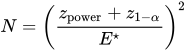
upper N equals left-parenthesis StartFraction z Subscript normal p normal o normal w normal e normal r Baseline plus z Subscript 1 minus alpha Baseline Over upper E Superscript star Baseline EndFraction right-parenthesis squared

For the two-sided case, the solution for N is obtained by numerically inverting the power equation.

Accrual rates are converted to and from sample sizes according to the equation a Subscript j Baseline equals n Subscript j Baseline slash upper T, where a Subscript j is the accrual rate for group j.

Expected numbers of events—that is, deaths, whether observed or censored—are converted to and from sample sizes according to the equation

e Subscript j Baseline equals StartLayout Enlarged left-brace 1st Row 1st Column n Subscript j Baseline left-bracket 1 minus upper S Subscript j Baseline left-parenthesis tau right-parenthesis right-bracket comma 2nd Column upper T equals 0 2nd Row 1st Column n Subscript j Baseline left-bracket 1 minus StartFraction 1 Over upper T EndFraction integral Subscript 0 Superscript upper T Baseline upper S Subscript j Baseline left-parenthesis upper T plus tau minus t right-parenthesis d t right-bracket comma 2nd Column upper T greater-than 0 EndLayout

where e Subscript j is the expected number of events in group j. For an exponential curve, the equation simplifies to

e Subscript j Baseline equals StartLayout Enlarged left-brace 1st Row 1st Column n Subscript j Baseline left-bracket 1 minus exp left-parenthesis minus lamda Subscript j Baseline tau right-parenthesis right-bracket comma 2nd Column upper T equals 0 2nd Row 1st Column n Subscript j Baseline left-bracket 1 minus StartFraction 1 Over lamda Subscript j Baseline upper T EndFraction left-parenthesis exp left-parenthesis minus lamda Subscript j Baseline tau right-parenthesis minus exp left-parenthesis minus lamda Subscript j Baseline left-parenthesis upper T plus tau right-parenthesis right-parenthesis right-parenthesis right-bracket comma 2nd Column upper T greater-than 0 EndLayout

For a piecewise linear curve, first define upper K Subscript j as the number of time points in the following collection: tau, upper T plus tau, and input time points for group j strictly between tau and upper T plus tau. Denote the ordered set of these points as StartSet u Subscript j Baseline 1 Baseline comma ellipsis comma u Subscript j upper K Sub Subscript j Subscript Baseline EndSet. The survival function values upper S Subscript j Baseline left-parenthesis tau right-parenthesis and upper S Subscript j Baseline left-parenthesis upper T plus tau right-parenthesis are calculated by linear interpolation between adjacent input time points if they do not coincide with any input time points. Then the equation for a piecewise linear curve simplifies to


e Subscript j Baseline equals StartLayout Enlarged left-brace 1st Row 1st Column n Subscript j Baseline left-bracket 1 minus upper S Subscript j Baseline left-parenthesis tau right-parenthesis right-bracket comma 2nd Column upper T equals 0 2nd Row 1st Column n Subscript j Baseline left-bracket 1 minus StartFraction 1 Over 2 upper T EndFraction sigma-summation Underscript i equals 1 Overscript upper K Subscript j Baseline minus 1 Endscripts left-parenthesis u Subscript j comma i plus 1 Baseline minus u Subscript j i Baseline right-parenthesis left-parenthesis upper S Subscript j Baseline left-parenthesis u Subscript j i Baseline right-parenthesis plus upper S Subscript j Baseline left-parenthesis u Subscript j comma i plus 1 Baseline right-parenthesis right-parenthesis right-bracket comma 2nd Column upper T greater-than 0 EndLayout
Last updated: December 09, 2022