The PSMATCH Procedure
Sensitivity Analysis
Propensity score analysis assumes that all the confounders (variables that affect both the outcome and the treatment assignment) have been measured. If some confounders are unobserved, individuals that have the same observed covariates might not have the same probability of being assigned to the treated group. The assumption of no unmeasured confounders cannot be verified, so you should analyze the sensitivity of inferences to departures from this assumption. Sensitivity analysis considers how strong the unobserved covariates would have to be in order to negate the conclusion of the study (assuming that the initial analysis found a significant effect of the treatment).
Liu, Kuramoto, and Stuart (2013) describe seven commonly used techniques for sensitivity analysis. Based on the study objectives, these methods are classified into two groups. One group finds the tipping point that negates the statistical significance of the outcome-treatment association (Liu, Kuramoto, and Stuart 2013). The other group (not discussed here) derives the point estimate of the true outcome-treatment association with a 95% confidence interval (Liu, Kuramoto, and Stuart 2013).
Rosenbaum (2010, p. 77) provides a sensitivity analysis based on the odds ratio,

where  and
and  are the probabilities that the kth and lth individuals are assigned to the treated group, given that they have the same observed covariates,
  .
.
For all kth and lth individuals with , assume that the odds ratio is bounded by
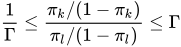
where  .
.
The parameter  measures the degree of hidden bias from unobserved confounders. For example, with
  ,
,
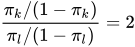
which indicates that even though they have the same values of the observed covariates, the kth individual is twice as likely as the lth individual to be in the treated group because of hidden bias.
Propensity score analysis assumes that if the kth and lth individuals have the same observed covariates, then  and
and  . When an outcome analysis leads to a significant result, Rosenbaum’s sensitivity analysis finds a tipping point,
  , that negates the conclusion of the study. A large value of
  is evidence that only a large departure from random treatment assignment can negate the conclusion of the study. If is plausible, the study conclusion is not robust to hidden bias from an unobserved confounder.
For the case of one-to-one matched observations, Rosenbaum (2010, pp. 78–84) provides a sensitivity analysis that is based on paired observations. The following subsection describes this approach.
Sensitivity Analysis on Matched Observations
In a set of one-to-one matched observations, if individuals k and l are in the same matched set, then the probability that individual k is in the treated group and individual l is in the control group is

and the following equation can be used for sensitivity analysis:
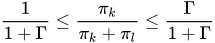
If , then .
For example, let  and
and  be the responses for the treated and control units in the jth matched set. The response is the improvement after treatment, and a positive value indicates a beneficial effect. Let

be the difference in responses between the treated and control units.
Suppose that a signed rank test is used in the outcome analysis. The signed rank statistic is
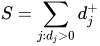
where  is the rank of
  .
.
Assume that =1. Then under the hypothesis of no treatment effect, S has mean
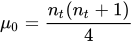
where  is the number of matched sets and the variance V (assuming that all
  is distinct) is
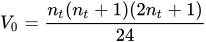
When  , the significance of

can be computed from the Student’s t distribution with  degrees of freedom.
For , S has mean

and variance

If a signed rank test shows a significantly better benefit in the treated group with , the sensitivity analysis searches for a tipping point that negates the study conclusion. A study conclusion is robust to hidden bias from the unobserved confounder if an extreme value of is needed to alter the study conclusion.
Example 101.9 illustrates a sensitivity analysis on a set of one-to-one matched observations.