The QUANTREG Procedure

Linear Test

Consider the linear model

y Subscript i Baseline equals bold x prime Subscript 1 i Baseline bold-italic beta 1 plus bold x prime Subscript 2 i Baseline bold-italic beta 2 plus epsilon Subscript i

where bold-italic beta 1 and bold-italic beta 2 are p- and q-dimensional unknown parameters and StartSet epsilon Subscript i Baseline EndSet, i equals 1 comma ellipsis comma n, are errors with unknown density function f Subscript i. Let bold x prime Subscript i Baseline equals left-parenthesis bold x prime Subscript 1 i Baseline comma bold x prime Subscript 2 i right-parenthesis, and let ModifyingAbove bold-italic beta With caret Subscript 1 Baseline left-parenthesis tau right-parenthesis and ModifyingAbove bold-italic beta With caret Subscript 2 Baseline left-parenthesis tau right-parenthesis be the parameter estimates for bold-italic beta 1 and bold-italic beta 2, respectively at the tau quantile. The covariance matrix bold upper Omega for the parameter estimates is partitioned correspondingly as bold upper Omega Subscript i j with i equals 1 comma 2 semicolon j equals 1 comma 2; and bold upper Omega Superscript 22 Baseline equals left-parenthesis bold upper Omega 22 minus bold upper Omega 21 bold upper Omega 11 Superscript negative 1 Baseline bold upper Omega 12 right-parenthesis Superscript negative 1 Baseline period

Testing Effects of Covariates

Three tests are available in the QUANTREG procedure for the linear null hypothesis upper H 0 colon beta 2 equals 0 at the tau quantile:

  • The Wald test statistic, which is based on the estimated coefficients for the unrestricted model, is given by

    upper T Subscript upper W Baseline left-parenthesis tau right-parenthesis equals ModifyingAbove bold-italic beta With caret prime Subscript 2 Baseline left-parenthesis tau right-parenthesis ModifyingAbove bold upper Sigma With caret left-parenthesis tau right-parenthesis Superscript negative 1 Baseline ModifyingAbove bold-italic beta With caret Subscript 2 Baseline left-parenthesis tau right-parenthesis

    where ModifyingAbove bold upper Sigma With caret left-parenthesis tau right-parenthesis is an estimator of the covariance of ModifyingAbove bold-italic beta With caret Subscript 2 Baseline left-parenthesis tau right-parenthesis. The QUANTREG procedure provides two estimators for the covariance, as described in the previous section. The estimator that is based on the asymptotic covariance is
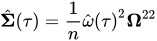
    ModifyingAbove bold upper Sigma With caret left-parenthesis tau right-parenthesis equals StartFraction 1 Over n EndFraction ModifyingAbove omega With caret left-parenthesis tau right-parenthesis squared bold upper Omega Superscript 22

    where ModifyingAbove omega With caret left-parenthesis tau right-parenthesis equals StartRoot tau left-parenthesis 1 minus tau right-parenthesis EndRoot ModifyingAbove s With caret left-parenthesis tau right-parenthesis and ModifyingAbove s With caret left-parenthesis tau right-parenthesis is the estimated sparsity function. The estimator that is based on the bootstrap covariance is the empirical covariance of the MCMB samples.

  • The likelihood ratio test is based on the difference between the objective function values in the restricted and unrestricted models. Let upper D 0 left-parenthesis tau right-parenthesis equals sigma-summation rho Subscript tau Baseline left-parenthesis y Subscript i Baseline minus bold x prime Subscript i Baseline ModifyingAbove bold-italic beta With caret left-parenthesis tau right-parenthesis right-parenthesis, and let upper D 1 left-parenthesis tau right-parenthesis equals sigma-summation rho Subscript tau Baseline left-parenthesis y Subscript i Baseline minus bold x prime Subscript 1 i Baseline ModifyingAbove bold-italic beta With caret Subscript 1 Baseline left-parenthesis tau right-parenthesis right-parenthesis. Set

    upper T Subscript normal upper L normal upper R Baseline left-parenthesis tau right-parenthesis equals 2 left-parenthesis tau left-parenthesis 1 minus tau right-parenthesis ModifyingAbove s With caret left-parenthesis tau right-parenthesis right-parenthesis Superscript negative 1 Baseline left-parenthesis upper D 1 left-parenthesis tau right-parenthesis minus upper D 0 left-parenthesis tau right-parenthesis right-parenthesis

    where ModifyingAbove s With caret left-parenthesis tau right-parenthesis is the estimated sparsity function.

  • The rank test statistic is given by

    upper T Subscript upper R Baseline left-parenthesis tau right-parenthesis equals bold upper S prime Subscript n Baseline bold upper M Subscript n Superscript negative 1 Baseline bold upper S Subscript n Baseline slash upper A squared left-parenthesis phi right-parenthesis

    where

    bold upper S Subscript n Baseline equals n Superscript negative 1 slash 2 Baseline left-parenthesis bold upper X 2 minus ModifyingAbove bold upper X With caret Subscript 2 Baseline right-parenthesis prime ModifyingAbove bold b With caret Subscript n
    bold upper Psi equals normal d normal i normal a normal g left-parenthesis f Subscript i Baseline left-parenthesis upper Q Subscript y Sub Subscript i Subscript vertical-bar bold x Sub Subscript 1 i Subscript comma bold x Sub Subscript 2 i Subscript Baseline left-parenthesis tau right-parenthesis right-parenthesis right-parenthesis
    ModifyingAbove bold upper X With caret Subscript 2 Baseline equals bold upper X 1 left-parenthesis bold upper X prime 1 bold upper Psi bold upper X 1 right-parenthesis Superscript negative 1 Baseline bold upper X prime 1 bold upper X 2
    bold upper M Subscript n Baseline equals left-parenthesis bold upper X 2 minus ModifyingAbove bold upper X With caret Subscript 2 Baseline right-parenthesis left-parenthesis bold upper X 2 minus ModifyingAbove bold upper X With caret Subscript 2 Baseline right-parenthesis Superscript prime Baseline slash n
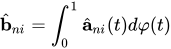
    ModifyingAbove bold b With caret Subscript n i Baseline equals integral Subscript 0 Superscript 1 Baseline ModifyingAbove bold a With caret Subscript n i Baseline left-parenthesis t right-parenthesis d phi left-parenthesis t right-parenthesis
    ModifyingAbove bold a With caret left-parenthesis t right-parenthesis equals max Underscript a Endscripts left-brace bold y prime bold a vertical-bar bold upper X prime 1 bold a equals left-parenthesis 1 minus t right-parenthesis bold upper X prime 1 bold e comma bold a element-of left-bracket 0 comma 1 right-bracket Superscript n Baseline right-brace
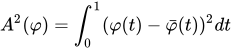
    upper A squared left-parenthesis phi right-parenthesis equals integral Subscript 0 Superscript 1 Baseline left-parenthesis phi left-parenthesis t right-parenthesis minus ModifyingAbove phi With bar left-parenthesis t right-parenthesis right-parenthesis squared d t
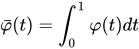
    ModifyingAbove phi With bar left-parenthesis t right-parenthesis equals integral Subscript 0 Superscript 1 Baseline phi left-parenthesis t right-parenthesis d t

    and phi left-parenthesis t right-parenthesis is one of the following score functions:

    • Wilcoxon scores: phi left-parenthesis t right-parenthesis equals t minus 1 slash 2

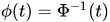
    • normal scores: phi left-parenthesis t right-parenthesis equals normal upper Phi Superscript negative 1 Baseline left-parenthesis t right-parenthesis, where normal upper Phi is the normal distribution function

    • sign scores: phi left-parenthesis t right-parenthesis equals 1 slash 2 sign left-parenthesis t minus 1 slash 2 right-parenthesis

    • tau scores: phi Subscript tau Baseline left-parenthesis t right-parenthesis equals tau minus upper I left-parenthesis t less-than tau right-parenthesis.

    The rank test statistic upper T Subscript upper R Baseline left-parenthesis tau right-parenthesis, unlike Wald tests or likelihood ratio tests, requires no estimation of the nuisance parameter f Subscript i under iid error models (Gutenbrunner et al. 1993).

Koenker and Machado (1999) prove that the three test statistics (upper T Subscript upper W Baseline left-parenthesis tau right-parenthesis comma upper T Subscript normal upper L normal upper R Baseline left-parenthesis tau right-parenthesis, and upper T Subscript upper R Baseline left-parenthesis tau right-parenthesis) are asymptotically equivalent and that their distributions converge to chi Subscript q Superscript 2 under the null hypothesis, where q is the dimension of beta 2.

Testing for Heteroscedasticity

After you obtain the parameter estimates for several quantiles specified in the MODEL statement, you can test whether there are significant differences for the estimates for the same covariates across the quantiles. For example, if you want to test whether the parameters beta 2 are the same across quantiles, the null hypothesis upper H 0 can be written as beta 2 left-parenthesis tau 1 right-parenthesis equals ellipsis equals beta 2 left-parenthesis tau Subscript k Baseline right-parenthesis, where tau Subscript j Baseline comma j equals 1 comma ellipsis comma k comma are the quantiles specified in the MODEL statement. See Koenker and Bassett (1982a) for details.

Last updated: December 09, 2022