The QUANTREG Procedure
Quantile Regression
Quantile regression generalizes the concept of a univariate quantile to a conditional quantile given one or more covariates. Recall that a student’s score on a test is at the  quantile if his or her score is better than that of
  of the students who took the test. The score is also said to be at the 100th percentile.
For a random variable Y with probability distribution function

the quantile of Y is defined as the inverse function

where the quantile level ranges between 0 and 1. In particular, the median is  .
.
For a random sample  of Y, it is well known that the sample median minimizes the sum of absolute deviations:
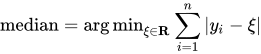
Likewise, the general sample quantile  , which is the analog of
  , is formulated as the minimizer
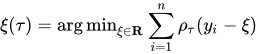
where  ,
,  , and where
  denotes the indicator function. The loss function
  assigns a weight of to positive residuals
  and a weight of
  to negative residuals.
Using this loss function, the linear conditional quantile function extends the sample quantile to the regression setting in the same way that the linear conditional mean function extends the sample mean. Recall that OLS regression estimates the linear conditional mean function  by solving for
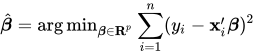
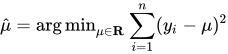
The estimated parameter  minimizes the sum of squared residuals in the same way that the sample mean
  minimizes the sum of squares:
Likewise, quantile regression estimates the linear conditional quantile function,  , by solving the following equation for
  :
:

The quantity  is called the regression quantile. The case
  (which minimizes the sum of absolute residuals) corresponds to median regression (which is also known as
  regression).
The following set of regression quantiles is referred to as the quantile process:

The QUANTREG procedure computes the quantile function  and conducts statistical inference on the estimated parameters .