The QUANTREG Procedure
CONDDIST Statement
<label:> CONDDIST options;
The CONDDIST statement estimates and displays the conditional and marginal probability functions for the response random variable. These functions include the cumulative distribution functions (CDFs) and the probability density functions (PDFs). For more information about the probability functions, see the section Estimating Probability Functions by Using the CONDDIST Statement.
You can specify multiple CONDDIST statements. You can use the optional label, which must be a valid SAS name, to identify the output group for its corresponding CONDDIST statement.
Table 5 summarizes the options available in the CONDDIST statement.
Table 5: CONDDIST Statement Options
| Option | Description |
|---|---|
| HIDERAW | Hides the observed marginal distribution of the training response for the analysis |
| MCDF | Performs the marginal distributions analysis |
| MWU | Performs the Mann-Whitney U test against the observed marginal CDF sample of the training response variable |
| OBS= | Specifies a subset of the training observations for the analysis by using the indices of these observations in the DATA= data set of the PROC QUANTREG statement |
| PDF=KDE | Specifies the kernel density estimator for estimating the probability density functions |
| PLOTS= | Specifies options for graphically displaying the probability functions |
| SHOWAVG | Requests the distribution of the training response that is conditional on the average explanatory covariates for the analysis |
| TESTDATA= | Specifies an input SAS data set that contains test observations for estimating the probability functions |
You can specify the following options:
-
HIDERAW
HR hides the observed marginal CDF sample of the training response for the analysis. This CDF sample is estimated from the sample of all the response values
 in the training data without using the quantile regression model. The CONDDIST statement assigns the type “Observed” and the label “TrainObs” to this distribution.
 - MCDF(mcdf-option)
-
performs the marginal distributions analysis by using the weighted bootstrap resampling method. For more information, see the section Marginal Distribution Analysis Using the Bootstrap Resampling Method. You can specify the following mcdf-options:
The MCDF option repeatedly fits a quantile process regression model for each reweighted bootstrap sample of the training observations in the DATA= data set in the PROC QUANTREG statement. If you also specify the TESTDATA= testing data set option in the CONDDIST statement, then the MCDF option additionally generates a reweighted bootstrap sample for the testing observations in each repetition; estimates counterfactual distribution for the testing sample by using the relevant training-sample quantile process model; and outputs the marginal distribution comparisons table to compare the averaged-across-all-samples training, testing, and counterfactual testing marginal distributions. You can output all the fitted training-sample quantile process regression models by using the following ODS OUTPUT statement:
ods output BootProcessEst=BPE; -
MWU(mwu-option)
WILCOXON(mwu-option)
RANKSUM(mwu-option) -
performs the Mann-Whitney U test (also called the Wilcoxon rank-sum test and denoted as the MWU test) for each CDF sample of all specified observations against the observed marginal CDF sample of the training response variable for the DATA= data set in the PROC QUANTREG statement.
You can specify the following mwu-option:
- OBS=number-list
specifies the observation indices to use for the conditional distribution analysis. Each observation index identifies a training observation in the DATA= data set that you specify in the PROC QUANTREG statement. The CONDDIST statement types the distributions of these observations as “Fit for Obs” and labels the distributions by using the observation ID values (if available) or the observation indices.
- PDF=KDE(kde-options)
-
specifies the kernel density estimator for estimating the probability density functions. For more information about the kernel density estimates, see the section Probability Density Functions.
You can specify the following kde-options:
- C=value
-
specifies the standardized bandwidth parameter c for the kernel density estimator.
You can specify one of the following values:
- number
specifies a positive number.
- MISE
minimizes the approximate mean integrated square error (MISE).
- SJPI
computes the bandwidth parameter by using the Sheather-Jones plug-in method.
By default, C=MISE.
- K=NORMAL | TRIANGULAR | QUADRATIC
specifies the type of kernel function to use for the kernel density estimator. NORMAL species the normal kernel. TRIANGULAR species the triangular kernel. QUADRATIC species the quadratic kernel. By default, K=NORMAL.
-
LOWER=value
L=value specifies the lower bound value for the kernel density curves that suppresses the lower tails of the PDF estimates. If value is smaller than the minimum quantile-grid value of all the PDF estimates, the CONDDIST statement ignores this suboption and outputs the minimum quantile-grid value as the lower bound value in the density estimation table.
-
LUADJUST=TRIM | SCALE | REFLECT
LUA=TRIM | SCALE | REFLECT -
specifies the adjustment type for kernel density estimation when you specify the LOWER=value or UPPER=value option (or both).
Let
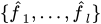 denote the lower tail of the PDF estimates,
  denote the remaining PDF estimates, and
  denote the upper tail of the PDF estimates. For simplicity of notation, assume that
  for all
  and
and  . You can specify one of the following types:
 - TRIM
trims the tails of the PDF estimates without adjusting the remaining PDF estimates, so that
for all  and
and  .
. - SCALE
suppresses the tails of the PDF estimates and scales the remaining PDF estimates by
 , where
 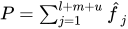 is the sum of the PDF estimates and
 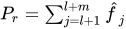 is the sum of the remaining PDF estimates.
 - REFLECT
-
suppresses the tails of the PDF estimates and adjusts the remaining PDF estimates by using the reflections of the suppressed tails. The adjusted
 equals
where K is the smallest integer that satisfies
 and
and  .
.
By default, LUA=TRIM.
-
UPPER=value
U=value specifies the upper bound value for the kernel density curves that suppresses the upper tails of the PDF estimates. If value is larger than the maximum quantile-grid value of all the PDF estimates, the CONDDIST statement ignores this suboption and outputs the maximum quantile-grid value as the upper bound value in the density estimation table.
When you specify the PLOT= option to create the CDF plot and the PDF plot, the LOWER= and UPPER= suboptions of the PDF=KDE option also set limits for the horizontal range of the plots.
-
PLOT | PLOTS<global-plot-options><=plot-request>
PLOT | PLOTS<global-plot-options><=(plot-request < …plot-request > )> -
specifies graphical options for displaying the probability functions.
You can specify the following global-plot-options, which apply to all plots that the CONDDIST statement generates:
You can specify the following plot-requests:
When you specify the PLOTS option, the following options in the CONDDIST statement control the visualization of their relevant probability functions:
the HIDERAW and SHOWAVG options
the HIDEFIT, HIDERAW, SHOWAVG, and SHOWOBS suboptions of the TESTDATA option
-
SHOWAVG
SA requests the conditional distribution of the training response at average,
 , for the analysis, where
 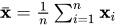 is the average explanatory covariates vector for all the training observations. The CONDDIST statement assigns the type "Fit at Average" and the label "TrainAvg" to this distribution.
 - TESTDATA(options)=SAS-data-set
-
specifies the test data set for the conditional distribution analysis. The TESTDATA= data set must contain all the explanatory variables that you specify in the MODEL statement.
You can specify the following options:
-
HIDEFIT
HF hides the counterfactual marginal CDF sample of the fitted test response for the analysis. This marginal CDF sample for
 integrates out the quantile regression model by pooling together all the quantile process predictions of all the test observations in the TESTDATA= data set. The CONDDIST statement assigns the type “Fit and Pooled” and the label “TestFit” to this distribution.
 -
HIDERAW
HR hides the observed marginal CDF sample of the test response for the analysis. This CDF sample is estimated from the sample of all the response values
in the TESTDATA= data set without using the quantile regression model. The CONDDIST statement assigns the type “Observed” and the label “TestObs” to this distribution. -
MWU(mwu-option)
WILCOXON(mwu-option)
RANKSUM(mwu-option) -
performs the Mann-Whitney U test for each CDF sample of all specified observations against the observed marginal CDF sample of the testing response variable for the TESTDATA= data set in the CONDDIST statement.
You can specify the following mwu-option:
-
SHOWAVG
SA requests the conditional CDF sample of the test response at average,
, for the analysis, where is the average explanatory covariates vector for the TESTDATA= data set. The CONDDIST statement assigns the type “Fit at Average” and the label “TestAvg” to this CDF sample. -
SHOWOBS
SO requests the conditional CDF samples of all the test observations in the analysis. The CONDDIST statement assigns the type “Fit for Obs” to the CDF samples of these observations and labels these CDF samples by using the observation ID values (if available) or the observation indices. By default, the TESTDATA= option ignores these CDF samples.
By default, if the TESTDATA= data set contains fewer than 16 observations, the CONDDIST statement ignores the observed marginal CDF sample of
. Otherwise, the CONDDIST statement estimates the observed marginal CDF sample of . -
HIDEFIT