The QUANTSELECT Procedure

Quasi-Likelihood Ratio Tests

Under the iid assumption, Koenker and Machado (1999) proposed two types of quasi-likelihood ratio tests for quantile regression, where the error distribution is flexible but not limited to the asymmetric Laplace distribution. The Type I test score, LR1, is defined as
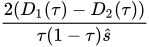
StartFraction 2 left-parenthesis upper D 1 left-parenthesis tau right-parenthesis minus upper D 2 left-parenthesis tau right-parenthesis right-parenthesis Over tau left-parenthesis 1 minus tau right-parenthesis ModifyingAbove s With caret EndFraction

where ModifyingAbove s With caret is the estimated sparsity function, upper D 1 left-parenthesis tau right-parenthesis equals sigma-summation rho Subscript tau Baseline left-parenthesis y Subscript i Baseline minus bold x Subscript i Baseline ModifyingAbove bold-italic beta With caret Subscript 1 Baseline left-parenthesis tau right-parenthesis right-parenthesis is the sum of check losses for the reduced model, and upper D 2 left-parenthesis tau right-parenthesis equals sigma-summation rho Subscript tau Baseline left-parenthesis y Subscript i Baseline minus bold x Subscript i Baseline ModifyingAbove bold-italic beta With caret left-parenthesis tau right-parenthesis right-parenthesis is the sum of check losses for the extended model. The Type II test score, LR2, is defined as

StartFraction 2 upper D 2 left-parenthesis tau right-parenthesis left-parenthesis log left-parenthesis upper D 1 left-parenthesis tau right-parenthesis right-parenthesis minus log left-parenthesis upper D 2 left-parenthesis tau right-parenthesis right-parenthesis right-parenthesis Over tau left-parenthesis 1 minus tau right-parenthesis ModifyingAbove s With caret EndFraction

Under the null hypothesis that the reduced model is the true model, both LR1 and LR2 follow a chi squared distribution with d f equals d f 2 minus d f 1 degrees of freedom, where d f 1 and d f 2 are the degrees of freedom for the reduced model and the extended model, respectively.

If you specify the TEST=LR1 option in the MODEL statement, the QUANTSELECT procedure uses LR1 score to compute the significance level. Or you can use the substitutable TEST=LR2 option for computing the significance level on Type II quasi-likelihood ratio test.

Under the iid assumption, the sparsity function is defined as s left-parenthesis tau right-parenthesis equals 1 slash f left-parenthesis upper F Superscript negative 1 Baseline left-parenthesis tau right-parenthesis right-parenthesis. Here the distribution of errors F is flexible but not limited to the asymmetric Laplace distribution. The algorithm for estimating s left-parenthesis tau right-parenthesis is as follows:

  1. Fit a quantile regression model and compute the residuals. Each residual r Subscript i Baseline equals y Subscript i Baseline minus bold x prime Subscript i Baseline ModifyingAbove bold-italic beta With caret left-parenthesis tau right-parenthesis can be viewed as an estimated realization of the corresponding error epsilon Subscript i. Then ModifyingAbove s With caret is computed on the reduced model for testing the entry effect and on the extended model for testing the removal effect.

  2. Compute quantile-level bandwidth h Subscript n. The QUANTSELECT procedure computes the Bofinger bandwidth, which is an optimizer of mean squared error for standard density estimation:

    h Subscript n Baseline equals n Superscript negative 1 slash 5 Baseline left-parenthesis 4.5 v squared left-parenthesis tau right-parenthesis right-parenthesis Superscript 1 slash 5

    The quantity

    v left-parenthesis tau right-parenthesis equals StartFraction s left-parenthesis tau right-parenthesis Over s Superscript left-parenthesis 2 right-parenthesis Baseline left-parenthesis tau right-parenthesis EndFraction equals StartFraction f squared Over 2 left-parenthesis f Superscript left-parenthesis 1 right-parenthesis Baseline slash f right-parenthesis squared plus left-bracket left-parenthesis f Superscript left-parenthesis 1 right-parenthesis Baseline slash f right-parenthesis squared minus f Superscript left-parenthesis 2 right-parenthesis Baseline slash f right-bracket EndFraction

    is not sensitive to f and can be estimated by assuming f is Gaussian as

    ModifyingAbove v With caret left-parenthesis tau right-parenthesis equals StartFraction exp left-parenthesis minus q squared right-parenthesis Over 2 pi left-parenthesis q squared plus 1 right-parenthesis EndFraction with q equals normal upper Phi Superscript negative 1 Baseline left-parenthesis tau right-parenthesis
  3. Compute residual quantiles ModifyingAbove upper F With caret Superscript negative 1 Baseline left-parenthesis tau 0 right-parenthesis and ModifyingAbove upper F With caret Superscript negative 1 Baseline left-parenthesis tau 1 right-parenthesis as follows:

    1. Set tau 0 equals max left-parenthesis 0 comma tau minus h Subscript n Baseline right-parenthesis and tau 1 equals min left-parenthesis 1 comma tau plus h Subscript n Baseline right-parenthesis.

    2. Use the equation

      ModifyingAbove upper F With caret Superscript negative 1 Baseline left-parenthesis t right-parenthesis equals StartLayout Enlarged left-brace 1st Row 1st Column r Subscript left-parenthesis 1 right-parenthesis Baseline 2nd Column if t element-of left-bracket 0 comma 1 slash 2 n right-parenthesis 2nd Row 1st Column lamda r Subscript left-parenthesis i plus 1 right-parenthesis Baseline plus left-parenthesis 1 minus lamda right-parenthesis r Subscript left-parenthesis i right-parenthesis Baseline 2nd Column if t element-of left-bracket left-parenthesis i minus 0.5 right-parenthesis slash n comma left-parenthesis i plus 0.5 right-parenthesis slash n right-parenthesis 3rd Row 1st Column r Subscript left-parenthesis n right-parenthesis Baseline 2nd Column if t element-of left-bracket left-parenthesis 2 n minus 1 right-parenthesis comma 1 right-bracket EndLayout

      where r Subscript left-parenthesis i right-parenthesis is the ith smallest residual and lamda equals t minus left-parenthesis i minus 0.5 right-parenthesis slash n.

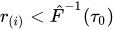
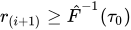
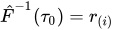
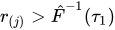
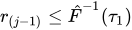
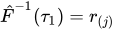
    3. If ModifyingAbove upper F With caret Superscript negative 1 Baseline left-parenthesis tau 0 right-parenthesis equals ModifyingAbove upper F With caret Superscript negative 1 Baseline left-parenthesis tau 1 right-parenthesis, find i that satisfies r Subscript left-parenthesis i right-parenthesis Baseline less-than ModifyingAbove upper F With caret Superscript negative 1 Baseline left-parenthesis tau 0 right-parenthesis and r Subscript left-parenthesis i plus 1 right-parenthesis Baseline greater-than-or-equal-to ModifyingAbove upper F With caret Superscript negative 1 Baseline left-parenthesis tau 0 right-parenthesis. If such an i exists, reset tau 0 equals left-parenthesis i minus 0.5 right-parenthesis slash n so that ModifyingAbove upper F With caret Superscript negative 1 Baseline left-parenthesis tau 0 right-parenthesis equals r Subscript left-parenthesis i right-parenthesis. Also find j that satisfies r Subscript left-parenthesis j right-parenthesis Baseline greater-than ModifyingAbove upper F With caret Superscript negative 1 Baseline left-parenthesis tau 1 right-parenthesis and r Subscript left-parenthesis j minus 1 right-parenthesis Baseline less-than-or-equal-to ModifyingAbove upper F With caret Superscript negative 1 Baseline left-parenthesis tau 1 right-parenthesis. If such a j exists, reset tau 1 equals left-parenthesis j minus 0.5 right-parenthesis slash n so that ModifyingAbove upper F With caret Superscript negative 1 Baseline left-parenthesis tau 1 right-parenthesis equals r Subscript left-parenthesis j right-parenthesis.

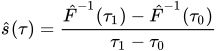
  4. Estimate the sparsity function s left-parenthesis tau right-parenthesis as

    ModifyingAbove s With caret left-parenthesis tau right-parenthesis equals StartFraction ModifyingAbove upper F With caret Superscript negative 1 Baseline left-parenthesis tau 1 right-parenthesis minus ModifyingAbove upper F With caret Superscript negative 1 Baseline left-parenthesis tau 0 right-parenthesis Over tau 1 minus tau 0 EndFraction

Because a real data set might not follow the null hypothesis and the iid assumptions, the LR1 and LR2 scores that are used for quantile regression effect selection often do not follow a chi squared distribution. Hence, the SLENTRY and SLSTAY values cannot reliably be viewed as probabilities. One way to address this difficulty is to treat the SLENTRY and SLSTAY values only as criteria for comparing importance levels of effect candidates at each selection step, and not to explain these values as probabilities.

Last updated: December 09, 2022