The QUANTSELECT Procedure
Quantile Regression for Extremal Quantile Levels
A quantile level  is extremal if is equal to or approaching 0 or 1. The solution for an extremal quantile-level quantile regression problem can be nonunique because the parameter estimate of the intercept effect can be arbitrarily small or large. In a quantile process regression toward the direction of the specified extremal quantile level, the tightest solution refers to the first solution whose quantile-level range includes the specified extremal quantile level. Among all the valid solutions for an extremal quantile-level quantile regression problem, the tightest solution can generalize the terminology of sample minimum and sample maximum.
The QUANTSELECT procedure computes the tightest solution for an extremal quantile-level quantile regression problem by using the ALGORITHM=SIMPLEX algorithm. If 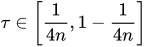 , is not extremal. Otherwise, follow these steps:
Set

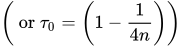 .
. Compute
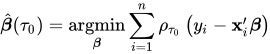 .
. Find the quantile-level lower limit (or upper limit),
 , such that
  is still optimal at .
 If
 (or
(or  ), return
  . Otherwise, update
  (or
(or  ) for a small tolerance
  , and go to step 2.