The QUANTLIFE Procedure
Notation for Censored Quantile Regression
Let T be a dependent variable, such as a survival time, and let x be a p  1 covariate vector. Quantile regression methods focus on modeling the conditional quantile function,
  , which is defined as

For example,  is the conditional median quantile, and
  is the conditional quantile function that corresponds to the 95th percentile.
A linear quantile regression model for has the form  . One of the advantages of quantile regression analysis is that the covariate effect
  can change with
  . Unlike ordinary least squares regression, which estimates the conditional expectation function
  , quantile regression offers the flexibility to model the entire conditional distribution.
Given observations  , standard quantile regression estimates the regression coefficients
  by minimizing the following objective function over b:
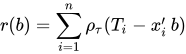
where 
However, in many applications, the responses  are subject to censoring. For example, in a biomedical study, censoring occurs when patients withdraw from the study or die from a cause that is unrelated to the disease being studied.
Let  denote the censoring variable. In the case of right-censoring, the triples
  are observed, where
  and
and  are the observed response variable and the censoring indicator, respectively. Standard quantile regression can lead to a biased estimator of the regression parameters when censoring occurs.
The following sections describe two methods for estimating the quantile coefficient in the presence of right-censoring.