The RMSTREG Procedure
Pseudovalue Regression
Pseudovalue regression is a generic method of fitting generalized linear models to time-to-event data (Andersen, Klein, and Rosthøj 2003). This section describes how the method works and how you can apply it to analyze models of the RMST.
Let  be independent and identically distributed quantities that might be random variables or vectors of variables. Let
  for some function
  . Suppose
  is an unbiased estimator of
  .
.
Let  be independent and identically distributed samples of covariates, and define the conditional expectation of
  given by
  as
as

The ith pseudo-observation of is computed as

where  is the jackknife leave-one-out estimator for based on
  .
.
The generalized linear model (Nelder and Wedderburn 1972) for assumes

where  is a suitable link function. Note that an additional column can be added to
  for an intercept effect.
Using pseudo-observations, you can estimate the regression parameters  by solving the following estimating equations

where  is a working covariance matrix.
Let  be a solution of the estimating equations. You can use a sandwich estimator to estimate the variance of . It takes the form
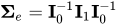
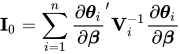
 is the model-based estimator of
  and is given by
 is the empirical estimator of and is computed as
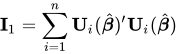
Andersen, Hansen, and Klein (2004) proposed using pseudovalue regression to analyze the RMST models. Assume  is a prespecified time point of interest. Let
  be the time-to-event variable for the ith subject. The RMST models can be fitted using pseudovalue regression by letting


Because the nonparametric estimator  is unbiased, it can be used in place of in the estimation process.