The SEQDESIGN Procedure

Two-Sided Fixed-Sample Tests in Clinical Trials

A two-sided test is a test of a hypothesis with a two-sided alternative. Two-sided tests include simple symmetric tests and more complicated asymmetric tests that might have distinct lower and upper alternative references.

Symmetric Two-Sided Tests for Equality

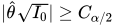
For a symmetric two-sided test with the null hypothesis delta equals delta 0 against the alternative delta not-equals delta 0, an equivalent null hypothesis is upper H 0 colon theta equals 0 with a two-sided alternative upper H 1 colon theta not-equals 0, where theta equals delta minus delta 0. A fixed-sample test rejects upper H 0 if StartAbsoluteValue ModifyingAbove theta With caret StartRoot upper I 0 EndRoot EndAbsoluteValue greater-than-or-equal-to upper C Subscript alpha slash 2, where ModifyingAbove theta With caret is a sample estimate of theta and upper C Subscript alpha slash 2 Baseline equals normal upper Phi Superscript negative 1 Baseline left-parenthesis 1 minus alpha slash 2 right-parenthesis is the critical value.

A common two-sided test is the test for the response difference between a treatment group and a control group. The null and alternative hypotheses are upper H 0 colon theta equals 0 and upper H 1 colon theta not-equals 0, respectively, where theta is the response difference between the two groups. If a greater value indicates a beneficial effect, then there are three possible results:

  • The test rejects the hypothesis upper H 0 of equality and indicates that the treatment is significantly better if the standardized statistic upper Z 0 equals ModifyingAbove theta With caret StartRoot upper I 0 EndRoot greater-than-or-equal-to upper C Subscript alpha slash 2.

  • The test rejects the hypothesis upper H 0 and indicates the treatment is significantly worse if the standardized statistic upper Z 0 equals ModifyingAbove theta With caret StartRoot upper I 0 EndRoot less-than-or-equal-to minus upper C Subscript alpha slash 2.

  • The test indicates no significant difference between the two responses if minus upper C Subscript alpha slash 2 Baseline less-than ModifyingAbove theta With caret StartRoot upper I 0 EndRoot less-than upper C Subscript alpha slash 2.

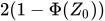
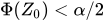
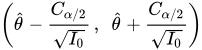
The p-value of the test is 2 left-parenthesis 1 minus normal upper Phi left-parenthesis upper Z 0 right-parenthesis right-parenthesis if upper Z 0 greater-than 0 and 2 normal upper Phi left-parenthesis upper Z 0 right-parenthesis if upper Z 0 less-than-or-equal-to 0. The hypothesis upper H 0 is rejected if the p-value of the test is less than alpha—that is, if 1 minus normal upper Phi left-parenthesis upper Z 0 right-parenthesis less-than alpha slash 2 or normal upper Phi left-parenthesis upper Z 0 right-parenthesis less-than alpha slash 2. A symmetric left-parenthesis 1 minus alpha right-parenthesis confidence interval for theta has lower and upper limits

left-parenthesis ModifyingAbove theta With caret minus StartFraction upper C Subscript alpha slash 2 Baseline Over StartRoot upper I 0 EndRoot EndFraction comma ModifyingAbove theta With caret plus StartFraction upper C Subscript alpha slash 2 Baseline Over StartRoot upper I 0 EndRoot EndFraction right-parenthesis

which is

left-parenthesis StartFraction 1 Over StartRoot upper I 0 EndRoot EndFraction left-parenthesis upper Z 0 minus upper C Subscript alpha slash 2 Baseline right-parenthesis comma StartFraction 1 Over StartRoot upper I 0 EndRoot EndFraction left-parenthesis upper Z 0 plus upper C Subscript alpha slash 2 Baseline right-parenthesis right-parenthesis

The hypothesis upper H 0 is rejected if the confidence interval for the parameter theta does not contain zero. That is, the lower limit is greater than zero or the upper limit is less than zero.

With an alternative reference theta equals theta 1 greater-than 0, a Type II error probability is defined as

beta equals upper P Subscript theta equals theta 1 Baseline left-parenthesis minus upper C Subscript alpha slash 2 Baseline less-than upper Z 0 less-than upper C Subscript alpha slash 2 Baseline right-parenthesis

which is

beta equals upper P Subscript theta equals theta 1 Baseline left-parenthesis left-parenthesis minus upper C Subscript alpha slash 2 Baseline minus theta 1 StartRoot upper I 0 EndRoot right-parenthesis less-than left-parenthesis upper Z 0 minus theta 1 StartRoot upper I 0 EndRoot right-parenthesis less-than left-parenthesis upper C Subscript alpha slash 2 Baseline minus theta 1 StartRoot upper I 0 EndRoot right-parenthesis right-parenthesis

Thus

beta equals normal upper Phi left-parenthesis upper C Subscript alpha slash 2 Baseline minus theta 1 StartRoot upper I 0 EndRoot right-parenthesis minus normal upper Phi left-parenthesis minus upper C Subscript alpha slash 2 Baseline minus theta 1 StartRoot upper I 0 EndRoot right-parenthesis

The resulting power 1 minus beta is the probability of correctly rejecting the null hypothesis, which includes the probability for the lower alternative and the probability for the upper alternative. The SEQDESIGN procedure uses only the probability of correctly rejecting the null hypothesis for the correct alternative in the power computation.

Thus, under the upper alternative hypothesis, the power in the SEQDESIGN procedure is computed as the probability of rejecting the null hypothesis for the upper alternative, 1 period minus normal upper Phi left-parenthesis upper C Subscript alpha slash 2 Baseline minus theta 1 StartRoot upper I 0 EndRoot right-parenthesis equals normal upper Phi left-parenthesis theta 1 StartRoot upper I 0 EndRoot minus upper C Subscript alpha slash 2 Baseline right-parenthesis, and a very small probability of rejecting the null hypothesis for the lower alternative, normal upper Phi left-parenthesis minus upper C Subscript alpha slash 2 Baseline minus theta 1 StartRoot upper I 0 EndRoot right-parenthesis, is ignored. This power computation is more rational than the power based on the probability of correctly rejecting the null hypothesis (Whitehead 1997, p. 75).


That is,

beta equals upper P Subscript theta equals theta 1 Baseline left-parenthesis left-parenthesis upper Z 0 minus theta 1 StartRoot upper I 0 EndRoot right-parenthesis less-than left-parenthesis upper C Subscript alpha slash 2 Baseline minus theta 1 StartRoot upper I 0 EndRoot right-parenthesis right-parenthesis equals normal upper Phi left-parenthesis upper C Subscript alpha slash 2 Baseline minus theta 1 StartRoot upper I 0 EndRoot right-parenthesis

Then with normal upper Phi Superscript negative 1 Baseline left-parenthesis beta right-parenthesis equals upper C Subscript alpha slash 2 Baseline minus theta 1 StartRoot upper I 0 EndRoot,

theta 1 StartRoot upper I 0 EndRoot equals upper C Subscript alpha slash 2 Baseline minus normal upper Phi Superscript negative 1 Baseline left-parenthesis beta right-parenthesis equals normal upper Phi Superscript negative 1 Baseline left-parenthesis 1 minus alpha slash 2 right-parenthesis plus normal upper Phi Superscript negative 1 Baseline left-parenthesis 1 minus beta right-parenthesis

The drift parameter theta 1 StartRoot upper I 0 EndRoot can be derived for specified alpha and beta, and the maximum information is given by

upper I 0 equals left-parenthesis StartFraction normal upper Phi Superscript negative 1 Baseline left-parenthesis 1 minus alpha slash 2 right-parenthesis plus normal upper Phi Superscript negative 1 Baseline left-parenthesis 1 minus beta right-parenthesis Over theta 1 EndFraction right-parenthesis squared

If the maximum information is available, then the required sample size can be derived. For example, in a one-sample test for mean, if the standard deviation sigma is known, the sample size n required for the test is

n equals sigma squared upper I 0 equals sigma squared left-parenthesis StartFraction normal upper Phi Superscript negative 1 Baseline left-parenthesis 1 minus alpha slash 2 right-parenthesis plus normal upper Phi Superscript negative 1 Baseline left-parenthesis 1 minus beta right-parenthesis Over theta 1 EndFraction right-parenthesis squared

On the other hand, if the alternative reference theta 1, standard deviation sigma, and sample size n are all known, then alpha can be derived with a given beta and, similarly, beta can be derived with a given alpha.

Generalized Two-Sided Tests for Equality

For a generalized two-sided test with the null hypothesis delta equals delta 0 against the alternative delta not-equals delta 0, an equivalent null hypothesis is upper H 0 colon theta less-than-or-equal-to 0 with a two-sided alternative upper H 1 colon theta not-equals 0, where theta equals delta minus delta 0. A fixed-sample test rejects upper H 0 if the standardized statistic upper Z 0 equals ModifyingAbove theta With caret StartRoot upper I 0 EndRoot less-than minus upper C Subscript alpha Sub Subscript l or upper Z 0 equals ModifyingAbove theta With caret StartRoot upper I 0 EndRoot greater-than upper C Subscript alpha Sub Subscript u, where the critical values upper C Subscript alpha Sub Subscript l Baseline equals normal upper Phi Superscript negative 1 Baseline left-parenthesis 1 minus alpha Subscript l Baseline right-parenthesis and upper C Subscript alpha Sub Subscript u Baseline equals normal upper Phi Superscript negative 1 Baseline left-parenthesis 1 minus alpha Subscript u Baseline right-parenthesis.

With the lower alternative reference theta Subscript 1 l Baseline less-than 0, a lower Type II error probability is defined as

beta Subscript l Baseline equals upper P Subscript theta equals theta Sub Subscript 1 l Baseline left-parenthesis minus upper C Subscript alpha Sub Subscript l Subscript Baseline less-than-or-equal-to upper Z Subscript 0 l Baseline StartRoot upper I 0 EndRoot right-parenthesis equals upper P Subscript theta equals theta Sub Subscript 1 l Baseline left-parenthesis minus upper C Subscript alpha Sub Subscript l Subscript Baseline minus theta Subscript 1 l Baseline StartRoot upper I 0 EndRoot less-than-or-equal-to upper Z Subscript 0 l Baseline StartRoot upper I 0 EndRoot minus theta Subscript 1 l Baseline StartRoot upper I 0 EndRoot right-parenthesis

This implies

beta Subscript l Baseline equals 1 minus normal upper Phi left-parenthesis minus upper C Subscript alpha Sub Subscript l Subscript Baseline minus theta Subscript 1 l Baseline StartRoot upper I 0 EndRoot right-parenthesis

and the power is the probability of correctly rejecting the null hypothesis for the lower alternative,

1 minus beta Subscript l Baseline equals normal upper Phi left-parenthesis minus upper C Subscript alpha Sub Subscript l Subscript Baseline minus theta Subscript 1 l Baseline StartRoot upper I 0 EndRoot right-parenthesis

The lower drift parameter is derived as

theta Subscript 1 l Baseline StartRoot upper I 0 EndRoot equals minus left-parenthesis normal upper Phi Superscript negative 1 Baseline left-parenthesis 1 minus alpha Subscript l Baseline right-parenthesis plus normal upper Phi Superscript negative 1 Baseline left-parenthesis 1 minus beta Subscript l Baseline right-parenthesis right-parenthesis

Then, with specified alpha Subscript l and beta Subscript l, if the maximum information is known, the lower alternative reference theta Subscript 1 l can be derived. If the maximum information is unknown, then with the specified lower alternative reference theta Subscript 1 l, the maximum information required is

upper I Subscript 0 l Baseline equals left-parenthesis StartFraction normal upper Phi Superscript negative 1 Baseline left-parenthesis 1 minus alpha Subscript l Baseline right-parenthesis plus normal upper Phi Superscript negative 1 Baseline left-parenthesis 1 minus beta Subscript l Baseline right-parenthesis Over minus theta Subscript 1 l Baseline EndFraction right-parenthesis squared

Similarly, the upper drift parameter is derived as

theta Subscript 1 u Baseline StartRoot upper I 0 EndRoot equals normal upper Phi Superscript negative 1 Baseline left-parenthesis 1 minus alpha Subscript u Baseline right-parenthesis plus normal upper Phi Superscript negative 1 Baseline left-parenthesis 1 minus beta Subscript u Baseline right-parenthesis

For a given alpha Subscript u, beta Subscript u, and the upper alternative reference theta Subscript 1 u, the maximum information required is

upper I Subscript 0 u Baseline equals left-parenthesis StartFraction normal upper Phi Superscript negative 1 Baseline left-parenthesis 1 minus alpha Subscript u Baseline right-parenthesis plus normal upper Phi Superscript negative 1 Baseline left-parenthesis 1 minus beta Subscript u Baseline right-parenthesis Over theta Subscript 1 u Baseline EndFraction right-parenthesis squared

Thus, the maximum information required for the design is given by

upper I 0 equals normal m normal a normal x left-parenthesis upper I Subscript 0 l Baseline comma upper I Subscript 0 u Baseline right-parenthesis

Note that with the maximum information level upper I 0, if upper I Subscript 0 l Baseline less-than upper I 0, then the derived power from the lower alternative is larger than the specified 1 minus beta Subscript l. Similarly, if upper I Subscript 0 u Baseline less-than upper I 0, then the derived power from the upper alternative is larger than the specified 1 minus beta Subscript u.

If maximum information is available, the required sample size can be derived. For example, in a one-sample test for mean, if the standard deviation sigma is known, the sample size n required for the test is n equals sigma squared upper I 0.

On the other hand, if the alternative references, Type I error probabilities alpha Subscript l and alpha Subscript u, standard deviation sigma, and sample size n are all specified, then the Type II error probabilities beta Subscript l and beta Subscript u and the corresponding powers can be derived.

Last updated: December 09, 2022