The SEQDESIGN Procedure
Applicable Two-Sample Tests and Sample Size Computation
The SEQDESIGN procedure provides sample size computation for two-sample tests: the test for the difference between two normal means, tests for binomial proportions, and the log-rank test for two survival distributions. These tests for binomial proportions include the test for the difference between two binomial proportions, the log odds ratio test for binomial proportions, and the log relative risk test for binomial proportions,
For a test of difference between two sample means, the required sample size depends on the assumed sample variances. Similarly, for a test of two-sample proportions, the required sample size depends on the assumed sample proportions. For a log-rank test of two survival distributions, the required sample size depends on the assumed sample hazard rates, accrual rate, and accrual time.
If the REF=NULLPROP or REF=NULLHAZARD option is specified, the proportions or hazard rates under the null hypothesis are used to derive the required sample size or number of events. Otherwise, the REF=PROP option (which is the default in the MODEL=TWOSAMPLEFREQ option) or the REF=HAZARD option (which is the default in the MODEL=TWOSAMPLESURVIVAL option) uses proportions or hazard rates under the alternative hypothesis to derive the required sample size or number of events.
Test for the Difference between Two Normal Means
The MODEL=TWOSAMPLEMEAN option in the SAMPLESIZE statement derives the sample size required to test the difference between the means of two normal populations  and
and  by using the null hypothesis
  , where
  .
.
At stage k, the MLE for  is computed as

where  and
and  are the values of the jth observation available in the kth stage groups
 A and B, respectively, and  and
and  are the cumulative sample sizes at stage k for these two groups.
The statistic  has a normal distribution

where the information  is the inverse of the variance
  .
.
Then the standardized statistic

Thus, to test the hypothesis against an upper alternative  ,
,  is rejected at stage k if the statistic
  , the upper
  boundary for the standardized Z statistic at stage k.
If the variances  and
and  are unknown, the sample variances can be used to derive the information if it is assumed that each sample variance is computed from a large sample such that the test statistic has an approximately normal distribution.
The maximum information is needed to derive the required sample size. If the maximum information is not specified or derived in the procedure, the alternative reference  specified in the MEANDIFF option is used to derive the maximum information.
Note that in order to derive the sample sizes and uniquely from the information,  is assumed for
  , where
  is the constant allocation ratio computed from the WEIGHT=
 option in the SAMPLESIZE statement.
In PROC SEQDESIGN, the computed total sample sizes for the two groups are

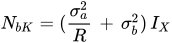
where  is the maximum information derived in the SEQDESIGN procedure, R is the constant allocation ratio, and
  and
and  are the specified standard deviations.
For  , the two sample sizes are equal, then

If the variances from the two groups are equal,  , then the total sample sizes for the two groups are

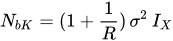
and the total sample size is

Furthermore, for , the two sample sizes are equal, then

With an available maximum information, you can specify the MODEL=TWOSAMPLEMEAN( WEIGHT= R STDDEV=  ) option in the SAMPLESIZE statement to compute the required total sample size and individual sample size at each stage. A procedure such as PROC GLM can be used to derive the two-sample Z test for the mean difference.
Test for the Difference between Two Binomial Proportions
The MODEL=TWOSAMPLEFREQ(TEST=PROP) option in the SAMPLESIZE statement derives the sample size required to test the difference between two binomial populations with , where  . At stage k, the MLE for is

where and are the values of the jth observation available in the kth stage for groups A and B, respectively, and and are the cumulative sample sizes at stage k for these two groups.
For sufficiently large sample sizes and , the statistic has an approximate normal distribution

where the information is the inverse of the variance

Thus, the standardized statistic
In practice,  and
and  , the estimated sample proportions for groups
 A and B, respectively, at stage k, can be used to derive the information and the test statistic  . Thus, to test the hypothesis against an upper alternative
  , is rejected at stage k if the statistic , the upper boundary for the standardized Z statistic at stage k.
The maximum information is needed to derive the required sample size. If the maximum information is not specified or derived with the ALTREF= option in the procedure, the PROP= option in the SAMPLESIZE statement is used to provide proportions under the alternative hypothesis for the alternative reference and then to derive the maximum information.
The proportions in the two groups are needed to derive the sample size. Also, in order to derive the sample sizes and uniquely from the information, is assumed for , where is the constant allocation ratio computed from the WEIGHT= option in the SAMPLESIZE statement. Then

In PROC SEQDESIGN, the total sample sizes in the two groups are computed as

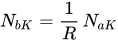
where is the constant allocation ratio, and  and
and  are proportions specified with the REF= option:
REF=NULLPROP uses proportions under
:  ,
, 
REF=AVGNULLPROP uses the average proportion under
: 
REF=PROP uses proportions under
 :
:  ,
, 
REF=AVGPROP uses the average proportion under

The total sample size is given by

For , the two sample sizes are equal,

You can specify the MODEL=TWOSAMPLEFREQ( TEST=PROP WEIGHT=R ) option in the SAMPLESIZE statement to compute the required total sample size and individual sample size at each stage. A procedure such as PROC GENMOD with the default DIST=NORMAL option in the MODEL statement can be used to derive the two-sample Z test for proportion difference.
Test for Two Binomial Proportions with a Log Odds Ratio Statistic
The MODEL=TWOSAMPLEFREQ(TEST=LOGOR) option in the SAMPLESIZE statement derives the sample size required to test two binomial proportions by using a log odds ratio statistic. The odds ratio is the ratio of the odds in one group to the odds in the other group, and the log odds ratio is the logarithm of the odds ratio

The hypothesis of no difference between two proportions,  , can be tested through the null hypothesis , where is the log odds ratio. For example, with
  and
and  , it corresponds to the equivalent hypothesis and
  .
.
The maximum likelihood estimate of is given by
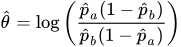
with an asymptotic variance

where I is the information (Diggle et al. 2002, pp. 341–342). That is, the standardized statistic
In practice, and , the estimated sample proportions for groups A and B, respectively, at stage k, can be used to derive the information and the test statistic  if the two sample sizes
  and
and  are sufficiently large such that the test statistic has an approximately normal distribution.
The maximum information is needed to derive the required sample size. If the maximum information is not specified or derived with the ALTREF= option in the procedure, the PROP= option in the SAMPLESIZE statement is used to provide proportions under the alternative hypothesis for the alternative reference and then to derive the maximum information.
In order to derive the sample sizes and uniquely from the information, is assumed for , where is the constant allocation ratio computed from the WEIGHT= option in the SAMPLESIZE statement. Then with

the sample size can be computed.
In PROC SEQDESIGN, the total sample sizes in the two groups are computed as


where is the constant allocation ratio, and and are proportions specified with the REF= option:
REF=NULLPROP uses proportions under
: , REF=AVGNULLPROP uses the average proportion under
: REF=PROP uses proportions under
: , REF=AVGPROP uses the average proportion under
You can specify the MODEL=TWOSAMPLEFREQ( TEST=LOGOR WEIGHT=R) option in the SAMPLESIZE statement to compute the required total sample size and individual sample size at each stage. A procedure such as PROC LOGISTIC can be used to derive the log odds ratio statistic.
Test for Two Binomial Proportions with a Log Relative Risk Statistic
The MODEL=TWOSAMPLEFREQ(TEST=LOGRR) option in the SAMPLESIZE statement derives the sample size required to test two binomial proportions by using a log relative risk statistic. The relative risk is the ratio of the proportion in one group to the proportion in the other group. The log relative risk statistic is the logarithm of the relative risk
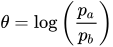
The hypothesis of no difference between two proportions, , can be tested through the null hypothesis . For example, with and , it corresponds to the equivalent hypothesis and  .
.
The maximum likelihood estimate of is given by
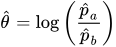
with an asymptotic variance
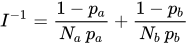
where I is the information (Chow and Liu 1998, p. 329).
In practice, and , the estimated sample proportions for groups A and B, respectively, at stage k, are used to derive the information and the test statistic .
The maximum information and proportions  and
and  are needed to derive the required sample size. If the maximum information is not specified or derived with the ALTREF= option in the procedure, the PROP= option in the SAMPLESIZE statement is used to provide proportions under the alternative hypothesis for the alternative reference and then to derive the maximum information.
Note that in order to derive the sample sizes and uniquely from the information, is assumed for , where is the constant allocation ratio computed from the WEIGHT= option in the SAMPLESIZE statement. Then the sample size can be computed from

In PROC SEQDESIGN, the computed sample sizes in the two groups are

where is the constant allocation ratio, and and are proportions specified with the REF= option:
REF=NULLPROP uses proportions under
: , REF=AVGNULLPROP uses the average proportion under
: REF=PROP uses proportions under
: , REF=AVGPROP uses the average proportion under
You can specify the MODEL=TWOSAMPLEFREQ( TEST=LOGRR WEIGHT=R) option in the SAMPLESIZE statement to compute the required total sample size and individual sample size at each stage. A procedure such as PROC LOGISTIC can be used to derive the log relative risk statistic.
Test for Two Survival Distributions with a Log-Rank Test
The MODEL=TWOSAMPLESURV option in the SAMPLESIZE statement derives the number of events required for a log-rank test of two survival distributions. The analysis of survival data involves the survival times for both censored and uncensored data. A noncensored survival time is the time from treatment to an event such as remission or relapse for an individual. A censored survival time is the time from treatment to the time of analysis for an individual surviving at that time, and the status is unknown beyond that time.
PROC SEQDESIGN computes the number of events by using the approximations described in Schoenfeld (1981). It differs from PROC POWER, which uses an approach similar to that of Freedman (1982). Thus, even in the case of a one-stage design, the designs that PROC SEQDESIGN and PROC POWER produce do not match exactly. For a comparison of these approximation methods, see Hsieh (1992).
Let T be the random variable of the survival time. Then the survival function

is the probability that an individual from the population has a survival time that exceeds t. And the hazard function is given by

where  is the density function of T.
The hazard functions can be used to test the equality of two survival distributions  with the null hypothesis
  , where
  and
and  are survival functions for groups
 A and B, respectively, and  and
and  are the corresponding hazard functions.
If the two hazards are proportional,  , where
  is a constant, then an equivalent null hypothesis is

Alternatively, another equivalent null hypothesis is given by

Suppose that the hazard rate h is a constant. Then with a specified median survival time  , the hazard rate can be derived from the equation

Denote the distinct event times at stage k as  , where
  is the total number of distinct event times. Then the score statistic is the log-rank statistic (Jennison and Turnbull 2000, pp. 259–261; Whitehead 1997, pp. 36–39)
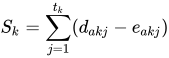
where  is the number of events from group
 A and  is the number of expected events from
 A. The number of expected events from  is computed as
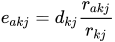
where  is the number of events from both groups,
  is the number of individuals from the treatment group who survived up to time
  , and
, and  is the number of individuals from both groups who survived up to time .
If the number of events is small relative to , the number of individuals survived up to time , then with a sufficiently large sample size,  has an approximately normal distribution

where the variance of is the estimated information
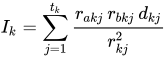
In order to derive the number of events from the information , is assumed for , where is the constant allocation ratio computed from the WEIGHT= option in the SAMPLESIZE statement.
The maximum information is needed to derive the required sample size. If the maximum information is specified or derived with the ALTREF= option in the procedure, the HAZARD=, MEDSURVTIME=, and HAZARDRATIO= options are not applicable. Otherwise, the HAZARD=, MEDSURVTIME=, or HAZARDRATIO= option is used to compute the alternative reference and then to derive the maximum information for the sample size calculation.
With  , if the number of events is few relative to the number of individuals who survived, then
  , and
, and

where  is the total number of events.
Thus, the required total number of events
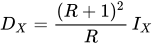
For a study group, if the hazard rate is constant, corresponding to an exponential survival distribution, and the individual accrual is uniform in the accrual time  with a constant accrual rate
  , then the required total sample size and sample size at each stage can be derived. See the section Input Number of Events for Fixed-Sample Design for a detailed description of the sample size computation that uses hazard rates, accrual rate, and accrual time.
You can specify the MODEL=TWOSAMPLESURVIVAL option in the SAMPLESIZE statement to compute the required total number of events and individual number of events at each stage. With the specifications of hazard rates, accrual rate, and accrual time, the required total sample size and individual sample size at each stage can also be derived. If the REF=NULLHAZARD option is specified, the hazard rates under the null hypothesis,  and
and  , are used in the sample size computation. Otherwise, the hazard rates under the alternative hypothesis,
  and
and  , are used. A procedure such as PROC LIFETEST can be used to derive the log-rank statistic.