The SEQDESIGN Procedure
Applicable Regression Parameter Tests and Sample Size Computation
The SEQDESIGN procedure provides sample size computation for tests of a regression parameter in three regression models: normal regression, logistic regression, and proportional hazards regression.
To test a parameter  in a regression model, the variance of the parameter estimate
  is needed for the sample size computation. In a simple regression model with one covariate
 X1, the variance of is inversely related to the variance of X1,  . That is,
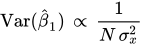
for the normal regression and logistic regression models, where N is the sample size, and
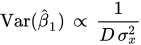
for the proportional hazards regression model, where D is the number of events.
For a regression model with more than one covariate, the variance of for the normal regression and logistic regression models is inversely related to the variance of X1 after adjusting for other covariates. That is,
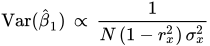
where is the estimate of the parameter  in the model and
  is the R square from the regression of
  on other covariates—that is, the proportion of the variance explained by these covariates.
Similarly, for a proportional hazards regression model,
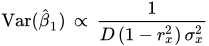
Thus, with the derived maximum information, the required sample size or number of events can also be computed for the testing of a parameter in a regression model with covariates.
Test for a Parameter in the Regression Model
The MODEL=REG option in the SAMPLESIZE statement derives the sample size required for a Z test of a normal regression. For a normal linear regression model, the response variable is normally distributed with the mean equal to a linear function of the explanatory variables and the constant variance  .
.
The normal linear model is

where  is the vector of the N observed responses,
  is the design matrix for these N observations,
  is the parameter vector, and
  is the
  identity matrix.
The least squares estimate is

and is normally distributed with mean  and variance

For a model with only one covariate X1,

where the variance
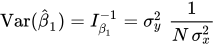
Thus, with the derived maximum information  , the required sample size is given by

For a normal linear model with more than one covariate, the variance of a single parameter is

where  is the diagonal element of the
  matrix corresponding to the parameter , is the variance of the variable
 X1, and is the proportion of variance of X1 explained by other covariates. The value  represents the variance of
 X1 after adjusting for all other covariates.
Thus, with the derived maximum information  , the required sample size is
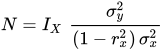
In the SEQDESIGN procedure, you can specify the MODEL=REG( VARIANCE= XVARIANCE= XRSQUARE=) option in the SAMPLESIZE statement to compute the required total sample size and individual sample size at each stage. A SAS procedure such as PROC REG can be used to compute the parameter estimate and its standard error at each stage.
Test for a Parameter in the Logistic Regression Model
The MODEL=LOGISTIC option in the SAMPLESIZE statement derives the sample size required for a Z test of a logistic regression parameter. The linear logistic model has the form
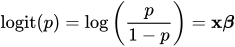
where p is the response probability to be modeled and is a vector of parameters.
Following the derivation in the section Test for a Parameter in the Regression Model, the required sample size for testing a parameter in is given by
With the variance of the logit response,  ,
,

where is the variance of X and is the proportion of variance explained by other covariates.
In the SEQDESIGN procedure, you can specify the MODEL=LOGISTIC( PROP=p XVARIANCE= XRSQUARE=) option in the SAMPLESIZE statement to compute the required total sample size and individual sample size at each stage.
A SAS procedure such as PROC LOGISTIC can be used to compute the parameter estimate and its standard error at each stage.
Test for a Parameter in the Proportional Hazards Regression Model
The MODEL=PHREG option in the SAMPLESIZE statement derives the number of events required for a Z test of a proportional hazards regression parameter. For analyses of survival data, Cox’s semiparametric model is often used to examine the effect of explanatory variables on hazard rates. The survival time of each observation in the population is assumed to follow its own hazard function,  , expressed as

where  is an arbitrary and unspecified baseline hazard function,
  is the vector of explanatory variables for the ith individual, and is the vector of regression parameters associated with the explanatory variables.
Hsieh and Lavori (2000, p. 553) show that the required number of events for testing a parameter in ,  , associated with the variable
 X1 is given by
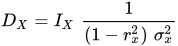
where is the variance of X1 and is the proportion of variance of X1 explained by other covariates.
In the SEQDESIGN procedure, you can specify the MODEL=PHREG( XVARIANCE= XRSQUARE=) option in the SAMPLESIZE statement to compute the required number of events and individual number of events at each stage.
A SAS procedure such as PROC PHREG can be used to compute the parameter estimate and its standard error at each stage.
Note that for a two-sample test, X1 is an indicator variable and is the only covariate in the model. Thus, if the two sample sizes are equal, then the variance  and the required number of events for testing the parameter is given by

See the section Input Number of Events for Fixed-Sample Design for a detailed description of the sample size computation that uses hazard rates, accrual rate, and accrual time.