The SEQTEST Procedure

Stochastic Curtailment

Lan, Simon, and Halperin (1982) introduce stochastic curtailment to stop a trial if, given current data, it is likely to predict the outcome of the trial with high probability. That is, a trial can be stopped to reject the null hypothesis upper H 0 if, given current data in the analyses, the conditional probability of rejecting upper H 0 under upper H 0 at the end of the trial is greater than gamma, where the constant gamma should be between 0.5 and 1 and values of 0.8 or 0.9 are recommended (Jennison and Turnbull 2000, p. 206). Similarly, a trial can be stopped to accept the null hypothesis upper H 0 if, given current data in the analyses, the conditional probability of rejecting upper H 0 under the alternative hypothesis upper H 1 at the end of the trial is less than gamma.

The following two approaches for stochastic curtailment are available in the SEQTEST procedures: conditional power approach and predictive power approach. For each approach, the derived group sequential test is used as the reference test for rejection.

Conditional Power Approach

In the SEQTEST procedure, you can compute two types of conditional power as described in the following sections:

TYPE=ALLSTAGES

The default TYPE=ALLSTAGES suboption in the CONDPOWER and PLOT=CONDPOWER options computes the conditional power at an interim stage k as the total probability of rejecting the null hypothesis at all future stages given the observed statistic (Zhu, Ni, and Yao 2011, pp. 131–132).

For a one-sided test with an upper alternative, the conditional power at an interim stage k is given by

StartLayout 1st Row 1st Column p Subscript k u Baseline left-parenthesis theta right-parenthesis 2nd Column equals 3rd Column upper P Subscript theta Baseline left-parenthesis z Subscript k plus 1 Baseline greater-than a Subscript k plus 1 Baseline vertical-bar z Subscript k Baseline comma theta right-parenthesis 2nd Row 1st Column Blank 2nd Column plus 3rd Column upper P Subscript theta Baseline left-parenthesis b Subscript k plus 1 Baseline less-than-or-equal-to z Subscript k plus 1 Baseline less-than a Subscript k plus 1 Baseline comma z Subscript k plus 2 Baseline greater-than a Subscript k plus 2 Baseline vertical-bar z Subscript k Baseline comma theta right-parenthesis 3rd Row 1st Column Blank 2nd Column plus 3rd Column ellipsis 4th Row 1st Column Blank 2nd Column plus 3rd Column upper P Subscript theta Baseline left-parenthesis b Subscript j Baseline less-than-or-equal-to z Subscript j Baseline less-than a Subscript j Baseline comma j equals k plus 1 comma ellipsis comma upper K minus 1 comma z Subscript upper K Baseline greater-than a Subscript upper K Baseline vertical-bar z Subscript k Baseline comma theta right-parenthesis EndLayout

where z Subscript k is the observed statistic and theta is the hypothetical reference. The conditional power for a one-sided test with a lower alternative is similarly derived.

For a two-sided test, the conditional power for the upper alternative is given by

StartLayout 1st Row 1st Column p Subscript k u Baseline left-parenthesis theta right-parenthesis 2nd Column equals 3rd Column upper P Subscript theta Baseline left-parenthesis z Subscript k plus 1 Baseline greater-than a Subscript k plus 1 Baseline vertical-bar z Subscript k Baseline comma theta right-parenthesis 2nd Row 1st Column Blank 2nd Column plus 3rd Column upper P Subscript theta Baseline left-parenthesis normal bar a Subscript k plus 1 Baseline less-than z Subscript k plus 1 Baseline less-than-or-equal-to normal bar b Subscript k plus 1 Baseline normal o normal r b Subscript k plus 1 Baseline less-than-or-equal-to z Subscript k plus 1 Baseline less-than a Subscript k plus 1 Baseline comma z Subscript k plus 2 Baseline greater-than a Subscript k plus 2 Baseline vertical-bar z Subscript k Baseline comma theta right-parenthesis 3rd Row 1st Column Blank 2nd Column plus 3rd Column ellipsis 4th Row 1st Column Blank 2nd Column plus 3rd Column Subscript theta Baseline left-parenthesis normal bar a Subscript j Baseline less-than z Subscript j Baseline less-than-or-equal-to normal bar b Subscript j Baseline normal o normal r b Subscript j Baseline less-than-or-equal-to z Subscript j Baseline less-than a Subscript j Baseline comma j equals k plus 1 comma ellipsis comma upper K minus 1 comma z Subscript upper K Baseline greater-than a Subscript upper K Baseline vertical-bar z Subscript k Baseline comma theta right-parenthesis EndLayout

The conditional power for the lower alternative is similarly derived.

TYPE=FINALSTAGE

The TYPE=FINALSTAGE suboption in the CONDPOWER and PLOT=CONDPOWER options computes the conditional power at an interim stage k as the probability that the test statistic at the final stage (stage K) would exceed the rejection critical value given the observed statistic (Jennison and Turnbull 2000, p. 207).

The conditional distribution of upper Z Subscript upper K given the observed statistic z Subscript k at the kth stage and the hypothetical reference theta is

upper Z Subscript upper K Baseline vertical-bar left-parenthesis z Subscript k Baseline comma theta right-parenthesis tilde upper N left-parenthesis z Subscript k Baseline normal upper Pi Subscript k Superscript one-half Baseline plus theta upper I Subscript upper X Superscript one-half Baseline left-parenthesis 1 minus normal upper Pi Subscript k Baseline right-parenthesis comma 1 minus normal upper Pi Subscript k Baseline right-parenthesis

where normal upper Pi Subscript k Baseline equals upper I Subscript k Baseline slash upper I Subscript upper X is the fraction of information at the kth stage.

The power for the upper alternative, normal p normal r normal o normal b left-parenthesis upper Z Subscript upper K Baseline greater-than a Subscript upper K Baseline vertical-bar z Subscript k Baseline comma theta right-parenthesis, is then given by

p Subscript k u Baseline left-parenthesis theta right-parenthesis equals normal upper Phi left-parenthesis left-parenthesis 1 minus normal upper Pi Subscript k Baseline right-parenthesis Superscript negative one-half Baseline left-parenthesis z Subscript k Baseline normal upper Pi Subscript k Superscript one-half Baseline minus a Subscript upper K Baseline right-parenthesis plus theta upper I Subscript upper X Superscript one-half Baseline left-parenthesis 1 minus normal upper Pi Subscript k Baseline right-parenthesis Superscript one-half Baseline right-parenthesis

where normal upper Phi is the cumulative distribution function of the standardized Z statistic and a Subscript upper K is the upper critical value at the final stage.

Similarly, the power for the lower alternative, normal p normal r normal o normal b left-parenthesis upper Z Subscript upper K Baseline less-than a Subscript normal bar upper K Baseline vertical-bar z Subscript k Baseline comma theta right-parenthesis, is

p Subscript k l Baseline left-parenthesis theta right-parenthesis equals 1 minus normal upper Phi left-parenthesis left-parenthesis 1 minus normal upper Pi Subscript k Baseline right-parenthesis Superscript negative one-half Baseline left-parenthesis z Subscript k Baseline normal upper Pi Subscript k Superscript one-half Baseline minus a Subscript normal bar upper K Baseline right-parenthesis plus theta upper I Subscript upper X Superscript one-half Baseline left-parenthesis 1 minus normal upper Pi Subscript k Baseline right-parenthesis Superscript one-half Baseline right-parenthesis

where a Subscript normal bar upper K is the lower critical value at the final stage.

If theta equals ModifyingAbove theta With caret Subscript k Baseline equals z Subscript k Baseline upper I Subscript k Superscript negative one-half, the maximum likelihood estimate at stage k, the powers for the upper and lower alternatives can be simplified:
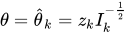


p Subscript k u Baseline left-parenthesis theta right-parenthesis equals normal upper Phi left-parenthesis left-parenthesis 1 minus normal upper Pi Subscript k Baseline right-parenthesis Superscript negative one-half Baseline left-parenthesis z Subscript k Baseline normal upper Pi Subscript k Superscript negative one-half Baseline minus a Subscript upper K Baseline right-parenthesis right-parenthesis
p Subscript k l Baseline left-parenthesis theta right-parenthesis equals 1 minus normal upper Phi left-parenthesis left-parenthesis 1 minus normal upper Pi Subscript k Baseline right-parenthesis Superscript negative one-half Baseline left-parenthesis z Subscript k Baseline normal upper Pi Subscript k Superscript negative one-half Baseline minus a Subscript normal bar upper K Baseline right-parenthesis right-parenthesis

If there exist interim stages between the kth stage and the final stage, k less-than upper K minus 1, the conditional power computed with TYPE=FINALSTAGE is not the conditional probability to reject the null hypothesis upper H 0. In this case, you can set the next stage as the final stage, and the conditional power is the conditional probability of rejecting upper H 0.

A special case of the conditional power is the futility index (Ware, Muller, and Braunwald 1985). It is 1 minus the conditional power under upper H 1 colon theta equals theta 1:

1 minus p Subscript k u Baseline left-parenthesis theta 1 right-parenthesis normal o normal r 1 minus p Subscript k l Baseline left-parenthesis theta 1 right-parenthesis

That is, it is the probability of accepting the null hypothesis under the alternative hypothesis given current data. A high futility index indicates a small probability of success (rejecting upper H 0) given the current data.

Predictive Power Approach

The conditional power depends on the specified reference theta, which might be supported by the current data (Jennison and Turnbull 2000, p. 210). An alternative is to use the predictive power (Herson 1979), which is a weighted average of the conditional power over values of theta. Without prior knowledge about theta, then with ModifyingAbove theta With caret equals z Subscript k Baseline slash StartRoot upper I Subscript k Baseline EndRoot, the maximum likelihood estimate at stage k, the posterior distribution for theta (Jennison and Turnbull 2000, p. 211) is
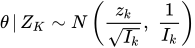
theta vertical-bar upper Z Subscript upper K Baseline tilde upper N left-parenthesis StartFraction z Subscript k Baseline Over StartRoot upper I Subscript k Baseline EndRoot EndFraction comma StartFraction 1 Over upper I Subscript k Baseline EndFraction right-parenthesis

Thus, the predictive power at stage k for the upper and lower alternatives can be derived as

p Subscript k u Baseline equals 1 minus normal upper Phi left-parenthesis left-parenthesis 1 minus normal upper Pi Subscript k Baseline right-parenthesis Superscript negative one-half Baseline left-parenthesis a Subscript upper K Baseline normal upper Pi Subscript k Superscript one-half Baseline minus z Subscript k Baseline right-parenthesis right-parenthesis
p Subscript k l Baseline equals normal upper Phi left-parenthesis left-parenthesis 1 minus normal upper Pi Subscript k Baseline right-parenthesis Superscript negative one-half Baseline left-parenthesis a Subscript normal bar upper K Baseline normal upper Pi Subscript k Superscript one-half Baseline minus z Subscript k Baseline right-parenthesis right-parenthesis

where a Subscript upper K and a Subscript normal bar upper K are the upper and lower critical values at the final stage.

Last updated: December 09, 2022




