The SURVEYFREQ Procedure
Sensitivity and Specificity
The SENSPEC option in the TABLES statement provides estimates of sensitivity, specificity, positive predictive value, and negative predictive value for  tables. These measures are conditional (row and column) proportions in the crosstabulation table. In sensitivity analysis, the row variable might represent a positive or negative diagnostic test result, and the column variable might represent the presence or absence of a condition. For more information, see Fleiss, Levin, and Paik (2003). The SENSPEC option also provides an estimate of accuracy, which is the proportion of correct classifications.
By default, the SENSPEC computations use table cell (1,1) as the reference cell that represents the true positives (positive row value and positive column value). You can specify a different reference cell by using the SENSPEC REFCELL= suboption or the REFCOLUMN= and REFROW= suboptions. For example, REFCELL=4 specifies table cell (2,2) as the true-positive cell (and row 2 and column 2 as the positive row and column levels, respectively). The notation in this section assumes that table cell (1,1) is the reference cell.
Sensitivity is computed as the column proportion for table cell (1,1), which is the ratio of the total in table cell (1,1) to the total in column 1 of the table. Sensitivity is denoted by

Specificity is computed as the column proportion for table cell (2,2), which is the ratio of the total in table cell (2,2) to the total in column 2. Specificity is denoted by

The positive predictive value is the row proportion for table cell (1,1), which is computed as

The negative predictive value is the row proportion for table cell (2,2), which is computed as

For more information, see the section Row and Column Proportions.
Accuracy (correct classification rate) is the overall proportion in table cells (1,1) and (2,2), which is computed as

PROC SURVEYFREQ estimates the variance of these proportions by using the method that you specify (Taylor series, bootstrap, BRR, jackknife, or replicate weights). For more information, see the sections Taylor Series Variance Estimation and Replication Variance Estimation.
The "Sensitivity and Specificity" table provides the estimates together with their standard errors and Wald confidence limits. The confidence limits are computed as

where  is the standard error of the estimate S and
  is the
 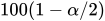 th percentile of the t distribution with df degrees of freedom. The value of the confidence coefficient
  is determined by the ALPHA= option; by default, ALPHA=0.05, which produces 95% confidence limits. For more information, see the section Wald Confidence Limits.