The SURVEYFREQ Procedure
Discordant Proportion Difference
The DISCORDDIFF option provides the estimate of the difference between discordant proportions for  tables (McNemar 1947). The difference is computed as

where the proportion estimates are described in the section Proportions.
PROC SURVEYFREQ estimates the variance of the difference by using the variance estimation method that you request. If you request a replication method (bootstrap, BRR, jackknife, or replicate weights), the procedure estimates the variance as described in the section Replication Variance Estimation. By default, PROC SURVEYFREQ estimates the variance by using the Taylor series method.
Confidence limits for the discordant difference are computed as

where  is the standard error of the estimate and
  is the
 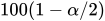 th percentile of the t distribution with df degrees of freedom. (For more information, see the section Degrees of Freedom.) The value of the confidence coefficient
  is determined by the ALPHA= option; by default, ALPHA=0.05, which produces 95% confidence limits.
PROC SURVEYFREQ also provides the corresponding t test of the null hypothesis that the discordant proportion difference is 0. The test statistic is computed as

The two-sided p-value is

where T has a t distribution with df degrees of freedom.