The SURVEYFREQ Procedure
Kappa Coefficients
Simple Kappa Coefficient
The KAPPA option (or the AGREE option) provides an estimate of the simple kappa coefficient, its standard error, and the confidence limits. This statistic is available for replication variance estimation methods (which you can request by specifying VARMETHOD=BOOTSTRAP, VARMETHOD=BRR, or VARMETHOD=JACKKNIFE or by including a REPWEIGHTS statement).
The simple kappa coefficient (Cohen 1960) is a measure of interrater agreement, where the row and column variables of the two-way table are viewed as two independent ratings. When there is perfect agreement between the two ratings, the kappa coefficient is +1. When the observed agreement exceeds chance agreement, the value of kappa is positive, and its magnitude reflects the strength of agreement. The minimum value of kappa is between –1 and 0, depending on the marginal proportions. For more information, see Fleiss, Levin, and Paik (2003).
PROC SURVEYFREQ computes the simple kappa coefficient as

where
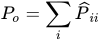
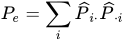
where  is the estimate of the proportion in table cell (i, i),
  is the estimate of the proportion in row i, and
  is the estimate of the proportion in column i. For information about how PROC SURVEYFREQ computes the proportion estimates, see the section Proportions.
PROC SURVEYFREQ estimates the variance of the simple kappa coefficient as described in the section Replication Variance Estimation. PROC SURVEYFREQ computes confidence limits for the simple kappa coefficient as

where  is the standard error of the kappa coefficient and
  is the
 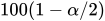 th percentile of the t distribution with df degrees of freedom. (For more information, see the section Degrees of Freedom.) The value of the confidence coefficient
  is determined by the ALPHA= option; by default, ALPHA=0.05, which produces 95% confidence limits.
Kappa Details
The kappa component  measures the observed agreement, and the component
  measures the chance-expected agreement. These values are displayed in the "Kappa Details" table when you specify the AGREE(DETAILS) or KAPPA(DETAILS) option. The "Kappa Details" table also displays the maximum possible value of the simple kappa coefficient given the marginal proportions of the two-way table. The maximum kappa is computed as

where

The "Kappa Details" table displays the  measure (Bangdiwala 1988; Bangdiwala et al. 2008), which is computed as

When the two-way table is  , the "Kappa Details" table displays the prevalence index and the bias index. The prevalence index is the absolute difference between the agreement proportions,
  . The bias index is the absolute difference between the disagreement proportions,
  . For more information, see Sim and Wright (2005) and Byrt, Bishop, and Carlin (1993).
Weighted Kappa Coefficient
The WTKAPPA option (or the AGREE option) provides an estimate of the weighted kappa coefficient, its standard error, and the confidence limits. This statistic is available for replication variance estimation methods.
The weighted kappa coefficient is a generalization of the simple kappa coefficient that uses agreement weights to quantify the relative difference between categories (levels). By default, PROC SURVEYFREQ uses Cicchetti-Allison agreement weights to compute the weighted kappa coefficient; if you specify the WTKAPPA(WT=FC) option, the procedure uses Fleiss-Cohen agreement weights. For information about how the agreement weights are computed, see the section Kappa Agreement Weights. For more information, see Fleiss, Cohen, and Everitt (1969) and Fleiss, Levin, and Paik (2003).
For tables, the weighted kappa coefficient equals the simple kappa coefficient; PROC SURVEYFREQ displays the weighted kappa coefficient only for tables larger than .
PROC SURVEYFREQ computes the weighted kappa coefficient as

where
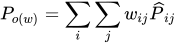

where  is the agreement weight for table cell (i, j),
  is the estimate of the proportion in table cell (i, j), is the estimate of the proportion in row i, and is the estimate of the proportion in column i. For information about how PROC SURVEYFREQ computes the proportion estimates, see the section Proportions.
The weighted kappa component  measures the observed agreement, and the component
  measures the chance-expected agreement. These values are displayed in the "Weighted Kappa Details" table when you specify the AGREE(DETAILS) or WTKAPPA(DETAILS) option.
PROC SURVEYFREQ estimates the variance of the simple kappa coefficient as described in the section Replication Variance Estimation. PROC SURVEYFREQ computes confidence limits for the weighted kappa coefficient as

where  is the standard error of the weighted kappa coefficient and is the th percentile of the t distribution with df degrees of freedom. (For more information, see the section Degrees of Freedom.) The value of the confidence coefficient is determined by the ALPHA= option; by default, ALPHA=0.05, which produces 95% confidence limits.
Kappa Agreement Weights
PROC SURVEYFREQ computes the weighted kappa coefficient by using the Cicchetti-Allison form (by default) or the Fleiss-Cohen form of agreement weights. These weights are based on the scores of the column variable in the two-way table request. If the column variable is numeric, the column scores are the numeric values of the column levels. If the column variable is a character variable, the column scores are the column numbers, where the columns are numbered in the order in which they appear in the crosstabulation table.
PROC SURVEYFREQ computes Cicchetti-Allison agreement weights as

where  is the score for column i and c is the number of columns (categories). For more information, see Cicchetti and Allison (1971).
PROC SURVEYFREQ computes Fleiss-Cohen agreement weights as

For more information, see Fleiss and Cohen (1973).
The agreement weights are constructed so that  for all i, and
  . For
. For  , the agreement weights must be nonnegative and less than 1, which is always true for character variables (where the scores are the column numbers). For numeric variables, you should assign numeric variable levels (scores) so that all agreement weights are nonnegative and less than 1.
You can assign numeric values to the variable levels in a way that reflects their degree of similarity. For example, suppose the column variable is numeric and has four levels, which you order according to similarity. If you assign the values 0, 2, 4, and 10 to the column variable levels, the Cicchetti-Allison agreement weights take the following values:  = 0.8,
  = 0.6,
  = 0.0,
  = 0.8,
  = 0.2, and
  = 0.4. For this example, the Fleiss-Cohen agreement weights are as follows: = 0.96, = 0.84, = 0.00, = 0.96, = 0.36, and = 0.64.
To display the kappa agreement weights, you can specify the WTKAPPA(PRINTKWTS) option.
AC1 Agreement Coefficient
When you specify the AGREE(AC1) option, PROC SURVEYFREQ provides Gwet’s first-order agreement coefficient, AC1 (Gwet 2008), its standard error, and the confidence limits. This option is available for replication variance estimation methods.
The AC1 agreement coefficient is computed as

where  ,
,  , and
, and  . The component is the proportion of observed agreement, and the component
  represents the proportion of chance-expected agreement. For more information, see Xie (2013) and Blood and Spratt (2007).
PROC SURVEYFREQ estimates the variance of the AC1 coefficient as described in the section Replication Variance Estimation and computes the confidence limits as

where  is the standard error of the AC1 coefficient and is the th percentile of the t distribution with df degrees of freedom. (For more information, see the section Degrees of Freedom.) The value of the confidence coefficient is determined by the ALPHA= option; by default, ALPHA=0.05, which produces 95% confidence limits.
Prevalence-Adjusted Bias-Adjusted Kappa Coefficient
When you specify the AGREE(PABAK) option, PROC SURVEYFREQ provides the prevalence-adjusted bias-adjusted kappa coefficient (PABAK) (Byrt, Bishop, and Carlin 1993). This statistic is available for replication variance estimation methods.
This coefficient is computed as

where and R is the dimension of the square, two-way table. The component is the proportion of observed agreement, and the component  represents the chance-expected agreement. When the table is ,
  . For more information, see Sim and Wright (2005), Xie (2013), and Holley and Guilford (1964).
PROC SURVEYFREQ estimates the variance of PABAK as described in the section Replication Variance Estimation and computes the confidence limits as

where  is the standard error of PABAK coefficient and is the th percentile of the t distribution with df degrees of freedom. (For more information, see the section Degrees of Freedom.) The value of the confidence coefficient is determined by the ALPHA= option; by default, ALPHA=0.05, which produces 95% confidence limits.