The SURVEYSELECT Procedure
Sampford’s PPS Method
Sampford’s method (METHOD=PPS_SAMPFORD) is an extension of Brewer’s method that selects more than two units from each stratum, with probability proportional to size and without replacement. The selection probability for unit i in stratum h is  . (Because selection probabilities cannot exceed 1, the relative size for each unit,
  , must not exceed
  .)
.)
Sampford’s method first selects a unit from stratum h with probability . Then subsequent units are selected with probability proportional to

and with replacement. If the same unit appears more than once in the sample of size  , then Sampford’s algorithm rejects that sample and selects a new sample. The sample is accepted if it contains distinct units.
If you specify the JTPROBS option, PROC SURVEYSELECT computes the joint selection probabilities for all pairs of selected units in each stratum. The joint selection probability for units i and j in stratum h is

where
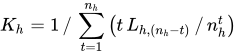
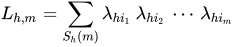
and  denotes all possible samples of size m, for
  . The sum
  is defined similarly to
  but sums over all possible samples of size m that do not include units i and j. For more information, see Cochran (1977, pp. 262–263) and Sampford (1967).