The SURVEYSELECT Procedure
Optimal Allocation
When you specify the ALLOC=OPTIMAL option in the STRATA statement, PROC SURVEYSELECT allocates the total sample size among the strata in proportion to stratum sizes, stratum costs, and stratum variances. You provide the stratum costs and variances in the COST= and VAR= options, respectively.
Optimal allocation minimizes the overall variance for a specified cost, or equivalently minimizes the overall cost for a specified variance. For more information, see Lohr (2010), Cochran (1977), and Kish (1965). For optimal allocation, PROC SURVEYSELECT computes the proportion of the total sample size for stratum h as
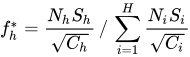
where  is the number of sampling units in stratum h,
  is the standard deviation within stratum h,
  is the unit cost within stratum h, and H is the total number of strata.
PROC SURVEYSELECT computes the target sample size for stratum h as

where n is the total sample size that you specify in the SAMPSIZE= option in the PROC SURVEYSELECT statement.
If you specify a minimum stratum sample size  in the ALLOCMIN= option in the STRATA statement, then all stratum sample sizes are required to be at least . By default, all stratum sample sizes are required to be at least 1 (to ensure that at least one sampling unit is selected from each stratum). If a target sample size is less than the required minimum value, PROC SURVEYSELECT sets the target sample size equal to the minimum value.
For without-replacement selection methods, a stratum sample size cannot exceed the number of sampling units in the stratum (). If a target stratum sample size exceeds the number of units in the stratum, PROC SURVEYSELECT allocates the number of available units () to the stratum and allocates the remaining sample size proportionally among the remaining strata.
PROC SURVEYSELECT computes the allocated stratum sample sizes  (which must be integers) by rounding the target sample size values in order of the fractional parts until the total sample size n is achieved.
PROC SURVEYSELECT provides the target allocation proportions  in the output data set variable
 AllocProportion. The variable ActualProportion contains the actual proportions for the allocated sample sizes . For stratum h, the actual proportion is computed as

where is the allocated sample size for stratum h and n is the total sample size. The actual proportions  can differ from the target allocation proportions because of rounding and the requirement that
  (or
(or  ).
).