The VARCOMP Procedure
Computational Methods
Four methods of estimation can be specified in the PROC VARCOMP statement by using the METHOD= option. They are described in the following sections.
The Type I Method
This method (METHOD=TYPE1) computes the Type I sum of squares for each effect, equates each mean square involving only random effects to its expected value, and solves the resulting system of equations (Gaylor, Lucas, and Anderson 1970). The  matrix is computed and adjusted in segments whenever memory is not sufficient to hold the entire matrix.
The MIVQUE0 Method
Based on the technique suggested by Hartley, Rao, and LaMotte (1978), the MIVQUE0 method (METHOD=MIVQUE0) produces unbiased estimates that are invariant with respect to the fixed effects of the model and that are locally best quadratic unbiased estimates given that the true ratio of each component to the residual error component is zero. The technique is similar to TYPE1 except that the random effects are adjusted only for the fixed effects. This affords a considerable timing advantage over the TYPE1 method; thus, MIVQUE0 is the default method used in PROC VARCOMP. The  matrix is computed and adjusted in segments whenever memory is not sufficient to hold the entire matrix. Each element
  of the form

is computed, where

and where  is part of the design matrix for the fixed effects,
  is part of the design matrix for one of the random effects, and SSQ is an operator that takes the sum of squares of the elements. For more information see Rao (1971, 1972) and Goodnight (1978).
The Maximum Likelihood Method
The maximum likelihood method ( METHOD=ML) computes maximum likelihood estimates of the variance components; see Searle, Casella, and McCulloch (1992). The computing algorithm makes use of the W-transformation developed by Hemmerle and Hartley (1973) and Goodnight and Hemmerle (1979). The procedure uses a Newton-Raphson algorithm, iterating until the log-likelihood objective function converges.
The objective function for METHOD=ML is  , where
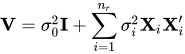
and where  is the residual variance,
  is the number of random effects in the model,
  represents the variance components, is part of the design matrix for one of the random effects, and

is the vector of residuals.
The Restricted Maximum Likelihood Method
The restricted maximum likelihood method ( METHOD=REML) is similar to the maximum likelihood method, but it first separates the likelihood into two parts: one that contains the fixed effects and one that does not (Patterson and Thompson 1971). The procedure uses a Newton-Raphson algorithm, iterating until convergence is reached for the log-likelihood objective function of the portion of the likelihood that does not contain the fixed effects. Using notation from earlier methods, the objective function for METHOD=REML is  . See Searle, Casella, and McCulloch (1992) for additional details.