The VARCOMP Procedure

Gauge Repeatability and Reproducibility Analysis

In a typical gauge R&R experiment, each operator (upper O Subscript j) makes multiple observations on each of several similar parts (upper P Subscript i) from a monitored process. The statistical model used to describe the response variable is the balanced two-factor crossed random model with interaction

y Subscript i j k Baseline equals mu Subscript y Baseline plus upper P Subscript i Baseline plus upper O Subscript j Baseline plus left-parenthesis upper P upper O right-parenthesis Subscript i j Baseline plus upper E Subscript i j k

where i equals 1 comma ellipsis comma p comma j equals 1 comma ellipsis comma o comma k equals 1 comma ellipsis comma r comma mu Subscript y Baseline is an unknown constant, and upper P Subscript i Baseline comma upper O Subscript j Baseline comma left-parenthesis upper P upper O right-parenthesis Subscript i j Baseline comma upper E Subscript i j k Baseline are jointly independent normal random variables with means of zero and variances normal upper V normal a normal r left-parenthesis upper P right-parenthesis comma normal upper V normal a normal r left-parenthesis upper O right-parenthesis comma normal upper V normal a normal r left-parenthesis upper P upper O right-parenthesis comma and normal upper V normal a normal r left-parenthesis upper E right-parenthesis, respectively. The corresponding SAS statements are as follows:

proc varcomp method=grr;
   class P O;
   model y = P|O;
run;

The first random effect in the MODEL statement is assumed to be the "Part" effect and the second is "Operator."

The ANOVA table for the preceding model is shown in Table 2.

Table 2: GRR Analysis of Variance

Source DF Mean Square Expected Mean Square
Parts(P) p minus 1 upper S Subscript upper P Superscript 2 normal upper V normal a normal r left-parenthesis upper E right-parenthesis plus r normal upper V normal a normal r left-parenthesis upper P upper O right-parenthesis plus o r normal upper V normal a normal r left-parenthesis upper P right-parenthesis
Operators(O) o minus 1 upper S Subscript upper O Superscript 2 normal upper V normal a normal r left-parenthesis upper E right-parenthesis plus r normal upper V normal a normal r left-parenthesis upper P upper O right-parenthesis plus p r normal upper V normal a normal r left-parenthesis upper O right-parenthesis
PtimesO left-parenthesis p minus 1 right-parenthesis left-parenthesis o minus 1 right-parenthesis upper S Subscript upper P upper O Superscript 2 normal upper V normal a normal r left-parenthesis upper E right-parenthesis plus r normal upper V normal a normal r left-parenthesis upper P upper O right-parenthesis
Error(E) p o left-parenthesis r minus 1 right-parenthesis upper S Subscript upper E Superscript 2 normal upper V normal a normal r left-parenthesis upper E right-parenthesis


The gauge R&R parameters of interest are given in Table 3 in terms of normal upper V normal a normal r left-parenthesis upper P right-parenthesis comma normal upper V normal a normal r left-parenthesis upper O right-parenthesis comma normal upper V normal a normal r left-parenthesis upper P upper O right-parenthesis comma and normal upper V normal a normal r left-parenthesis upper E right-parenthesis period

Table 3: Gauge R&R Parameters

Parameter Formula
Mean of population of measurements mu Subscript y Baseline equals y overbar Subscript dot dot dot Baseline equals normal upper Sigma Subscript i j k Baseline y Subscript i j k Baseline slash p o r
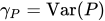
Variance of the monitored process gamma Subscript upper P Baseline equals normal upper V normal a normal r left-parenthesis upper P right-parenthesis
Variance of the measurement system gamma Subscript upper M Baseline equals normal upper V normal a normal r left-parenthesis upper O right-parenthesis plus normal upper V normal a normal r left-parenthesis upper P upper O right-parenthesis plus normal upper V normal a normal r left-parenthesis upper E right-parenthesis
Total variance of the response variable gamma Subscript y Baseline equals normal upper V normal a normal r left-parenthesis y right-parenthesis equals gamma Subscript upper P Baseline plus gamma Subscript upper M
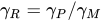
Ratio of process variance to measurement variance gamma Subscript upper R Baseline equals gamma Subscript upper P Baseline slash gamma Subscript upper M
Proportion of total variance due to the process rho Subscript upper P Baseline equals gamma Subscript upper P Baseline slash gamma Subscript y Baseline equals StartFraction gamma Subscript upper R Baseline Over 1 plus gamma Subscript upper R Baseline EndFraction
Proportion of total variance due to the measurement rho Subscript upper M Baseline equals gamma Subscript upper M Baseline slash gamma Subscript y Baseline equals 1 minus rho Subscript upper P
Signal-to-noise ratio normal upper S normal upper N normal upper R equals StartRoot 2 times gamma Subscript upper R Baseline EndRoot
Discrimination ratio normal upper D normal upper R equals 1 plus 2 gamma Subscript upper R


For a one-way model, gamma Subscript upper M Baseline equals normal upper V normal a normal r left-parenthesis upper E right-parenthesis comma and for a two-way model with no interaction, gamma Subscript upper M Baseline equals normal upper V normal a normal r left-parenthesis upper O right-parenthesis plus normal upper V normal a normal r left-parenthesis upper E right-parenthesis period

If you use the SPECLIMITS option to give specification limits, the two parameters in Table 4 will also be estimated and displayed.

Table 4: Gauge R&R Parameters Related to Specification Limits

Parameter Formula
Precision-to-tolerance ratio normal upper P normal upper T normal upper R left-parenthesis normal upper L normal upper S normal upper L comma normal upper U normal upper S normal upper L comma normal k right-parenthesis equals k StartRoot gamma Subscript upper M Baseline EndRoot slash left-parenthesis normal upper U normal upper S normal upper L minus normal upper L normal upper S normal upper L right-parenthesis
Process capability ratio normal upper C normal p left-parenthesis normal upper L normal upper S normal upper L comma normal upper U normal upper S normal upper L comma normal k right-parenthesis equals left-parenthesis normal upper U normal upper S normal upper L minus normal upper L normal upper S normal upper L right-parenthesis slash left-parenthesis k StartRoot gamma Subscript upper P Baseline EndRoot right-parenthesis


Here, USL and LSL are the specification limits, and the value k corresponds to the number of standard deviations between the "natural" tolerance limits of a normal process.

If you use the RATIO option, the ratios in Table 5 will also be estimated and displayed.

Table 5: Gauge R&R Ratios

Ratio Formula
Ratio of process variance to total variance normal upper V normal a normal r left-parenthesis upper P right-parenthesis slash gamma Subscript y
Ratio of operator variance to total variance normal upper V normal a normal r left-parenthesis upper O right-parenthesis slash gamma Subscript y
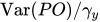
Ratio of process by operator variance to total variance normal upper V normal a normal r left-parenthesis upper P upper O right-parenthesis slash gamma Subscript y
Ratio of process variance to residual variance normal upper V normal a normal r left-parenthesis upper P right-parenthesis slash normal upper V normal a normal r left-parenthesis upper E right-parenthesis
Ratio of operator variance to residual variance normal upper V normal a normal r left-parenthesis upper O right-parenthesis slash normal upper V normal a normal r left-parenthesis upper E right-parenthesis
Ratio of process by operator variance to residual variance normal upper V normal a normal r left-parenthesis upper P upper O right-parenthesis slash normal upper V normal a normal r left-parenthesis upper E right-parenthesis


Last updated: December 09, 2022