The VARIOGRAM Procedure

Semivariance Computation

With the classification of a point pair upper P Subscript i Baseline upper P Subscript j into an angle/distance class, as shown earlier in this section, the semivariance computation proceeds as follows.

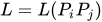
Denote all pairs that upper P Subscript i Baseline upper P Subscript j belong to angle class left-bracket theta Subscript k Baseline minus delta theta Subscript k Baseline comma theta Subscript k Baseline plus delta theta Subscript k Baseline right-parenthesis and distance class upper L equals upper L left-parenthesis upper P Subscript i Baseline upper P Subscript j Baseline right-parenthesis as upper N left-parenthesis theta Subscript k Baseline comma upper L right-parenthesis. For example, based on FigureĀ 20 and FigureĀ 21, upper P 1 upper P 2 belongs to upper N left-parenthesis 60 Superscript ring Baseline comma 1 right-parenthesis.

Let bar upper N left-parenthesis theta Subscript k Baseline comma upper L right-parenthesis bar denote the number of such pairs. The component of the standard (or method of moments) semivariance that correspond to angle/distance class upper N left-parenthesis theta Subscript k Baseline comma upper L right-parenthesis is given by

ModifyingAbove gamma With caret left-parenthesis h Subscript k Baseline right-parenthesis equals StartFraction 1 Over 2 bar upper N left-parenthesis theta Subscript k Baseline comma upper L right-parenthesis bar EndFraction sigma-summation Underscript upper P Subscript i Baseline upper P Subscript j Baseline element-of upper N left-parenthesis theta Subscript k Baseline comma upper L right-parenthesis Endscripts left-bracket upper V left-parenthesis bold-italic s Subscript i Baseline right-parenthesis minus upper V left-parenthesis bold-italic s Subscript j Baseline right-parenthesis right-bracket squared

where h Subscript k is the average distance in class upper N left-parenthesis theta Subscript k Baseline comma upper L right-parenthesis; that is,

h Subscript k Baseline equals StartFraction 1 Over bar upper N left-parenthesis theta Subscript k Baseline comma upper L right-parenthesis bar EndFraction sigma-summation Underscript upper P Subscript i Baseline upper P Subscript j Baseline element-of upper N left-parenthesis theta Subscript k Baseline comma upper L right-parenthesis Endscripts bar upper P Subscript i Baseline upper P Subscript j bar

The robust version of the semivariance is given by

ModifyingAbove gamma With bar left-parenthesis h Subscript k Baseline right-parenthesis equals StartFraction normal upper Psi Superscript 4 Baseline left-parenthesis h Subscript k Baseline right-parenthesis Over 2 left-bracket 0.457 plus 0.494 slash upper N left-parenthesis theta Subscript k Baseline comma upper L right-parenthesis right-bracket EndFraction

where

normal upper Psi left-parenthesis h Subscript k Baseline right-parenthesis equals StartFraction 1 Over upper N left-parenthesis theta Subscript k Baseline comma upper L right-parenthesis EndFraction sigma-summation Underscript upper P Subscript i Baseline upper P Subscript j Baseline element-of upper N left-parenthesis theta Subscript k Baseline comma upper L right-parenthesis Endscripts left-bracket upper V left-parenthesis bold-italic s Subscript i Baseline right-parenthesis minus upper V left-parenthesis bold-italic s Subscript j Baseline right-parenthesis right-bracket Superscript one-half

This robust version of the semivariance is computed when you specify the ROBUST option in the COMPUTE statement in PROC VARIOGRAM.

PROC VARIOGRAM computes and writes to the OUTVAR= data set the quantities h Subscript k Baseline comma theta Subscript k Baseline comma upper L comma upper N left-parenthesis theta Subscript k Baseline comma upper L right-parenthesis comma ModifyingAbove gamma With caret left-parenthesis h right-parenthesis, and ModifyingAbove gamma With bar left-parenthesis h right-parenthesis.

Last updated: December 09, 2022