Definition of DATA Step Statements
Definition
A SAS DATA step statement is a type of SAS language element that runs within a SAS DATA step and is part of the SAS DATA step programming language.
A SAS DATA step is a group of SAS language elements that begins with a DATA statement and ends with a RUN statement. The DATA statement is followed by other programming language elements such as more DATA step statements, functions, data set options, formats, and informats. These language elements are used to read, transform, and write data.
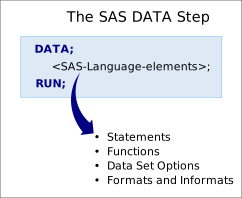
Summary of DATA step functionality:
- reads, transforms, and outputs data.
- runs in a single thread in SAS or in multiple threads in SAS Cloud Analytic Services (CAS). CAS is a cloud-based run-time environment that enables massively parallel execution.
- has a built-in looping functionality that automatically reads records from external files until the end of file is reached.
Executable and Declarative Statements
DATA step statements are executable or declarative statements that can appear in the DATA step and run in SAS. The difference between these 2 types of statements is based on when the statements take effect — during compile-time or during program execution.
For more information about the phases of DATA step processing, see Flow of Action in SAS Programmer’s Guide: Essentials.
Declarative statements
Declarative statements supply information to SAS and take effect during the compilation phase of DATA step processing. Declarative statements are often referred to as “compile-time only” statements. They supply information to the program data vector (PDV) about the variables to be written to output and they determine the attributes of the variables.
Declarative statements also help SAS executable statements know what rows to read during iterations. They are therefore critical because when this variable information is determined at compile time, the attributes are set and cannot be changed. This is also why these compile-time only statements cannot be conditionally executed: they take effect at compile time before the DATA step executes.
For example, although the WHERE statement is specified within a DATA step and the statement might appear to be in effect, it is actually a declarative statement that takes effect during compile time. The WHERE statement is declarative because it supplies SAS with information needed by executable statements such as SET, MERGE, and MODIFY.
Executable statements
Executable statements result in some action during individual iterations of the DATA step. They take effect at the execution phase, after the program has already been compiled. Executable statements control all the looping and flow of the program.
The following tables show the executable and declarative statements that you can use in the SAS DATA step.
|
Executable Statements |
||
|---|---|---|
|
ABORT |
IF-THEN/ELSE |
PUT, Formatted |
|
Array Reference |
INFILE |
PUT, List |
|
Assignment |
INPUT |
PUT, Named |
|
CALL |
GOTO |
PUT |
|
CONTINUE |
INPUT, Column |
PUT, ODS |
|
DELETE |
INPUT, Formatted |
PUTLOG |
|
DESCRIBE |
INPUT, List |
REDIRECT |
|
DISPLAY |
INPUT, Named |
REMOVE |
|
DO |
LEAVE |
REPLACE |
|
DO, Iterative |
LINK |
RESETLINE |
|
DO UNTIL |
LIST |
RETURN |
|
DO WHILE |
LOSTCARD |
SELECT |
|
ERROR |
MERGE |
SET |
|
EXECUTE |
MODIFY |
STOP |
|
FILE |
Null |
Sum |
|
FILE, ODS |
OUTPUT |
UPDATE |
|
IF, Subsetting |
PUT, Column |
|
|
Declarative Statements |
||
|---|---|---|
|
ARRAY |
DATALINES4 |
Labels, Statement |
|
ATTRIB |
DROP |
LENGTH |
|
BY |
END |
RENAME |
|
CARDS |
FORMAT |
RETAIN |
|
CARDS4 |
INFORMAT |
WHERE |
|
DATA |
KEEP |
WINDOW |
|
DATALINES |
LABEL |
|
DATA step statements can be grouped into functional categories. For a list of DATA step statements by category, see DATA Step Statements by Category.