The PHREG Procedure

Specifics for Bayesian Analysis

To request a Bayesian analysis, you specify the BAYES statement in addition to the PROC PHREG statement and the MODEL statement. You include a CLASS statement if you have effects that involve categorical variables. The FREQ or WEIGHT statement can be included if you have a frequency or weight variable, respectively, in the input data. You can use the STRATA statement to carry out a stratified analysis for the Cox model, but it is not allowed in the proportional hazards spline model or the piecewise constant baseline hazard model. Programming statements can be used to create time-dependent covariates for the Cox model, but they are not allowed in the proportional hazards spline model or the piecewise constant baseline hazard model. You can use the counting process style of input or the ENTRY= option in the MODEL statement to specify left truncation of failure times. The HAZARDRATIO statement enables you to request a hazard ratio analysis based on the posterior samples. The ASSESS, CONTRAST, ID, OUTPUT, and TEST statements, if specified, are ignored. Also ignored are the COVM and COVS options in the PROC PHREG statement and the following options in the MODEL statement: BEST=, CORRB, COVB, DETAILS, HIERARCHY=, INCLUDE=, MAXSTEP=, NOFIT, PLCONV=, SELECTION=, SEQUENTIAL, SLENTRY=, and SLSTAY=.

Proportional Hazards Spline Model

The proportional hazards spline model (Royston and Parmar 2002) with fixed covariate vector bold x has a cumulative hazard function at time t,

upper H left-parenthesis t semicolon bold x vertical-bar bold-italic gamma right-parenthesis equals normal e Superscript s left-parenthesis log left-parenthesis t right-parenthesis comma bold-italic gamma right-parenthesis plus bold-italic beta prime bold x

where bold-italic beta is the vector of regression coefficients and s left-parenthesis log left-parenthesis t right-parenthesis comma bold-italic gamma right-parenthesis is a cubic spline function as described for the SPLINE option in the BAYES statement. The number of knots is equal to one plus the degrees of freedom (which you specify in the DF= option). The knots are determined by the sequence of the distinct event times of the data. PROC PHREG places the terminal knots at the minimum and maximum of the sequence and selects the m internal knots as the kth percentiles of the sequence, where k equals 100 StartFraction 1 Over m plus 1 EndFraction comma ellipsis comma 100 StartFraction m Over m plus 1 EndFraction. For example, if you specify DF=4, the three internal knots are the 25th, 50th, and 75th percentiles of the distinct event times.

Let StartSet left-parenthesis t Subscript i Baseline comma bold x Subscript i Baseline comma delta Subscript i Baseline right-parenthesis comma i equals 1 comma 2 comma ellipsis comma n EndSet be the observed data. The likelihood function of the proportional hazards spline model is given by


upper L Subscript upper R upper P Baseline left-parenthesis bold-italic gamma comma beta right-parenthesis equals product Underscript i Endscripts StartSet StartFraction 1 Over t Subscript i Baseline EndFraction StartFraction d s left-parenthesis y Subscript i Baseline comma bold-italic gamma right-parenthesis Over d y Subscript i Baseline EndFraction EndSet Superscript delta Super Subscript i Baseline normal e Superscript eta Super Subscript i Superscript minus normal e Super Superscript eta Super Super Subscript i

where y Subscript i Baseline equals log left-parenthesis t Subscript i Baseline right-parenthesis and eta Subscript i Baseline equals s left-parenthesis y Subscript i Baseline comma bold-italic gamma right-parenthesis plus bold-italic beta prime bold x Subscript bold i. Note that

StartFraction d s left-parenthesis y semicolon bold-italic gamma right-parenthesis Over d y EndFraction equals gamma 1 plus sigma-summation Underscript j equals 2 Overscript m Endscripts gamma Subscript j Baseline left-bracket 3 left-parenthesis y minus k Subscript j Baseline right-parenthesis Subscript plus Superscript 2 Baseline minus 3 lamda Subscript j Baseline left-parenthesis x minus k Subscript normal m normal i normal n Baseline right-parenthesis Subscript plus Superscript 2 Baseline minus 3 left-parenthesis 1 minus lamda Subscript j Baseline right-parenthesis left-parenthesis x minus k Subscript normal m normal a normal x Baseline right-parenthesis Subscript plus Superscript 2 Baseline right-bracket

Piecewise Constant Baseline Hazard Model

Let StartSet left-parenthesis t Subscript i Baseline comma bold x Subscript i Baseline comma delta Subscript i Baseline right-parenthesis comma i equals 1 comma 2 comma ellipsis comma n EndSet be the observed data. Let a 0 equals 0 less-than a 1 less-than ellipsis less-than a Subscript upper J minus 1 Baseline less-than a Subscript upper J Baseline equals normal infinity be a partition of the time axis.

Hazards in Original Scale

The hazard function for subject i is

h left-parenthesis t vertical-bar bold x Subscript i Baseline semicolon bold-italic theta right-parenthesis equals h 0 left-parenthesis t right-parenthesis exp left-parenthesis bold-italic beta prime bold x Subscript i Baseline right-parenthesis

where

h 0 left-parenthesis t right-parenthesis equals lamda Subscript j Baseline normal i normal f a Subscript j minus 1 Baseline less-than-or-equal-to t less-than a Subscript j Baseline comma j equals 1 comma ellipsis comma upper J

The baseline cumulative hazard function is
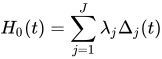
upper H 0 left-parenthesis t right-parenthesis equals sigma-summation Underscript j equals 1 Overscript upper J Endscripts lamda Subscript j Baseline normal upper Delta Subscript j Baseline left-parenthesis t right-parenthesis

where

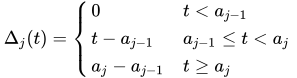
StartLayout 1st Row  normal upper Delta Subscript j Baseline left-parenthesis t right-parenthesis equals StartLayout Enlarged left-brace 1st Row 1st Column 0 2nd Column t less-than a Subscript j minus 1 Baseline 2nd Row 1st Column t minus a Subscript j minus 1 Baseline 2nd Column a Subscript j minus 1 Baseline less-than-or-equal-to t less-than a Subscript j Baseline 3rd Row 1st Column a Subscript j Baseline minus a Subscript j minus 1 Baseline 2nd Column t greater-than-or-equal-to a Subscript j EndLayout EndLayout

The log likelihood is given by

StartLayout 1st Row 1st Column l left-parenthesis bold-italic lamda comma bold-italic beta right-parenthesis 2nd Column equals 3rd Column sigma-summation Underscript i equals 1 Overscript n Endscripts delta Subscript i Baseline left-bracket sigma-summation Underscript j equals 1 Overscript upper J Endscripts upper I left-parenthesis a Subscript j minus 1 Baseline less-than-or-equal-to t Subscript i Baseline less-than a Subscript j Baseline right-parenthesis log lamda Subscript j Baseline plus bold-italic beta prime bold x Subscript i Baseline right-bracket minus sigma-summation Underscript i equals 1 Overscript n Endscripts left-bracket sigma-summation Underscript j equals 1 Overscript upper J Endscripts normal upper Delta Subscript j Baseline left-parenthesis t Subscript i Baseline right-parenthesis lamda Subscript j Baseline right-bracket exp left-parenthesis bold-italic beta prime bold x Subscript i Baseline right-parenthesis 2nd Row 1st Column Blank 2nd Column equals 3rd Column sigma-summation Underscript j equals 1 Overscript upper J Endscripts d Subscript j Baseline log lamda Subscript j plus sigma-summation Underscript i equals 1 Overscript n Endscripts delta Subscript i Baseline bold-italic beta prime bold x Subscript i minus sigma-summation Underscript j equals 1 Overscript upper J Endscripts lamda Subscript j Baseline left-bracket sigma-summation Underscript i equals 1 Overscript n Endscripts normal upper Delta Subscript j Baseline left-parenthesis t Subscript i Baseline right-parenthesis exp left-parenthesis bold-italic beta prime bold x Subscript i Baseline right-parenthesis right-bracket EndLayout

where d Subscript j Baseline equals sigma-summation Underscript i equals 1 Overscript n Endscripts delta Subscript i Baseline upper I left-parenthesis a Subscript j minus 1 Baseline less-than-or-equal-to t Subscript i Baseline less-than a Subscript j Baseline right-parenthesis.

Note that for 1 less-than-or-equal-to j less-than-or-equal-to upper J, the full conditional for lamda Subscript j is log-concave only when d Subscript j Baseline greater-than 0, but the full conditionals for the beta’s are always log-concave.

For a given bold-italic beta, StartFraction partial-differential l Over partial-differential bold-italic lamda EndFraction equals 0 gives

ModifyingAbove lamda With tilde Subscript j Baseline left-parenthesis bold-italic beta right-parenthesis equals StartFraction d Subscript j Baseline Over sigma-summation Underscript i equals 1 Overscript n Endscripts normal upper Delta Subscript j Baseline left-parenthesis t Subscript i Baseline right-parenthesis exp left-parenthesis bold-italic beta prime bold x Subscript i Baseline right-parenthesis EndFraction comma j equals 1 comma ellipsis comma upper J

Substituting these values into l left-parenthesis bold-italic lamda comma bold-italic beta right-parenthesis gives the profile log likelihood for bold-italic beta

l Subscript p Baseline left-parenthesis bold-italic beta right-parenthesis equals sigma-summation Underscript i equals 1 Overscript n Endscripts delta Subscript i Baseline bold-italic beta prime bold x Subscript i Baseline minus sigma-summation Underscript j equals 1 Overscript upper J Endscripts d Subscript j Baseline log left-bracket sigma-summation Underscript l equals 1 Overscript n Endscripts normal upper Delta Subscript j Baseline left-parenthesis t Subscript l Baseline right-parenthesis exp left-parenthesis bold-italic beta prime bold x Subscript l Baseline right-parenthesis right-bracket plus c

where c equals sigma-summation Underscript j Endscripts left-parenthesis d Subscript j Baseline log d Subscript j Baseline minus d Subscript j Baseline right-parenthesis. Since the constant c does not depend on bold-italic beta, it can be discarded from l Subscript p Baseline left-parenthesis bold-italic beta right-parenthesis in the optimization.

The MLE ModifyingAbove bold-italic beta With caret of bold-italic beta is obtained by maximizing

l Subscript p Baseline left-parenthesis bold-italic beta right-parenthesis equals sigma-summation Underscript i equals 1 Overscript n Endscripts delta Subscript i Baseline bold-italic beta prime bold x Subscript i Baseline minus sigma-summation Underscript j equals 1 Overscript upper J Endscripts d Subscript j Baseline log left-bracket sigma-summation Underscript l equals 1 Overscript n Endscripts normal upper Delta Subscript j Baseline left-parenthesis t Subscript l Baseline right-parenthesis exp left-parenthesis bold-italic beta prime bold x Subscript l Baseline right-parenthesis right-bracket

with respect to bold-italic beta, and the MLE ModifyingAbove bold-italic lamda With caret of bold-italic lamda is given by

ModifyingAbove bold-italic lamda With caret equals ModifyingAbove bold-italic lamda With tilde left-parenthesis ModifyingAbove bold-italic beta With caret right-parenthesis

For j equals 1 comma ellipsis comma upper J, let

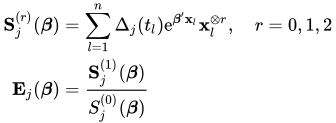
StartLayout 1st Row 1st Column bold upper S Subscript j Superscript left-parenthesis r right-parenthesis Baseline left-parenthesis bold-italic beta right-parenthesis 2nd Column equals 3rd Column sigma-summation Underscript l equals 1 Overscript n Endscripts normal upper Delta Subscript j Baseline left-parenthesis t Subscript l Baseline right-parenthesis normal e Superscript bold-italic beta prime bold x Super Subscript l Superscript Baseline bold x Subscript l Superscript circled-times r Baseline comma r equals 0 comma 1 comma 2 2nd Row 1st Column bold upper E Subscript j Baseline left-parenthesis bold-italic beta right-parenthesis 2nd Column equals 3rd Column StartFraction bold upper S Subscript j Superscript left-parenthesis 1 right-parenthesis Baseline left-parenthesis bold-italic beta right-parenthesis Over upper S Subscript j Superscript left-parenthesis 0 right-parenthesis Baseline left-parenthesis bold-italic beta right-parenthesis EndFraction EndLayout

The partial derivatives of l Subscript p Baseline left-parenthesis bold-italic beta right-parenthesis are

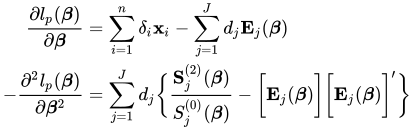
StartLayout 1st Row 1st Column StartFraction partial-differential l Subscript p Baseline left-parenthesis bold-italic beta right-parenthesis Over partial-differential bold-italic beta EndFraction 2nd Column equals 3rd Column sigma-summation Underscript i equals 1 Overscript n Endscripts delta Subscript i Baseline bold x Subscript i minus sigma-summation Underscript j equals 1 Overscript upper J Endscripts d Subscript j Baseline bold upper E Subscript j Baseline left-parenthesis bold-italic beta right-parenthesis 2nd Row 1st Column minus StartFraction partial-differential squared l Subscript p Baseline left-parenthesis bold-italic beta right-parenthesis Over partial-differential bold-italic beta squared EndFraction 2nd Column equals 3rd Column sigma-summation Underscript j equals 1 Overscript upper J Endscripts d Subscript j Baseline StartSet StartFraction bold upper S Subscript j Superscript left-parenthesis 2 right-parenthesis Baseline left-parenthesis bold-italic beta right-parenthesis Over upper S Subscript j Superscript left-parenthesis 0 right-parenthesis Baseline left-parenthesis bold-italic beta right-parenthesis EndFraction minus left-bracket bold upper E Subscript j Baseline left-parenthesis bold-italic beta right-parenthesis right-bracket left-bracket bold upper E Subscript j Baseline left-parenthesis bold-italic beta right-parenthesis right-bracket prime EndSet EndLayout

The asymptotic covariance matrix for left-parenthesis ModifyingAbove bold-italic lamda With caret comma ModifyingAbove bold-italic beta With caret right-parenthesis is obtained as the inverse of the information matrix given by
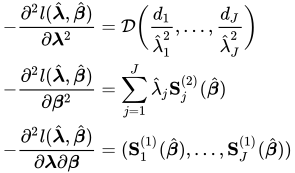
StartLayout 1st Row 1st Column minus StartFraction partial-differential squared l left-parenthesis ModifyingAbove bold-italic lamda With caret comma ModifyingAbove bold-italic beta With caret right-parenthesis Over partial-differential bold-italic lamda squared EndFraction 2nd Column equals 3rd Column script upper D left-parenthesis StartFraction d 1 Over ModifyingAbove lamda With caret Subscript 1 Superscript 2 Baseline EndFraction comma ellipsis comma StartFraction d Subscript upper J Baseline Over ModifyingAbove lamda With caret Subscript upper J Superscript 2 Baseline EndFraction right-parenthesis 2nd Row 1st Column minus StartFraction partial-differential squared l left-parenthesis ModifyingAbove bold-italic lamda With caret comma ModifyingAbove bold-italic beta With caret right-parenthesis Over partial-differential bold-italic beta squared EndFraction 2nd Column equals 3rd Column sigma-summation Underscript j equals 1 Overscript upper J Endscripts ModifyingAbove lamda With caret Subscript j Baseline bold upper S Subscript j Superscript left-parenthesis 2 right-parenthesis Baseline left-parenthesis ModifyingAbove bold-italic beta With caret right-parenthesis 3rd Row 1st Column minus StartFraction partial-differential squared l left-parenthesis ModifyingAbove bold-italic lamda With caret comma ModifyingAbove bold-italic beta With caret right-parenthesis Over partial-differential bold-italic lamda partial-differential bold-italic beta EndFraction 2nd Column equals 3rd Column left-parenthesis bold upper S 1 Superscript left-parenthesis 1 right-parenthesis Baseline left-parenthesis ModifyingAbove bold-italic beta With caret right-parenthesis comma ellipsis comma bold upper S Subscript upper J Superscript left-parenthesis 1 right-parenthesis Baseline left-parenthesis ModifyingAbove bold-italic beta With caret right-parenthesis right-parenthesis EndLayout

See Example 6.5.1 in Lawless (2003) for details.

Hazards in Log Scale

By letting

alpha Subscript j Baseline equals log left-parenthesis lamda Subscript j Baseline right-parenthesis comma j equals 1 comma ellipsis comma upper J

you can build a prior correlation among the lamda Subscript j’s by using a correlated prior bold-italic alpha tilde upper N left-parenthesis bold-italic alpha 0 comma normal upper Sigma Subscript alpha Baseline right-parenthesis, where bold-italic alpha equals left-parenthesis alpha 1 comma ellipsis comma alpha Subscript upper J Baseline right-parenthesis prime.

The log likelihood is given by

l left-parenthesis bold-italic alpha comma bold-italic beta right-parenthesis equals sigma-summation Underscript j equals 1 Overscript upper J Endscripts d Subscript j Baseline alpha Subscript j Baseline plus sigma-summation Underscript i equals 1 Overscript n Endscripts delta Subscript i Baseline bold-italic beta prime bold x Subscript i Baseline minus sigma-summation Underscript j equals 1 Overscript upper J Endscripts normal e Superscript alpha Super Subscript j Baseline upper S Subscript j Superscript left-parenthesis 0 right-parenthesis Baseline left-parenthesis bold-italic beta right-parenthesis

Then the MLE of lamda Subscript j is given by

normal e Superscript ModifyingAbove alpha With caret Super Subscript j Baseline equals ModifyingAbove lamda With caret Subscript j Baseline equals StartFraction d Subscript j Baseline Over upper S Subscript j Superscript 0 Baseline left-parenthesis ModifyingAbove bold-italic beta With caret right-parenthesis EndFraction

Note that the full conditionals for alpha’s and beta’s are always log-concave.

The asymptotic covariance matrix for left-parenthesis ModifyingAbove bold-italic alpha With caret comma ModifyingAbove bold-italic beta With caret right-parenthesis is obtained as the inverse of the information matrix formed by
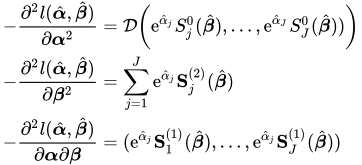
StartLayout 1st Row 1st Column minus StartFraction partial-differential squared l left-parenthesis ModifyingAbove bold-italic alpha With caret comma ModifyingAbove bold-italic beta With caret right-parenthesis Over partial-differential bold-italic alpha squared EndFraction 2nd Column equals 3rd Column script upper D left-parenthesis normal e Superscript ModifyingAbove alpha With caret Super Subscript j Superscript Baseline upper S Subscript j Superscript 0 Baseline left-parenthesis ModifyingAbove bold-italic beta With caret right-parenthesis comma ellipsis comma normal e Superscript ModifyingAbove alpha With caret Super Subscript upper J Superscript Baseline upper S Subscript upper J Superscript 0 Baseline left-parenthesis ModifyingAbove bold-italic beta With caret right-parenthesis right-parenthesis right-parenthesis 2nd Row 1st Column minus StartFraction partial-differential squared l left-parenthesis ModifyingAbove bold-italic alpha With caret comma ModifyingAbove bold-italic beta With caret right-parenthesis Over partial-differential bold-italic beta squared EndFraction 2nd Column equals 3rd Column sigma-summation Underscript j equals 1 Overscript upper J Endscripts normal e Superscript ModifyingAbove alpha With caret Super Subscript j Baseline bold upper S Subscript j Superscript left-parenthesis 2 right-parenthesis Baseline left-parenthesis ModifyingAbove bold-italic beta With caret right-parenthesis 3rd Row 1st Column minus StartFraction partial-differential squared l left-parenthesis ModifyingAbove bold-italic alpha With caret comma ModifyingAbove bold-italic beta With caret right-parenthesis Over partial-differential bold-italic alpha partial-differential bold-italic beta EndFraction 2nd Column equals 3rd Column left-parenthesis normal e Superscript ModifyingAbove alpha With caret Super Subscript j Superscript Baseline bold upper S 1 Superscript left-parenthesis 1 right-parenthesis Baseline left-parenthesis ModifyingAbove bold-italic beta With caret right-parenthesis comma ellipsis comma normal e Superscript ModifyingAbove alpha With caret Super Subscript j Superscript Baseline bold upper S Subscript upper J Superscript left-parenthesis 1 right-parenthesis Baseline left-parenthesis ModifyingAbove bold-italic beta With caret right-parenthesis right-parenthesis EndLayout

Priors for Model Parameters

For a Cox model, the model parameters are the regression coefficients. For a piecewise exponential model, the model parameters consist of the regression coefficients and the hazards or log-hazards. The priors for the hazards and the priors for the regression coefficients are assumed to be independent, while you can have a joint multivariate normal prior for the log-hazards and the regression coefficients. For a proportional hazards spline model, the model parameters consist of the regression coefficients and the cubic spline parameters. You can have a joint multivariate normal prior for the cubic spline parameters and the regression coefficients. Otherwise, the prior for the cubic spline parameters and the prior for the regression coefficients are assumed to be independent.

Cubic Spline Parameters
Uniform Prior

The joint prior density is given by

p left-parenthesis gamma 1 comma ellipsis comma gamma Subscript upper J Baseline right-parenthesis proportional-to 1 comma for-all minus normal infinity less-than gamma Subscript i Baseline less-than normal infinity
Normal Prior

Assume bold-italic gamma has a multivariate normal prior with mean vector bold-italic gamma 0 and covariance matrix bold upper Psi 0. The joint prior density is given by

p left-parenthesis gamma right-parenthesis proportional-to normal e Superscript minus one-half left-parenthesis bold-italic gamma minus bold-italic gamma 0 right-parenthesis prime bold upper Psi 0 Super Superscript negative 1 Superscript left-parenthesis bold-italic gamma minus bold-italic gamma 0 right-parenthesis
Hazard Parameters

Let lamda 1 comma ellipsis comma lamda Subscript upper J Baseline be the constant baseline hazards.

Improper Prior

The joint prior density is given by
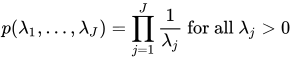
p left-parenthesis lamda 1 comma ellipsis comma lamda Subscript upper J Baseline right-parenthesis equals product Underscript j equals 1 Overscript upper J Endscripts StartFraction 1 Over lamda Subscript j Baseline EndFraction for all lamda Subscript j Baseline greater-than 0

This prior is improper (nonintegrable), but the posterior distribution is proper as long as there is at least one event time in each of the constant hazard intervals.

Uniform Prior

The joint prior density is given by

p left-parenthesis lamda 1 comma ellipsis comma lamda Subscript upper J Baseline right-parenthesis proportional-to 1 for all lamda Subscript j Baseline greater-than 0

This prior is improper (nonintegrable), but the posteriors are proper as long as there is at least one event time in each of the constant hazard intervals.

Gamma Prior

The gamma distribution upper G left-parenthesis a comma b right-parenthesis has a PDF

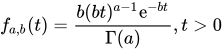
f Subscript a comma b Baseline left-parenthesis t right-parenthesis equals StartFraction b left-parenthesis b t right-parenthesis Superscript a minus 1 Baseline normal e Superscript minus b t Baseline Over normal upper Gamma left-parenthesis a right-parenthesis EndFraction comma t greater-than 0

where a is the shape parameter and b Superscript negative 1 is the scale parameter. The mean is StartFraction a Over b EndFraction and the variance is StartFraction a Over b squared EndFraction.

Independent Gamma Prior

Suppose for j equals 1 comma ellipsis comma upper J, lamda Subscript j has an independent upper G left-parenthesis a Subscript j Baseline comma b Subscript j Baseline right-parenthesis prior. The joint prior density is given by

p left-parenthesis lamda 1 comma ellipsis comma lamda Subscript upper J Baseline right-parenthesis proportional-to product Underscript j equals 1 Overscript upper J Endscripts StartSet lamda Subscript j Superscript a Super Subscript j Superscript minus 1 Baseline normal e Superscript minus b Super Subscript j Superscript lamda Super Subscript j Superscript Baseline EndSet comma for-all lamda Subscript j Baseline greater-than 0
AR1 Prior

lamda 1 comma ellipsis comma lamda Subscript upper J Baseline are correlated as follows:

StartLayout 1st Row 1st Column lamda 1 2nd Column tilde 3rd Column upper G left-parenthesis a 1 comma b 1 right-parenthesis 2nd Row 1st Column lamda 2 2nd Column tilde 3rd Column upper G left-parenthesis a 2 comma StartFraction b 2 Over lamda 1 EndFraction right-parenthesis 3rd Row 1st Column ellipsis 2nd Column Blank 3rd Column ellipsis 4th Row 1st Column lamda Subscript upper J 2nd Column tilde 3rd Column upper G left-parenthesis a Subscript upper J Baseline comma StartFraction b Subscript upper J Baseline Over lamda Subscript upper J minus 1 Baseline EndFraction right-parenthesis EndLayout

The joint prior density is given by

p left-parenthesis lamda 1 comma ellipsis comma lamda Subscript upper J Baseline right-parenthesis proportional-to lamda 1 Superscript a 1 minus 1 Baseline normal e Superscript minus b 1 lamda 1 Baseline product Underscript j equals 2 Overscript upper J Endscripts left-parenthesis StartFraction b Subscript j Baseline Over lamda Subscript j minus 1 Baseline EndFraction right-parenthesis Superscript a Super Subscript j Baseline lamda Subscript j Superscript a Super Subscript j Superscript minus 1 Baseline normal e Superscript minus StartFraction b Super Subscript j Superscript Over lamda Super Subscript j minus 1 Superscript EndFraction lamda Super Subscript j
Log-Hazard Parameters

Write bold-italic alpha equals left-parenthesis alpha 1 comma ellipsis comma alpha Subscript upper J Baseline right-parenthesis prime identical-to left-parenthesis log lamda 1 comma ellipsis comma log lamda Subscript upper J Baseline right-parenthesis prime.

Uniform Prior

The joint prior density is given by

p left-parenthesis alpha 1 comma ellipsis comma alpha Subscript upper J Baseline right-parenthesis proportional-to 1 comma for-all minus normal infinity less-than alpha Subscript i Baseline less-than normal infinity

Note that the uniform prior for the log-hazards is the same as the improper prior for the hazards.

Normal Prior

Assume bold-italic alpha has a multivariate normal prior with mean vector bold-italic alpha 0 and covariance matrix bold upper Psi 0. The joint prior density is given by

p left-parenthesis bold-italic alpha right-parenthesis proportional-to normal e Superscript minus one-half left-parenthesis bold-italic alpha minus bold-italic alpha 0 right-parenthesis prime bold upper Psi 0 Super Superscript negative 1 Superscript left-parenthesis bold-italic alpha minus bold-italic alpha 0 right-parenthesis
Regression Coefficients

Let bold-italic beta equals left-parenthesis beta 1 comma ellipsis comma beta Subscript k Baseline right-parenthesis prime be the vector of regression coefficients.

Uniform Prior

The joint prior density is given by

p left-parenthesis beta 1 comma ellipsis comma beta Subscript k Baseline right-parenthesis proportional-to 1 comma for-all minus normal infinity less-than beta Subscript i Baseline less-than normal infinity

This prior is improper, but the posterior distributions for bold-italic beta are proper.

Normal Prior

Assume bold-italic beta has a multivariate normal prior with mean vector bold-italic beta 0 and covariance matrix bold upper Sigma 0. The joint prior density is given by

p left-parenthesis bold-italic beta right-parenthesis proportional-to normal e Superscript minus one-half left-parenthesis bold-italic beta minus bold-italic beta 0 right-parenthesis prime bold upper Sigma 0 Super Superscript negative 1 Superscript left-parenthesis bold-italic beta minus bold-italic beta 0 right-parenthesis
Joint Multivariate Normal Prior for Log-Hazards and Regression Coefficients

Assume left-parenthesis bold-italic alpha prime comma bold-italic beta Superscript prime Baseline right-parenthesis prime has a multivariate normal prior with mean vector left-parenthesis alpha prime 0 comma bold-italic beta prime 0 right-parenthesis prime and covariance matrix bold upper Phi 0. The joint prior density is given by

p left-parenthesis bold-italic alpha comma bold-italic beta right-parenthesis proportional-to normal e Superscript minus one-half left-bracket left-parenthesis bold-italic alpha minus bold-italic alpha 0 right-parenthesis prime comma left-parenthesis bold-italic beta minus bold-italic beta 0 right-parenthesis Super Superscript prime Superscript right-bracket bold upper Phi 0 Super Superscript negative 1 Superscript left-bracket left-parenthesis bold-italic alpha minus bold-italic alpha 0 right-parenthesis prime comma left-parenthesis bold-italic beta minus bold-italic beta 0 right-parenthesis Super Superscript prime Superscript right-bracket prime
Joint Multivariate Normal Prior for Cubic Spline Parameters and Regression Coefficients

Assume left-parenthesis bold-italic gamma prime comma bold-italic beta Superscript prime Baseline right-parenthesis prime has a multivariate normal prior with mean vector left-parenthesis gamma prime 0 comma beta prime 0 right-parenthesis prime and covariance matrix bold upper Phi 0. The joint prior density is given by

p left-parenthesis bold-italic gamma comma bold-italic beta right-parenthesis proportional-to normal e Superscript minus one-half left-bracket left-parenthesis bold-italic gamma minus bold-italic alpha 0 right-parenthesis prime comma left-parenthesis bold-italic beta minus bold-italic beta 0 right-parenthesis Super Superscript prime Superscript right-bracket bold upper Phi 0 Super Superscript negative 1 Superscript left-bracket left-parenthesis bold-italic gamma minus bold-italic alpha 0 right-parenthesis prime comma left-parenthesis bold-italic beta minus bold-italic beta 0 right-parenthesis Super Superscript prime Superscript right-bracket prime
Zellner’s g-Prior

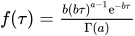
Assume bold-italic beta has a multivariate normal prior with mean vector bold 0 and covariance matrix left-parenthesis g bold upper X prime bold upper X right-parenthesis Superscript negative 1, where bold upper X is the design matrix and g is either a constant or it follows a gamma prior with density f left-parenthesis tau right-parenthesis equals StartFraction b left-parenthesis b tau right-parenthesis Superscript a minus 1 Baseline normal e Superscript minus b tau Baseline Over normal upper Gamma left-parenthesis a right-parenthesis EndFraction where a and b are the SHAPE= and ISCALE= parameters. Let k be the rank of bold upper X. The joint prior density with g being a constant c is given by

p left-parenthesis bold-italic beta right-parenthesis proportional-to c Superscript StartFraction k Over 2 EndFraction Baseline normal e Superscript minus one-half bold-italic beta prime left-parenthesis c bold upper X prime bold upper X right-parenthesis Super Superscript negative 1 Superscript bold-italic beta

The joint prior density with g having a gamma prior is given by

p left-parenthesis bold-italic beta comma tau right-parenthesis proportional-to tau Superscript StartFraction k Over 2 EndFraction Baseline normal e Superscript minus one-half bold-italic beta prime left-parenthesis tau bold upper X prime bold upper X right-parenthesis Super Superscript negative 1 Superscript bold-italic beta Baseline StartFraction b left-parenthesis b tau right-parenthesis Superscript a minus 1 Baseline normal e Superscript minus b tau Baseline Over normal upper Gamma left-parenthesis a right-parenthesis EndFraction
Dispersion Parameter for Frailty Model
Improper Prior

The density is

p left-parenthesis theta right-parenthesis equals StartFraction 1 Over theta EndFraction
Inverse Gamma Prior

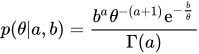
The inverse gamma distribution upper I upper G left-parenthesis a comma b right-parenthesis has a density

p left-parenthesis theta vertical-bar a comma b right-parenthesis equals StartFraction b Superscript a Baseline theta Superscript minus left-parenthesis a plus 1 right-parenthesis Baseline normal e Superscript minus StartFraction b Over theta EndFraction Baseline Over normal upper Gamma left-parenthesis a right-parenthesis EndFraction

where a and b are the SHAPE= and SCALE= parameters, respectively.

Gamma Prior

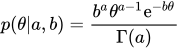
The gamma distribution upper G left-parenthesis a comma b right-parenthesis has a density

p left-parenthesis theta vertical-bar a comma b right-parenthesis equals StartFraction b Superscript a Baseline theta Superscript a minus 1 Baseline normal e Superscript minus b theta Baseline Over normal upper Gamma left-parenthesis a right-parenthesis EndFraction

where a and b are the SHAPE= and ISCALE= parameters, respectively.

Posterior Distribution

Denote the observed data as D.

Cox Model
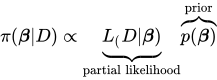
pi left-parenthesis bold-italic beta vertical-bar upper D right-parenthesis proportional-to ModifyingBelow upper L Subscript left-parenthesis Baseline upper D vertical-bar bold-italic beta right-parenthesis With bottom-brace Underscript normal p normal a normal r normal t normal i normal a normal l normal l normal i normal k normal e normal l normal i normal h normal o normal o normal d Endscripts ModifyingAbove p left-parenthesis bold-italic beta right-parenthesis With top-brace Overscript normal p normal r normal i normal o normal r Endscripts
Proportional Hazards Spline Model
StartLayout 1st Row  pi left-parenthesis bold-italic gamma comma bold-italic beta vertical-bar upper D right-parenthesis proportional-to StartLayout Enlarged left-brace 1st Row 1st Column upper L Subscript normal upper R normal upper P Baseline left-parenthesis upper D vertical-bar bold-italic gamma comma bold-italic beta right-parenthesis p left-parenthesis bold-italic gamma comma bold-italic beta right-parenthesis 2nd Column if left-parenthesis gamma prime comma bold-italic beta Superscript prime Baseline right-parenthesis prime tilde MVN 2nd Row 1st Column upper L Subscript normal upper R normal upper P Baseline left-parenthesis upper D vertical-bar bold-italic gamma comma bold-italic beta right-parenthesis p left-parenthesis bold-italic gamma right-parenthesis p left-parenthesis bold-italic beta right-parenthesis 2nd Column otherwise EndLayout EndLayout

where upper L Subscript normal upper R normal upper P is the likelihood function with cubic spline parameters bold-italic gamma and regression coefficients bold-italic beta as parameters.

Frailty Model

Based on the framework of Sargent (1998),
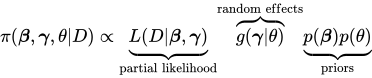
pi left-parenthesis bold-italic beta comma bold-italic gamma comma theta vertical-bar upper D right-parenthesis proportional-to ModifyingBelow upper L left-parenthesis upper D vertical-bar bold-italic beta comma bold-italic gamma right-parenthesis With bottom-brace Underscript normal p normal a normal r normal t normal i normal a normal l normal l normal i normal k normal e normal l normal i normal h normal o normal o normal d Endscripts ModifyingAbove g left-parenthesis bold-italic gamma vertical-bar theta right-parenthesis With top-brace Overscript normal r normal a normal n normal d normal o normal m normal e normal f normal f normal e normal c normal t normal s Endscripts ModifyingBelow p left-parenthesis bold-italic beta right-parenthesis p left-parenthesis theta right-parenthesis With bottom-brace Underscript normal p normal r normal i normal o normal r normal s Endscripts

where the joint density of the random effects bold-italic gamma equals left-parenthesis gamma 1 comma ellipsis comma gamma Subscript s Baseline right-parenthesis prime is given by

g left-parenthesis bold-italic gamma vertical-bar theta right-parenthesis proportional-to StartLayout Enlarged left-brace 1st Row 1st Column product Underscript i Endscripts exp left-parenthesis StartFraction gamma Subscript i Baseline Over theta EndFraction right-parenthesis exp left-parenthesis minus exp left-parenthesis StartFraction gamma Subscript i Baseline Over theta EndFraction right-parenthesis right-parenthesis 2nd Column gamma frailty 2nd Row 1st Column product Underscript i Endscripts exp left-parenthesis minus StartFraction gamma Subscript i Superscript 2 Baseline Over 2 theta EndFraction right-parenthesis 2nd Column lognormal frailty EndLayout
Piecewise Exponential Model
Hazard Parameters

pi left-parenthesis bold-italic lamda comma bold-italic beta vertical-bar upper D right-parenthesis proportional-to upper L Subscript upper H Baseline left-parenthesis upper D vertical-bar bold-italic lamda comma bold-italic beta right-parenthesis p left-parenthesis bold-italic lamda right-parenthesis p left-parenthesis bold-italic beta right-parenthesis

where upper L Subscript upper H Baseline left-parenthesis upper D vertical-bar bold-italic lamda comma bold-italic beta right-parenthesis is the likelihood function with hazards bold-italic lamda and regression coefficients bold-italic beta as parameters.

Log-Hazard Parameters
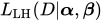
StartLayout 1st Row  pi left-parenthesis bold-italic alpha comma bold-italic beta vertical-bar upper D right-parenthesis proportional-to StartLayout Enlarged left-brace 1st Row 1st Column upper L Subscript normal upper L normal upper H Baseline left-parenthesis upper D vertical-bar bold-italic alpha comma bold-italic beta right-parenthesis p left-parenthesis bold-italic alpha comma bold-italic beta right-parenthesis 2nd Column if left-parenthesis bold-italic alpha prime comma bold-italic beta Superscript prime Baseline right-parenthesis prime tilde MVN 2nd Row 1st Column upper L Subscript normal upper L normal upper H Baseline left-parenthesis upper D vertical-bar bold-italic alpha comma bold-italic beta right-parenthesis p left-parenthesis bold-italic alpha right-parenthesis p left-parenthesis bold-italic beta right-parenthesis 2nd Column otherwise EndLayout EndLayout

where upper L Subscript normal upper L normal upper H Baseline left-parenthesis upper D vertical-bar bold-italic alpha comma bold-italic beta right-parenthesis is the likelihood function with log-hazards bold-italic alpha and regression coefficients bold-italic beta as parameters.

Sampling from the Posterior Distribution

For the Gibbs sampler, PROC PHREG uses the ARMS (adaptive rejection Metropolis sampling) algorithm of Gilks, Best, and Tan (1995) to sample from the full conditionals. This is the default sampling scheme. Alternatively, you can requests the random walk Metropolis (RWM) algorithm to sample an entire parameter vector from the posterior distribution. For a general discussion of these algorithms, see section Markov Chain Monte Carlo Method in Chapter 8, Introduction to Bayesian Analysis Procedures.

You can output these posterior samples into a SAS data set by using the OUTPOST= option in the BAYES statement, or you can use the following SAS statement to output the posterior samples into the SAS data set Post:

 ods output PosteriorSample=Post;

The output data set also includes the variables LogLike and LogPost, which represent the log of the likelihood and the log of the posterior log density, respectively.

Let bold-italic theta equals left-parenthesis theta 1 comma ellipsis comma theta Subscript k Baseline right-parenthesis prime be the parameter vector. For the Cox model, the theta Subscript i’s are the regression coefficients beta Subscript i’s, and for the piecewise constant baseline hazard model, the theta Subscript i’s consist of the baseline hazards lamda Subscript i’s (or log baseline hazards alpha Subscript i’s) and the regression coefficients beta Subscript j’s. Let upper L left-parenthesis upper D vertical-bar bold-italic theta right-parenthesis be the likelihood function, where D is the observed data. Note that for the Cox model, the likelihood contains the infinite-dimensional baseline hazard function, and the gamma process is perhaps the most commonly used prior process (Ibrahim, Chen, and Sinha 2001). However, Sinha, Ibrahim, and Chen (2003) justify using the partial likelihood as the likelihood function for the Bayesian analysis. Let p left-parenthesis bold-italic theta right-parenthesis be the prior distribution. The posterior f pi left-parenthesis bold-italic theta vertical-bar upper D right-parenthesis is proportional to the joint distribution upper L left-parenthesis upper D vertical-bar bold-italic theta right-parenthesis p left-parenthesis bold-italic theta right-parenthesis.

Gibbs Sampler

The full conditional distribution of theta Subscript i is proportional to the joint distribution; that is,

pi left-parenthesis theta Subscript i Baseline vertical-bar theta Subscript j Baseline comma i not-equals j comma upper D right-parenthesis proportional-to upper L left-parenthesis upper D vertical-bar bold-italic theta right-parenthesis p left-parenthesis bold-italic theta right-parenthesis

For example, the one-dimensional conditional distribution of theta 1, given theta Subscript j Baseline equals theta Subscript j Superscript asterisk Baseline comma 2 less-than-or-equal-to j less-than-or-equal-to k, is computed as

pi left-parenthesis theta 1 vertical-bar theta Subscript j Baseline equals theta Subscript j Superscript asterisk Baseline comma 2 less-than-or-equal-to j less-than-or-equal-to k comma upper D right-parenthesis equals upper L left-parenthesis upper D vertical-bar bold-italic theta equals left-parenthesis theta 1 comma theta 2 Superscript asterisk Baseline comma ellipsis comma theta Subscript k Superscript asterisk Baseline right-parenthesis Superscript prime Baseline right-parenthesis p left-parenthesis bold-italic theta equals left-parenthesis theta 1 comma theta 2 Superscript asterisk Baseline comma ellipsis comma theta Subscript k Superscript asterisk Baseline right-parenthesis prime right-parenthesis

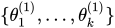
Suppose you have a set of arbitrary starting values StartSet theta 1 Superscript left-parenthesis 0 right-parenthesis Baseline comma ellipsis comma theta Subscript k Superscript left-parenthesis 0 right-parenthesis Baseline EndSet. Using the ARMS algorithm, an iteration of the Gibbs sampler consists of the following:
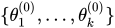
  • draw theta 1 Superscript left-parenthesis 1 right-parenthesis from pi left-parenthesis theta 1 vertical-bar theta 2 Superscript left-parenthesis 0 right-parenthesis Baseline comma ellipsis comma theta Subscript k Superscript left-parenthesis 0 right-parenthesis Baseline comma upper D right-parenthesis

  • draw theta 2 Superscript left-parenthesis 1 right-parenthesis from pi left-parenthesis theta 2 vertical-bar theta 1 Superscript left-parenthesis 1 right-parenthesis Baseline comma theta 3 Superscript left-parenthesis 0 right-parenthesis Baseline comma ellipsis comma theta Subscript k Superscript left-parenthesis 0 right-parenthesis Baseline comma upper D right-parenthesis

  • vertical-ellipsis

  • draw theta Subscript k Superscript left-parenthesis 1 right-parenthesis from pi left-parenthesis theta Subscript k Baseline vertical-bar theta 1 Superscript left-parenthesis 1 right-parenthesis Baseline comma ellipsis comma theta Subscript k minus 1 Superscript left-parenthesis 1 right-parenthesis Baseline comma upper D right-parenthesis

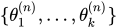
After one iteration, you have StartSet theta 1 Superscript left-parenthesis 1 right-parenthesis Baseline comma ellipsis comma theta Subscript k Superscript left-parenthesis 1 right-parenthesis Baseline EndSet. After n iterations, you have StartSet theta 1 Superscript left-parenthesis n right-parenthesis Baseline comma ellipsis comma theta Subscript k Superscript left-parenthesis n right-parenthesis Baseline EndSet. Cumulatively, a chain of n samples is obtained.

Random Walk Metropolis Algorithm

PROC PHREG uses a multivariate normal proposal distribution q left-parenthesis period vertical-bar bold-italic theta right-parenthesis centered at bold-italic theta. With an initial parameter vector bold-italic theta Superscript left-parenthesis 0 right-parenthesis, a new sample bold-italic theta Superscript left-parenthesis 1 right-parenthesis is obtained as follows:

  • sample bold-italic theta Superscript asterisk from q left-parenthesis period vertical-bar bold-italic theta Superscript left-parenthesis 0 right-parenthesis Baseline right-parenthesis

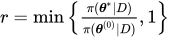
  • calculate the quantity r equals min left-brace StartFraction pi left-parenthesis bold-italic theta Superscript asterisk Baseline vertical-bar upper D right-parenthesis Over pi left-parenthesis bold-italic theta Superscript left-parenthesis 0 right-parenthesis Baseline vertical-bar upper D right-parenthesis EndFraction comma 1 right-brace

  • sample u from the uniform distribution upper U left-parenthesis 0 comma 1 right-parenthesis

  • set bold-italic theta Superscript left-parenthesis 1 right-parenthesis Baseline equals bold-italic theta Superscript asterisk if u less-than r; otherwise set bold-italic theta Superscript left-parenthesis 1 right-parenthesis Baseline equals bold-italic theta Superscript left-parenthesis 0 right-parenthesis

With bold-italic theta Superscript left-parenthesis 1 right-parenthesis taking the role of bold-italic theta Superscript left-parenthesis 0 right-parenthesis, the previous steps are repeated to generate the next sample bold-italic theta Superscript left-parenthesis 2 right-parenthesis. After n iterations, a chain of n samples StartSet bold-italic theta Superscript left-parenthesis 1 right-parenthesis Baseline comma ellipsis comma bold-italic theta Superscript left-parenthesis n right-parenthesis Baseline EndSet is obtained.

Starting Values of the Markov Chains

When the BAYES statement is specified, PROC PHREG generates one Markov chain that contains the approximate posterior samples of the model parameters. Additional chains are produced when the Gelman-Rubin diagnostics are requested. Starting values (initial values) can be specified in the INITIAL= data set in the BAYES statement. If the INITIAL= option is not specified, PROC PHREG picks its own initial values for the chains based on the maximum likelihood estimates of bold-italic theta and the prior information of bold-italic theta.

Denote left-bracket x right-bracket as the integral value of x.

Constant Baseline Hazard Parameters lamda Subscript i’s

For the first chain that the summary statistics and diagnostics are based on, the initial values are

lamda Subscript i Superscript left-parenthesis 0 right-parenthesis Baseline equals ModifyingAbove lamda With caret Subscript i

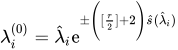
For subsequent chains, the starting values are picked in two different ways according to the total number of chains specified. If the total number of chains specified is less than or equal to 10, initial values of the rth chain (2 less-than-or-equal-to r less-than-or-equal-to 10) are given by

lamda Subscript i Superscript left-parenthesis 0 right-parenthesis Baseline equals ModifyingAbove lamda With caret Subscript i Baseline normal e Superscript plus-or-minus left-parenthesis left-bracket StartFraction r Over 2 EndFraction right-bracket plus 2 right-parenthesis ModifyingAbove s With caret left-parenthesis ModifyingAbove lamda With caret Super Subscript i Superscript right-parenthesis

with the plus sign for odd r and minus sign for even r. If the total number of chains is greater than 10, initial values are picked at random over a wide range of values. Let u Subscript i be a uniform random number between 0 and 1; the initial value for lamda Subscript i is given by

lamda Subscript i Superscript left-parenthesis 0 right-parenthesis Baseline equals ModifyingAbove lamda With caret Subscript i Baseline normal e Superscript 16 left-parenthesis u Super Subscript i Superscript minus 0.5 right-parenthesis ModifyingAbove s With caret left-parenthesis ModifyingAbove lamda With caret Super Subscript i Superscript right-parenthesis
Regression Coefficients and Log-Hazard Parameters theta Subscript i’s

The theta Subscript i’s are the regression coefficients beta Subscript i’s, and in the piecewise exponential model, include the log-hazard parameters alpha Subscript i’s. For the first chain that the summary statistics and regression diagnostics are based on, the initial values are

theta Subscript i Superscript left-parenthesis 0 right-parenthesis Baseline equals ModifyingAbove theta With caret Subscript i

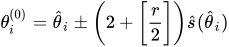
If the number of chains requested is less than or equal to 10, initial values for the rth chain (2 less-than-or-equal-to r less-than-or-equal-to 10) are given by

theta Subscript i Superscript left-parenthesis 0 right-parenthesis Baseline equals ModifyingAbove theta With caret Subscript i Baseline plus-or-minus left-parenthesis 2 plus left-bracket StartFraction r Over 2 EndFraction right-bracket right-parenthesis ModifyingAbove s With caret left-parenthesis ModifyingAbove theta With caret Subscript i Baseline right-parenthesis

with the plus sign for odd r and minus sign for even r. When there are more than 10 chains, the initial value for the theta Subscript i is picked at random over the range left-parenthesis ModifyingAbove theta Subscript i Baseline With caret minus 8 ModifyingAbove s With caret left-parenthesis ModifyingAbove theta Subscript i Baseline With caret right-parenthesis comma ModifyingAbove theta Subscript i Baseline With caret plus 8 ModifyingAbove s With caret left-parenthesis ModifyingAbove theta Subscript i Baseline With caret right-parenthesis right-parenthesis; that is,

theta Subscript i Superscript left-parenthesis 0 right-parenthesis Baseline equals ModifyingAbove theta With caret Subscript i Baseline plus 16 left-parenthesis u Subscript i Baseline minus 0.5 right-parenthesis ModifyingAbove s With caret left-parenthesis ModifyingAbove theta With caret Subscript i Baseline right-parenthesis

where u Subscript i is a uniform random number between 0 and 1.

Fit Statistics

Denote the observed data by D. Let bold-italic theta be the vector of parameters of length k. Let upper L left-parenthesis upper D vertical-bar bold-italic theta right-parenthesis be the likelihood. The deviance information criterion (DIC) proposed in Spiegelhalter et al. (2002) is a Bayesian model assessment tool. Let Devleft-parenthesis bold-italic theta right-parenthesis equals minus 2 log upper L left-parenthesis upper D vertical-bar bold-italic theta right-parenthesis. Let ModifyingAbove normal upper D normal e normal v left-parenthesis theta right-parenthesis With bar and bold-italic theta overbar be the corresponding posterior means of normal upper D normal e normal v left-parenthesis bold-italic theta right-parenthesis and bold-italic theta, respectively. The deviance information criterion is computed as

normal upper D normal upper I normal upper C equals 2 ModifyingAbove normal upper D normal e normal v left-parenthesis bold-italic theta right-parenthesis With bar minus normal upper D normal e normal v left-parenthesis bold-italic theta overbar right-parenthesis

Also computed is

p upper D equals ModifyingAbove normal upper D normal e normal v left-parenthesis bold-italic theta right-parenthesis With bar minus normal upper D normal e normal v left-parenthesis bold-italic theta overbar right-parenthesis

where pD is interpreted as the effective number of parameters.

Note that normal upper D normal e normal v left-parenthesis bold-italic theta right-parenthesis defined here does not have the standardizing term as in the section Deviance Information Criterion (DIC) in Chapter 8, Introduction to Bayesian Analysis Procedures. Nevertheless, the DIC calculated here is still useful for variable selection.

Posterior Distribution for Quantities of Interest

Let bold-italic theta equals left-parenthesis theta 1 comma ellipsis comma theta Subscript k Baseline right-parenthesis prime be the parameter vector. For the Cox model, the theta Subscript i’s are the regression coefficients beta Subscript i’s; for the proportional hazards spline model, the theta Subscript i’s consist of the cubic spline parameters gamma Subscript i’s and the regression coefficients beta Subscript j’s; for the piecewise constant baseline hazard model, the theta Subscript i’s consist of the baseline hazards lamda Subscript i’s (or log baseline hazards alpha Subscript i’s) and the regression coefficients beta Subscript j’s.

Let script upper S equals StartSet bold-italic theta Superscript left-parenthesis r right-parenthesis Baseline comma r equals 1 comma ellipsis comma upper N EndSet be the chain that represents the posterior distribution for bold-italic theta.

Consider a quantity of interest tau that can be expressed as a function f left-parenthesis bold-italic theta right-parenthesis of the parameter vector bold-italic theta. You can construct the posterior distribution of tau by evaluating the function f left-parenthesis bold-italic theta Superscript left-parenthesis r right-parenthesis Baseline right-parenthesis for each bold-italic theta Superscript left-parenthesis r right-parenthesis in script upper S. The posterior chain for tau is StartSet f left-parenthesis bold-italic theta Superscript left-parenthesis r right-parenthesis Baseline right-parenthesis comma r equals 1 comma ellipsis comma upper N EndSet period Summary statistics such as mean, standard deviation, percentiles, and credible intervals are used to describe the posterior distribution of tau.

Hazard Ratio

As shown in the section Hazard Ratios, a log-hazard ratio is a linear combination of the regression coefficients. Let bold h be the vector of linear coefficients. The posterior sample for this hazard ratio is the set StartSet exp left-parenthesis normal h prime bold-italic beta Superscript left-parenthesis r right-parenthesis Baseline right-parenthesis comma r equals 1 comma ellipsis comma upper N EndSet.

Survival Distribution

Let normal x be a covariate vector of interest.

Cox Model

Let StartSet left-parenthesis t Subscript i Baseline comma bold z Subscript i Baseline comma delta Subscript i Baseline right-parenthesis comma i equals 1 comma 2 comma ellipsis comma n EndSet be the observed data. Define

StartLayout 1st Row  upper Y Subscript i Baseline left-parenthesis t right-parenthesis equals StartLayout Enlarged left-brace 1st Row 1st Column 1 2nd Column t less-than t Subscript i Baseline 2nd Row 1st Column 0 2nd Column normal o normal t normal h normal e normal r normal w normal i normal s normal e EndLayout EndLayout

Consider the rth draw bold-italic beta Superscript left-parenthesis r right-parenthesis of script upper S. The baseline cumulative hazard function at time t is given by

upper H 0 left-parenthesis t vertical-bar bold-italic beta Superscript left-parenthesis r right-parenthesis Baseline right-parenthesis equals sigma-summation Underscript i colon t Subscript i Baseline less-than-or-equal-to t Endscripts StartFraction delta Subscript i Baseline Over sigma-summation Underscript l equals 1 Overscript n Endscripts upper Y Subscript l Baseline left-parenthesis t Subscript i Baseline right-parenthesis normal e normal x normal p left-parenthesis bold z prime Subscript l Baseline bold-italic beta Superscript left-parenthesis r right-parenthesis Baseline right-parenthesis EndFraction

For the given covariate vector normal x, the cumulative hazard function at time t is

upper H left-parenthesis t semicolon bold x vertical-bar bold-italic beta Superscript left-parenthesis r right-parenthesis Baseline right-parenthesis equals upper H 0 left-parenthesis t vertical-bar bold-italic beta Superscript left-parenthesis r right-parenthesis Baseline right-parenthesis exp left-parenthesis bold x prime bold-italic beta Superscript left-parenthesis r right-parenthesis Baseline right-parenthesis

and the survival function at time t is

upper S left-parenthesis t semicolon bold x vertical-bar bold-italic beta Superscript left-parenthesis r right-parenthesis Baseline right-parenthesis equals exp left-bracket minus upper H left-parenthesis t semicolon bold x vertical-bar bold-italic beta Superscript left-parenthesis r right-parenthesis Baseline right-parenthesis right-bracket
Proportional Hazards Spline Model

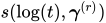
Consider the rth draw bold-italic theta Superscript left-parenthesis r right-parenthesis in script upper S, where bold-italic theta Superscript left-parenthesis r right-parenthesis consists of bold-italic gamma Superscript left-parenthesis r right-parenthesis Baseline equals left-parenthesis gamma 1 Superscript left-parenthesis r right-parenthesis Baseline comma ellipsis comma gamma Subscript upper J Superscript left-parenthesis r right-parenthesis Baseline right-parenthesis prime and bold-italic beta Superscript left-parenthesis r right-parenthesis. The baseline cumulative hazard function at time t is

upper H 0 left-parenthesis t vertical-bar bold-italic gamma Superscript left-parenthesis r right-parenthesis Baseline right-parenthesis equals exp left-bracket s left-parenthesis log left-parenthesis t right-parenthesis comma bold-italic gamma Superscript left-parenthesis r right-parenthesis Baseline right-parenthesis right-bracket

where s left-parenthesis log left-parenthesis t right-parenthesis comma bold-italic gamma Superscript left-parenthesis r right-parenthesis Baseline right-parenthesis is a cubic spline function as described for the SPLINE option in the BAYES statement. For the given covariate vector normal x, the cumulative hazard function at time t is

upper H left-parenthesis t semicolon bold x vertical-bar bold-italic gamma Superscript left-parenthesis r right-parenthesis Baseline comma bold-italic beta Superscript left-parenthesis r right-parenthesis Baseline right-parenthesis equals upper H 0 left-parenthesis t vertical-bar bold-italic gamma Superscript left-parenthesis r right-parenthesis Baseline right-parenthesis exp left-parenthesis bold x prime bold-italic beta Superscript left-parenthesis r right-parenthesis Baseline right-parenthesis

and the survival function at time t is

upper S left-parenthesis t semicolon bold x vertical-bar bold-italic gamma Superscript left-parenthesis r right-parenthesis Baseline comma bold-italic beta Superscript left-parenthesis r right-parenthesis Baseline right-parenthesis equals exp left-bracket minus upper H left-parenthesis t semicolon bold x vertical-bar bold-italic gamma Superscript left-parenthesis r right-parenthesis Baseline comma bold-italic beta Superscript left-parenthesis r right-parenthesis Baseline right-parenthesis right-bracket
Piecewise Exponential Model

Let 0 equals a 0 less-than a 1 less-than ellipsis less-than a Subscript upper J Baseline less-than normal infinity be a partition of the time axis. Consider the rth draw bold-italic theta Superscript left-parenthesis r right-parenthesis in script upper S, where bold-italic theta Superscript left-parenthesis r right-parenthesis consists of bold-italic lamda Superscript left-parenthesis r right-parenthesis Baseline equals left-parenthesis lamda 1 Superscript left-parenthesis r right-parenthesis Baseline comma ellipsis comma lamda Subscript upper J Superscript left-parenthesis r right-parenthesis Baseline right-parenthesis prime and bold-italic beta Superscript left-parenthesis r right-parenthesis. The baseline cumulative hazard function at time t is
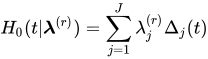
upper H 0 left-parenthesis t vertical-bar bold-italic lamda Superscript left-parenthesis r right-parenthesis Baseline right-parenthesis equals sigma-summation Underscript j equals 1 Overscript upper J Endscripts lamda Subscript j Superscript left-parenthesis r right-parenthesis Baseline normal upper Delta Subscript j Baseline left-parenthesis t right-parenthesis

where

StartLayout 1st Row  normal upper Delta Subscript j Baseline left-parenthesis t right-parenthesis equals StartLayout Enlarged left-brace 1st Row 1st Column 0 2nd Column t less-than a Subscript j minus 1 Baseline 2nd Row 1st Column t minus a Subscript j minus 1 Baseline 2nd Column a Subscript j minus 1 Baseline less-than-or-equal-to t less-than a Subscript j Baseline 3rd Row 1st Column a Subscript j Baseline minus a Subscript j minus 1 Baseline 2nd Column t greater-than-or-equal-to a Subscript j EndLayout EndLayout

For the given covariate vector bold x, the cumulative hazard function at time t is

upper H left-parenthesis t semicolon bold x vertical-bar bold-italic lamda Superscript left-parenthesis r right-parenthesis Baseline comma bold-italic beta Superscript left-parenthesis r right-parenthesis Baseline right-parenthesis equals upper H 0 left-parenthesis t vertical-bar bold-italic lamda Superscript left-parenthesis r right-parenthesis Baseline right-parenthesis exp left-parenthesis bold x prime bold-italic beta Superscript left-parenthesis r right-parenthesis Baseline right-parenthesis

and the survival function at time t is

upper S left-parenthesis t semicolon bold x vertical-bar bold-italic lamda Superscript left-parenthesis r right-parenthesis Baseline comma bold-italic beta Superscript left-parenthesis r right-parenthesis Baseline right-parenthesis equals exp left-bracket minus upper H left-parenthesis t semicolon bold x vertical-bar bold-italic lamda Superscript left-parenthesis r right-parenthesis Baseline comma bold-italic beta Superscript left-parenthesis r right-parenthesis Baseline right-parenthesis right-bracket
Last updated: March 08, 2022