The BGLIMM Procedure
Gamerman Algorithm
The Gamerman algorithm (Gamerman 1997), which is named after the inventor Dani Gamerman, is a special case of the Metropolis algorithm in which the proposal distribution is derived from one iteration of the iterative weighted least squares (IWLS) algorithm. As the name suggests, a weighted least squares algorithm runs inside an iteration loop. For each iteration, a set of weights for the observations is used in the least squares fit. The weights are constructed by applying a weight function to the current residuals. The proposal distribution uses the current iteration’s parameter values to form the proposal distribution from which to generate a proposed random value (Gamerman 1997).
The Gamerman algorithm is suitable for both GLM and GLMM models.
The maximum likelihood (ML) estimator in a GLM and the asymptotic variance are obtained by iterative application of weighted least squares (IWLS) to transformed observations. Following McCullagh and Nelder (1989), define the transformed response as

and define the corresponding weights as

The Gamerman algorithm is summarized as follows:
Start with
 and
and  .
. -
Sample
 from the proposal density
 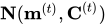 , where
-
Accept
with probability 
where
 is the posterior density and
  and
and  are the transitional probabilities that are based on the proposal density
 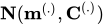 . More specifically, is an
  density that is evaluated at
  , whereas
  and
and  have the same expression as
  and
and  but depend on
  instead of . If is not accepted, the chain stays with .
 Set
 and return to step 1.
PROC BGLIMM uses this algorithm to draw samples for both the fixed-effects parameters  and the random-effects parameters
  : the GLMM simplifies to a GLM when is conditioned on; similarly, for the ith cluster, the model for
  is simplified to a GLM when are treated as known and conditioned on.
For the random-effects block, the same Metropolis-Hastings sampling with the least squares proposal can apply. The conditional posterior is

The transformed response is now  , and the proposal density is
 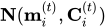 , where
