The CAUSALTRT Procedure

Estimating the Average Treatment Effect for the Treated (ATT)

In some research settings or program evaluation studies, instead of the average treatment effect (ATE), researchers or policy makers might be more interested in the causal treatment effects only for those who choose to participate in the treatment condition. Hence, the average treatment effect for the treated (ATT or ATET) becomes the focus.

The CAUSALTRT procedure enables you to estimate the ATT and the corresponding conditional potential outcome means by using either of the following methods:

  • Inverse probability weighting with ratio adjustment (IPWR). To estimate the ATT, the inverse probability weights that are described in the section Inverse Probability Weighting are multiplied by the predicted propensity scores. The ATT weights are therefore given by

    StartFraction e left-parenthesis bold x Subscript i Baseline right-parenthesis Over probability left-parenthesis upper T equals t Subscript i Baseline vertical-bar bold x Subscript i Baseline right-parenthesis EndFraction equals t Subscript i Baseline plus StartFraction left-parenthesis 1 minus t Subscript i Baseline right-parenthesis e left-parenthesis bold x Subscript i Baseline right-parenthesis Over 1 minus e left-parenthesis bold x Subscript i Baseline right-parenthesis EndFraction

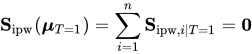
    The estimating equations that are solved by the IPWR estimates for the conditional potential outcome means bold-italic mu Subscript upper T equals 1 are

    bold upper S Subscript normal i normal p normal w Baseline left-parenthesis bold-italic mu Subscript upper T equals 1 Baseline right-parenthesis equals sigma-summation Underscript i equals 1 Overscript n Endscripts bold upper S Subscript normal i normal p normal w comma i vertical-bar upper T equals 1 Baseline equals bold 0

    where

    bold upper S Subscript normal i normal p normal w comma i vertical-bar upper T equals 1 Baseline equals StartBinomialOrMatrix left-parenthesis 1 minus t Subscript i Baseline right-parenthesis left-parenthesis y Subscript i Baseline minus mu Subscript 0 vertical-bar upper T equals 1 Baseline right-parenthesis StartFraction ModifyingAbove e With caret Subscript i Baseline Over 1 minus ModifyingAbove e With caret Subscript i Baseline EndFraction Choose t Subscript i Baseline left-parenthesis y Subscript i Baseline minus mu Subscript 1 vertical-bar upper T equals 1 Baseline right-parenthesis EndBinomialOrMatrix

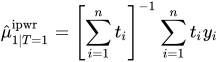
    The IPWR estimates for the conditional potential outcome means bold-italic mu Subscript upper T equals 1 are given by

    ModifyingAbove mu With caret Subscript 0 vertical-bar upper T equals 1 Superscript normal i normal p normal w normal r Baseline equals left-bracket sigma-summation Underscript i equals 1 Overscript n Endscripts left-parenthesis 1 minus t Subscript i Baseline right-parenthesis StartFraction ModifyingAbove e With caret Subscript i Baseline Over 1 minus ModifyingAbove e With caret Subscript i Baseline EndFraction right-bracket Superscript negative 1 Baseline sigma-summation Underscript i equals 1 Overscript n Endscripts left-parenthesis 1 minus t Subscript i Baseline right-parenthesis y Subscript i Baseline StartFraction ModifyingAbove e With caret Subscript i Baseline Over 1 minus ModifyingAbove e With caret Subscript i Baseline EndFraction
    ModifyingAbove mu With caret Subscript 1 vertical-bar upper T equals 1 Superscript normal i normal p normal w normal r Baseline equals left-bracket sigma-summation Underscript i equals 1 Overscript n Endscripts t Subscript i Baseline right-bracket Superscript negative 1 Baseline sigma-summation Underscript i equals 1 Overscript n Endscripts t Subscript i Baseline y Subscript i

    If the propensity score model is correctly specified and the stable unit treatment value assumption (SUTVA), positivity, and no unmeasured confounders assumptions are satisfied, then the predicted conditional means are unbiased estimates for mu Subscript j vertical-bar upper T equals 1.

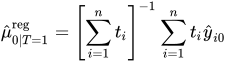
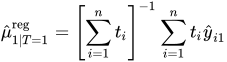
  • Regression adjustment (REGADJ). For this method, PROC CAUSALTRT obtains predicted potential outcomes ModifyingAbove y With caret Subscript i j from the outcome models that are fitted separately for each treatment condition. This approach is described in section Regression Adjustment. To estimate bold-italic mu Subscript upper T equals 1, the predicted values are averaged only for individuals who received treatment. The REGADJ estimates for the conditional potential outcome means bold-italic mu Subscript upper T equals 1 are given by

    ModifyingAbove mu With caret Subscript 0 vertical-bar upper T equals 1 Superscript normal r normal e normal g Baseline equals left-bracket sigma-summation Underscript i equals 1 Overscript n Endscripts t Subscript i Baseline right-bracket Superscript negative 1 Baseline sigma-summation Underscript i equals 1 Overscript n Endscripts t Subscript i Baseline ModifyingAbove y With caret Subscript i Baseline 0
    ModifyingAbove mu With caret Subscript 1 vertical-bar upper T equals 1 Superscript normal r normal e normal g Baseline equals left-bracket sigma-summation Underscript i equals 1 Overscript n Endscripts t Subscript i Baseline right-bracket Superscript negative 1 Baseline sigma-summation Underscript i equals 1 Overscript n Endscripts t Subscript i Baseline ModifyingAbove y With caret Subscript i Baseline 1

    The estimates therefore solve the estimating equations
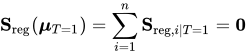
    bold upper S Subscript normal r normal e normal g Baseline left-parenthesis bold-italic mu Subscript upper T equals 1 Baseline right-parenthesis equals sigma-summation Underscript i equals 1 Overscript n Endscripts bold upper S Subscript normal r normal e normal g comma i vertical-bar upper T equals 1 Baseline equals bold 0

    where

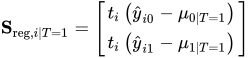
    bold upper S Subscript normal r normal e normal g comma i vertical-bar upper T equals 1 Baseline equals StartBinomialOrMatrix t Subscript i Baseline left-parenthesis ModifyingAbove y With caret Subscript i Baseline 0 Baseline minus mu Subscript 0 vertical-bar upper T equals 1 Baseline right-parenthesis Choose t Subscript i Baseline left-parenthesis ModifyingAbove y With caret Subscript i Baseline 1 Baseline minus mu Subscript 1 vertical-bar upper T equals 1 Baseline right-parenthesis EndBinomialOrMatrix

To request the estimation of the conditional potential outcome means and ATT, specify the ATT option in the PROC CAUSALTRT statement.

Last updated: December 09, 2022