The GAM Procedure
Selection of Smoothing Parameters
CV and GCV
The smoothers discussed here have a single smoothing parameter. In choosing the smoothing parameter, cross validation can be used. Cross validation works by leaving points  out one at a time, estimating the squared residual for smooth function at
  based on the remaining
  data points, and choosing the smoother to minimize the sum of those squared residuals. This mimics the use of training and test samples for prediction. The cross validation function is defined as
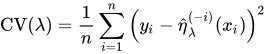
where  indicates the fit at , computed by leaving out the ith data point. The quantity
  is sometimes called the prediction sum of squares, or PRESS (Allen 1974).
All of the smoothers fit by the GAM procedure can be formulated as a linear combination of the sample responses

for some matrix  , which depends on
  . (The matrix depends on x and the sample data as well, but this dependence is suppressed in the preceding equation.) Let
  be the ith diagonal element of . Then the CV function can be expressed as
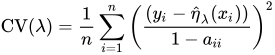
In most cases, it is very time-consuming to compute the quantity individually. To solve this computational problem, Wahba (1990) has proposed the generalized cross validation function (GCV) that can be used to solve a wide variety of problems involving selection of a parameter to minimize the prediction risk.
The GCV function is defined as

The GCV formula simply replaces the with  . Therefore, it can be viewed as a weighted version of CV. In most of the cases of interest, GCV is closely related to CV but much easier to compute. Specify the METHOD=GCV option in the MODEL statement in order to use the GCV function to choose the smoothing parameters.
Degrees of Freedom
The estimated GAM model can be expressed as
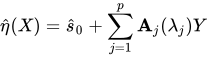
Because the weights are calculated based on previous iteration during the local scoring iteration, the matrices  might depend on Y for non-Gaussian data. However, for the final iteration, the matrix for the spline smoothers has the same role as the projection matrix in linear regression; therefore, nonparametric degrees of freedom (DF) for the jth spline smoother can be defined as

For loess smoothers is not symmetric and so is not a projection matrix. In this case PROC GAM uses

The GAM procedure gives you the option of specifying the degrees of freedom for each individual smoothing component. If you choose a particular value for the degrees of freedom, then during every local scoring iteration the procedure will search for a corresponding smoothing parameter lambda that yields the specified value or comes as close as possible. The final estimate for the smoother during this local scoring iteration will be based on this lambda. Note that for univariate spline and loess components, an additional degree of freedom is used by default to account for the linear portion of the model, so the value displayed in the "Fit Summary" and "Analysis of Deviance" tables will be one less than the value you specify.