The GENMOD Procedure
Bayesian Analysis
In generalized linear models, the response has a probability distribution from a family of distributions of the exponential form. That is, the probability density of the response Y for continuous response variables, or the probability function for discrete responses, can be expressed as

for some functions a, b, and c that determine the specific distribution. The canonical parameters  depend only on the means of the response
  , which are related to the regression parameters
  through the link function
  . The additional parameter
  is the dispersion parameter. The GENMOD procedure estimates the regression parameters and the scale parameter
  by maximum likelihood. However, the GENMOD procedure can also provide Bayesian estimates of the regression parameters and either the scale
  , the dispersion , or the precision
  by sampling from the posterior distribution. Except where noted, the following discussion applies to either , , or
  , although is used to illustrate the formulas. Note that the Poisson and binomial distributions do not have a dispersion parameter, and the dispersion is considered to be fixed at
  . The ASSESS, CONTRAST, ESTIMATE, OUTPUT, and REPEATED statements, if specified, are ignored. Also ignored are the PLOTS= option in the PROC GENMOD statement and the following options in the MODEL statement: ALPHA=, CORRB, COVB, TYPE1, TYPE3, SCALE=DEVIANCE (DSCALE), SCALE=PEARSON (PSCALE), OBSTATS, RESIDUALS, XVARS, PREDICTED, DIAGNOSTICS, and SCALE= for Poisson and binomial distributions. The multinomial and zero-inflated Poisson distributions are not available for Bayesian analysis.
See the section Assessing Markov Chain Convergence in Chapter 8, Introduction to Bayesian Analysis Procedures, for information about assessing the convergence of the chain of posterior samples.
Several algorithms, specified with the SAMPLING= option in the BAYES statement, are available in GENMOD for drawing samples from the posterior distribution.
ARMS Algorithm for Gibbs Sampling
This section provides details for Bayesian analysis by Gibbs sampling in generalized linear models. See the section Gibbs Sampler in Chapter 8, Introduction to Bayesian Analysis Procedures, for a general discussion of Gibbs sampling. See Gilks, Richardson, and Spiegelhalter (1996) for a discussion of applications of Gibbs sampling to a number of different models, including generalized linear models.
Let  be the parameter vector. For generalized linear models, the
  s are the regression coefficients
  s and the dispersion parameter . Let
  be the likelihood function, where D is the observed data. Let
  be the prior distribution. The full conditional distribution of
  is proportional to the joint distribution; that is,

For instance, the one-dimensional conditional distribution of  given
given  , is computed as

Suppose you have a set of arbitrary starting values 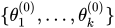 . Using the ARMS (adaptive rejection Metropolis sampling) algorithm (Gilks and Wild 1992; Gilks, Best, and Tan 1995), you can do the following:
draw
 from
from 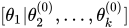
draw
 from
from 

draw
 from
from 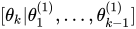
This completes one iteration of the Gibbs sampler. After one iteration, you have 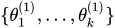 . After n iterations, you have
 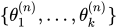 . PROC GENMOD implements the ARMS algorithm provided by Gilks (2003) to draw a sample from a full conditional distribution. See the section Adaptive Rejection Sampling Algorithm in Chapter 8, Introduction to Bayesian Analysis Procedures, for more information about the ARMS algorithm.
Gamerman Algorithm
The Gamerman algorithm, unlike a Gibbs sampling algorithm, samples parameters from their multivariate posterior conditional distribution. The algorithm uses the structure of generalized linear models to efficiently sample from the posterior distribution of the model parameters. For a detailed description and explanation of the algorithm, see Gamerman (1997) and the section Gamerman Algorithm in Chapter 8, Introduction to Bayesian Analysis Procedures. The Gamerman algorithm is the default method used to sample from the posterior distribution. See any of the introductory references in Chapter 8, Introduction to Bayesian Analysis Procedures, for a discussion of conjugate prior distributions for a linear model with the normal distribution.
Independence Metropolis Algorithm
The independence Metropolis algorithm is another sampling algorithm that draws multivariate samples from the posterior distribution. See the section Independence Sampler in Chapter 8, Introduction to Bayesian Analysis Procedures, for more details.
Posterior Samples Output Data Set
You can output posterior samples into a SAS data set through ODS. The following SAS statement outputs the posterior samples into the SAS data set Post:
ODS OUTPUT POSTERIORSAMPLE=Post
You can alternatively create the SAS data set Post with the OUTPOST=Post option in the BAYES statement.
The data set also includes the variables LogPost and LogLike, which represent the log of the posterior likelihood and the log of the likelihood, respectively.
Priors for Model Parameters
The model parameters are the regression coefficients and the dispersion parameter (or the precision or scale), if the model has one. The priors for the dispersion parameter and the priors for the regression coefficients are assumed to be independent, while you can have a joint multivariate normal prior for the regression coefficients.
Dispersion, Precision, or Scale Parameter
Gamma Prior
The gamma distribution  has a probability density function
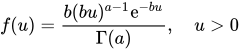
where a is the shape parameter and b is the inverse-scale parameter. The mean is  and the variance is
  .
.
Improper Prior
The joint prior density is given by

Inverse Gamma Prior
The inverse gamma distribution  has a probability density function

where a is the shape parameter and b is the scale parameter. The mean is  if
if  , and the variance is
  if
if  .
.
Regression Coefficients
Let  be the regression coefficients.
Jeffreys’ Prior
The joint prior density is given by
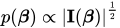
where  is the Fisher information matrix for the model. If the underlying model has a scale parameter (for example, a normal linear regression model), then the Fisher information matrix is computed with the scale parameter set to a fixed value of one.
If you specify the CONDITIONAL option, then Jeffreys’ prior, conditional on the current Markov chain value of the generalized linear model precision parameter , is given by

where is the model precision parameter.
See Ibrahim and Laud (1991) for a full discussion, with examples, of Jeffreys’ prior for generalized linear models.
Normal Prior
Assume has a multivariate normal prior with mean vector  and covariance matrix
  . The joint prior density is given by

If you specify the CONDITIONAL option, then, conditional on the current Markov chain value of the generalized linear model precision parameter , the joint prior density is given by

Uniform Prior
The joint prior density is given by

Deviance Information Criterion
Let be the model parameters at iteration i of the Gibbs sampler and let LL() be the corresponding model log likelihood. PROC GENMOD computes the following fit statistics defined by Spiegelhalter et al. (2002):
-
Effective number of parameters:

-
Deviance information criterion (DIC):

where

PROC GENMOD uses the full log likelihoods defined in the section Log-Likelihood Functions, with all terms included, for computing the DIC.
Posterior Distribution
Denote the observed data by D.
The posterior distribution is

where  is the likelihood function with regression coefficients as parameters.
Starting Values of the Markov Chains
When the BAYES statement is specified, PROC GENMOD generates one Markov chain containing the approximate posterior samples of the model parameters. Additional chains are produced when the Gelman-Rubin diagnostics are requested. Starting values (or initial values) can be specified in the INITIAL= data set in the BAYES statement. If INITIAL= option is not specified, PROC GENMOD picks its own initial values for the chains.
Denote  as the integral value of x. Denote
  as the estimated standard error of the estimator X.
Regression Coefficients
For the first chain that the summary statistics and regression diagnostics are based on, the default initial values are estimates of the mode of the posterior distribution. If the INITIALMLE option is specified, the initial values are the maximum likelihood estimates; that is,

Initial values for the rth chain ( ) are given by
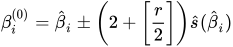
with the plus sign for odd r and minus sign for even r.
Dispersion, Scale, or Precision Parameter 
Let be the generalized linear model parameter you choose to sample, either the dispersion, scale, or precision parameter. Note that the Poisson and binomial distributions do not have this additional parameter.
For the first chain that the summary statistics and regression diagnostics are based on, the default initial values are estimates of the mode of the posterior distribution. If the INITIALMLE option is specified, the initial values are the maximum likelihood estimates; that is,

The initial values of the rth chain () are given by
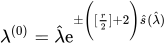
with the plus sign for odd r and minus sign for even r.
OUTPOST= Output Data Set
The OUTPOST= data set contains the generated posterior samples. There are 3+n variables, where n is the number of model parameters. The variable Iteration represents the iteration number, the variable LogLike contains the log of the likelihood, and the variable LogPost contains the log of the posterior. The other n variables represent the draws of the Markov chain for the model parameters.