The GENMOD Procedure
BAYES Statement
BAYES <options> ;
The BAYES statement requests a Bayesian analysis of the regression model by using Gibbs sampling. The Bayesian posterior samples (also known as the chain) for the regression parameters are not tabulated. The Bayesian posterior samples (also known as the chain) for the regression parameters can be output to a SAS data set. Table 2 summarizes the options available in the BAYES statement.
Table 2: BAYES Statement Options
| Option | Description |
|---|---|
| Monte Carlo Options | |
| INITIAL= | Specifies the initial values of the chain |
| INITIALMLE | Specifies that maximum likelihood estimates be used as initial values of the chain |
| METROPOLIS= | Specifies the use of a Metropolis step in the ARMS algorithm |
| NBI= | Specifies the number of burn-in iterations |
| NMC= | Specifies the number of iterations after burn-in |
| SAMPLING= | Specifies the algorithm used to sample the posterior distribution |
| SEED= | Specifies the random number generator seed |
| THINNING= | Controls the thinning of the Markov chain |
| Model and Prior Options | |
| COEFFPRIOR= | Specifies the prior of the regression coefficients |
| DISPERSIONPRIOR= | Specifies the prior of the dispersion parameter |
| PRECISIONPRIOR= | Specifies the prior of the precision parameter |
| SCALEPRIOR= | Specifies the prior of the scale parameter |
| Summary Statistics and Convergence Diagnostics | |
| DIAGNOSTICS= | Displays convergence diagnostics |
| PLOTS= | Displays diagnostic plots |
| STATISTICS= | Displays summary statistics of the posterior samples |
| Posterior Samples | |
| OUTPOST= | Names a SAS data set for the posterior samples |
The following list describes these options and their suboptions.
-
COEFFPRIOR=JEFFREYS<(option)> | NORMAL<(options)> | UNIFORM
COEFF=JEFFREYS<(options)> | NORMAL<(options)> | UNIFORM
CPRIOR=JEFFREYS<(options)> | NORMAL<(options)> | UNIFORM -
specifies the prior distribution for the regression coefficients. The default is COEFFPRIOR=UNIFORM, which specifies the noninformative and improper prior of a constant.
Jeffreys’ prior is specified by COEFFPRIOR=JEFFREYS, which can be followed by the following option in parentheses. Jeffreys’ prior is proportional to
 , where
  is the Fisher information matrix. See the section Jeffreys’ Prior and Ibrahim and Laud (1991) for more details.
 - CONDITIONAL
specifies that the Jeffreys’ prior, conditional on the current Markov chain value of the generalized linear model precision parameter
 , is proportional to
  .
.
The normal prior is specified by COEFFPRIOR=NORMAL, which can be followed by one of the following options enclosed in parentheses. However, if you do not specify an option, the normal prior
 , where
  is the identity matrix, is used. See the section Normal Prior for more details.
 - CONDITIONAL
specifies that the normal prior, conditional on the current Markov chain value of the generalized linear model precision parameter
, is  , where
  and
and  are the mean and covariance of the normal prior specified by other normal options.
 - INPUT=SAS-data-set
-
specifies a SAS data set containing the mean and covariance information of the normal prior. The data set must have a
_TYPE_variable to represent the type of each observation and a variable for each regression coefficient. If the data set also contains a_NAME_variable, the values of this variable are used to identify the covariances for the_TYPE_='COV' observations; otherwise, the_TYPE_='COV' observations are assumed to be in the same order as the explanatory variables in the MODEL statement. PROC GENMOD reads the mean vector from the observation with_TYPE_='MEAN' and reads the covariance matrix from observations with_TYPE_='COV'.For an independent normal prior, specify either variances or a covariance matrix in addition to the means. You can specify the variances in the
_TYPE_='VAR' option, or you can equivalently specify the precisions (inverse of the variances) in the_TYPE_='PRECISION' option. Each variable in the INPUT= data set corresponds to a parameter in the model, and the variable name must match the parameter name. Parameter names can be found in any of the tables (such as the "Initial Values of the Chain" table) in the Bayesian Analysis section of the results. See Example 51.10 for an example. - RELVAR<=c>
specifies the normal prior
 , where
  is a diagonal matrix with diagonal elements equal to the variances of the corresponding ML estimator. By default,
  .
. - VAR<=c>
specifies the normal prior
 , where is the identity matrix.
-
DIAGNOSTICS=ALL | NONE | (keyword-list)
DIAG=ALL | NONE | (keyword-list) -
controls the number of diagnostics produced. You can request all the following diagnostics by specifying DIAGNOSTICS=ALL. If you do not want any of these diagnostics, specify DIAGNOSTICS=NONE. If you want some but not all of the diagnostics, or if you want to change certain settings of these diagnostics, specify a subset of the following keywords. The default is DIAGNOSTICS=(AUTOCORR ESS GEWEKE).
- AUTOCORR <(LAGS= numeric-list)>
computes the autocorrelations of lags given by LAGS= list for each parameter. Elements in the list are truncated to integers and repeated values are removed. If the LAGS= option is not specified, autocorrelations of lags 1, 5, 10, and 50 are computed for each variable. See the section Autocorrelations in Chapter 8, Introduction to Bayesian Analysis Procedures, for details.
- ESS
computes Carlin’s estimate of the effective sample size, the correlation time, and the efficiency of the chain for each parameter. See the section Effective Sample Size in Chapter 8, Introduction to Bayesian Analysis Procedures, for details.
- GELMAN <(gelman-options)>
-
computes the Gelman and Rubin convergence diagnostics. You can specify one or more of the following gelman-options:
See the section Gelman and Rubin Diagnostics in Chapter 8, Introduction to Bayesian Analysis Procedures, for details.
- GEWEKE <(geweke-options)>
-
computes the Geweke spectral density diagnostics, which are essentially a two-sample t test between the first
 portion and the last
  portion of the chain. The default is
  and
and  , but you can choose other fractions by using the following geweke-options:
 - FRAC1=value
specifies the fraction
for the first window. - FRAC2=value
specifies the fraction
for the second window.
See the section Geweke Diagnostics in Chapter 8, Introduction to Bayesian Analysis Procedures, for details.
- HEIDELBERGER <(heidel-options)>
-
computes the Heidelberger and Welch diagnostic for each variable, which consists of a stationarity test of the null hypothesis that the sample values form a stationary process. If the stationarity test is not rejected, a halfwidth test is then carried out. Optionally, you can specify one or more of the following heidel-options:
- SALPHA=value
specifies the
 level
level  for the stationarity test.
 - HALPHA=value
specifies the
level for the halfwidth test. - EPS=value
specifies a positive number
 such that if the halfwidth is less than times the sample mean of the retained iterates, the halfwidth test is passed.
See the section Heidelberger and Welch Diagnostics in Chapter 8, Introduction to Bayesian Analysis Procedures, for details.
-
MCSE
MCERROR computes the Monte Carlo standard error for each parameter. The Monte Caro standard error, which measures the simulation accuracy, is the standard error of the posterior mean estimate and is calculated as the posterior standard deviation divided by the square root of the effective sample size. See the section Standard Error of the Mean Estimate in Chapter 8, Introduction to Bayesian Analysis Procedures, for details.
- RAFTERY<(raftery-options)>
-
computes the Raftery and Lewis diagnostics that evaluate the accuracy of the estimated quantile (
 for a given
  ) of a chain. can achieve any degree of accuracy when the chain is allowed to run for a long time. A stopping criterion is when the estimated probability
  reaches within
  of the value Q with probability S; that is,
  . The following raftery-options enable you to specify
  , and a precision level for the test:
 See the section Raftery and Lewis Diagnostics in Chapter 8, Introduction to Bayesian Analysis Procedures, for details.
-
DISPERSIONPRIOR=GAMMA<(options)> | IGAMMA<(options)> | IMPROPER
DPRIOR=GAMMA<(options)> | IGAMMA<(options)> | IMPROPER -
specifies that Gibbs sampling be performed on the generalized linear model dispersion parameter and the prior distribution for the dispersion parameter, if there is a dispersion parameter in the model. For models that do not have a dispersion parameter (the Poisson and binomial), this option is ignored. Note that you can specify Gibbs sampling on either the dispersion parameter
 , the scale parameter
  , or the precision parameter
  , with the DPRIOR=, SPRIOR=, and PPRIOR= options, respectively. These three parameters are transformations of one another, and you should specify Gibbs sampling for only one of them.
 A gamma prior
 with density
 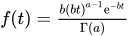 is specified by DISPERSIONPRIOR=GAMMA, which can be followed by one of the following gamma-options enclosed in parentheses. The hyperparameters a and b are the shape and inverse-scale parameters of the gamma distribution, respectively. See the section Gamma Prior for details. The default is
 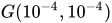 .
. - RELSHAPE<=c>
specifies independent
 distribution, where
  is the MLE of the dispersion parameter. With this choice of hyperparameters, the mean of the prior distribution is and the variance is
  . By default, c=
 .
. -
SHAPE=a
ISCALE=b when both specified, results in a
prior. - SHAPE=c
when specified alone, results in a
 prior.
 - ISCALE=c
when specified alone, results in a
prior.
An inverse gamma prior
 with density
  is specified by DISPERSIONPRIOR=IGAMMA, which can be followed by one of the following inverse gamma options enclosed in parentheses. The hyperparameters a and b are the shape and scale parameters of the inverse gamma distribution, respectively. See the section Inverse Gamma Prior for details. The default is
  .
. - RELSHAPE<=c>
specifies independent
 distribution, where is the MLE of the dispersion parameter. With this choice of hyperparameters, the mean of the prior distribution is . By default, c=.
 -
SHAPE=a
SCALE=b when both specified, results in a
prior. - SHAPE=c
when specified alone, results in an
 prior.
 - SCALE=c
when specified alone, results in an
prior.
An improper prior with density
 proportional to
  is specified with DISPERSIONPRIOR=IMPROPER.
 - INITIAL=SAS-data-set
specifies the SAS data set that contains the initial values of the Markov chains. The INITIAL= data set must contain all the variables of the model. You can specify multiple rows as the initial values of the parallel chains for the Gelman-Rubin statistics, but posterior summaries, diagnostics, and plots are computed only for the first chain. If the data set also contains the variable
_SEED_, the value of the_SEED_variable is used as the seed of the random number generator for the corresponding chain.- INITIALMLE
specifies that maximum likelihood estimates of the model parameters be used as initial values of the Markov chain. If this option is not specified, estimates of the mode of the posterior distribution obtained by optimization are used as initial values.
- METROPOLIS=YES | NO
specifies the use of a Metropolis step to generate Gibbs samples for posterior distributions that are not log concave. The default value is METROPOLIS=YES.
- NBI=number
specifies the number of burn-in iterations before the chains are saved. The default is 2000.
- NMC=number
specifies the number of iterations after the burn-in. The default is 10000.
-
OUTPOST=SAS-data-set
OUT=SAS-data-set -
names the SAS data set that contains the posterior samples. See the sections OUTPOST= Output Data Set and Posterior Samples Output Data Set for more information. Alternatively, you can create the output data set by specifying an ODS OUTPUT statement as follows:
ODS OUTPUT POSTERIORSAMPLE=SAS-data-set
-
PRECISIONPRIOR=GAMMA<(options)> | IMPROPER
PPRIOR=GAMMA<(options)> | IMPROPER -
specifies that Gibbs sampling be performed on the generalized linear model precision parameter and the prior distribution for the precision parameter, if there is a precision parameter in the model. For models that do not have a precision parameter (the Poisson and binomial), this option is ignored. Note that you can specify Gibbs sampling on either the dispersion parameter
, the scale parameter , or the precision parameter , with the DPRIOR=, SPRIOR=, and PPRIOR= options, respectively. These three parameters are transformations of one another, and you should specify Gibbs sampling for only one of them. A gamma prior
with density is specified by PRECISIONPRIOR=GAMMA, which can be followed by one of the following gamma-options enclosed in parentheses. The hyperparameters a and b are the shape and inverse-scale parameters of the gamma distribution, respectively. See the section Gamma Prior for details. The default is . - RELSHAPE<=c>
specifies independent
 distribution, where
  is the MLE of the dispersion parameter. With this choice of hyperparameters, the mean of the prior distribution is and the variance is
  . By default,
  .
. -
SHAPE=a
ISCALE=b when both specified, results in a
prior. - SHAPE=c
when specified alone, results in an
prior. - ISCALE=c
when specified alone, results in an
prior.
An improper prior with density
proportional to is specified with PRECISIONPRIOR=IMPROPER. -
PLOTS<(global-plot-options)>=plot-request
PLOTS<(global-plot-options)>=(plot-request < …plot-request>) -
controls the display of diagnostic plots. Three types of plots can be requested: trace plots, autocorrelation function plots, and kernel density plots. By default, the plots are displayed in panels unless the global-plot-option UNPACK is specified. Also, when you are specifying more than one type of plots, the plots are displayed by parameters unless the global-plot-option GROUPBY is specified. When you specify only one plot-request, you can omit the parentheses around the plot-request. For example:
 plots=none
 plots(unpack)=trace
 plots=(trace autocorr)
ODS Graphics must be enabled before requesting plots. For example, the following SAS statements enable ODS Graphics:
ods graphics on;
proc genmod;
   model y=x;
   bayes plots=trace;
run;
ods graphics off;
The global-plot-options are as follows:
The plot-requests include the following:
- SAMPLING=option
-
specifies an algorithm used to sample the posterior distribution. The following options are available:
-
SCALEPRIOR=GAMMA<(options)> | IMPROPER
SPRIOR=GAMMA<(options)> | IMPROPER -
specifies that Gibbs sampling be performed on the generalized linear model scale parameter and the prior distribution for the scale parameter, if there is a scale parameter in the model. For models that do not have a scale parameter (the Poisson and binomial), this option is ignored. Note that you can specify Gibbs sampling on either the dispersion parameter
, the scale parameter , or the precision parameter , with the DPRIOR=, SPRIOR=, and PPRIOR= options, respectively. These three parameters are transformations of one another, and you should specify Gibbs sampling for only one of them. A gamma prior
with density is specified by SCALEPRIOR=GAMMA, which can be followed by one of the following gamma-options enclosed in parentheses. The hyperparameters a and b are the shape and inverse-scale parameters of the gamma distribution, respectively. See the section Gamma Prior for details. The default is . - RELSHAPE<=c>
specifies independent
 distribution, where
  is the MLE of the dispersion parameter. With this choice of hyperparameters, the mean of the prior distribution is and the variance is
  . By default, .
 -
SHAPE=a
ISCALE=b when both specified, results in a
prior. - SHAPE=c
when specified alone, results in an
prior. - ISCALE=c
when specified alone, results in an
prior.
An improper prior with density
proportional to is specified with SCALEPRIOR=IMPROPER. - SEED=number
specifies an integer seed in the range 1 to
 for the random number generator in the simulation. Specifying a seed enables you to reproduce identical Markov chains for the same specification. If the SEED= option is not specified, or if you specify a nonpositive seed, a random seed is derived from the time of day.
 -
STATISTICS <(global-options)> = ALL | NONE | keyword | (keyword-list)
STATS <(global-options)> = ALL | NONE | keyword | (keyword-list) -
controls the number of posterior statistics produced. Specifying STATISTICS=ALL is equivalent to specifying STATISTICS= (SUMMARY INTERVAL COV CORR). If you do not want any posterior statistics, you specify STATISTICS=NONE. The default is STATISTICS=(SUMMARY INTERVAL). See the section Summary Statistics in Chapter 8, Introduction to Bayesian Analysis Procedures, for details. The global-options include the following:
The list of keywords includes the following:
-
THINNING=number
THIN=number -
controls the thinning of the Markov chain. Only one in every k samples is used when THINNING=k, and if NBI=
 and NMC=n, the number of samples kept is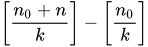
where [a] represents the integer part of the number a. The default is THINNING=1.