The GLIMMIX Procedure

Residual-Based Estimators

The GLIMMIX procedure can compute the classical sandwich estimator of the covariance matrix of the fixed effects, as well as several bias-adjusted estimators. This requires that the model is either an (overdispersed) GLM or a GLMM that can be processed by subjects (see the section Processing by Subjects).

Consider a statistical model of the form

bold upper Y equals bold-italic mu plus bold-italic epsilon comma bold-italic epsilon tilde left-parenthesis bold 0 comma bold upper Sigma right-parenthesis

The general expression of a sandwich covariance estimator is then

c times ModifyingAbove bold upper Omega With caret left-parenthesis sigma-summation Underscript i equals 1 Overscript m Endscripts bold upper A Subscript i Baseline ModifyingAbove bold upper D With caret prime Subscript i Baseline ModifyingAbove bold upper Sigma With caret Subscript i Superscript negative 1 Baseline bold upper F prime Subscript i Baseline bold e Subscript i Baseline bold e prime Subscript i Baseline bold upper F Subscript i Baseline ModifyingAbove bold upper Sigma With caret Subscript i Superscript negative 1 Baseline ModifyingAbove bold upper D With caret Subscript i Baseline bold upper A Subscript i Baseline right-parenthesis ModifyingAbove bold upper Omega With caret

where bold e Subscript i Baseline equals bold y Subscript i Baseline minus ModifyingAbove bold-italic mu With caret Subscript i, bold upper Omega equals left-parenthesis bold upper D prime bold upper Sigma Superscript negative 1 Baseline bold upper D right-parenthesis Superscript minus.

For a GLMM estimated by one of the pseudo-likelihood techniques that involve linearization, you can make the following substitutions: bold upper Y right-arrow bold upper P, bold upper Sigma right-arrow bold upper V left-parenthesis bold-italic theta right-parenthesis, bold upper D right-arrow bold upper X, ModifyingAbove bold-italic mu With caret right-arrow bold upper X ModifyingAbove bold-italic beta With caret. These matrices are defined in the section Pseudo-likelihood Estimation Based on Linearization.

The various estimators computed by the GLIMMIX procedure differ in the choice of the constant c and the matrices bold upper F Subscript i and bold upper A Subscript i. You obtain the classical estimator, for example, with c = 1, and bold upper F Subscript i Baseline equals bold upper A Subscript i equal to the identity matrix.

The EMPIRICAL=ROOT estimator of Kauermann and Carroll (2001) is based on the approximation

normal upper V normal a normal r left-bracket bold e Subscript i Baseline bold e prime Subscript i right-bracket almost-equals left-parenthesis bold upper I minus bold upper H Subscript i Baseline right-parenthesis bold upper Sigma Subscript i

where bold upper H Subscript i Baseline equals bold upper D Subscript i Baseline bold upper Omega bold upper D prime Subscript i Baseline bold upper Sigma Subscript i Superscript negative 1. The EMPIRICAL=FIRORES estimator is based on the approximation

normal upper V normal a normal r left-bracket bold e Subscript i Baseline bold e prime Subscript i right-bracket almost-equals left-parenthesis bold upper I minus bold upper H Subscript i Baseline right-parenthesis bold upper Sigma Subscript i Baseline left-parenthesis bold upper I minus bold upper H prime Subscript i right-parenthesis

of Mancl and DeRouen (2001). Finally, the EMPIRICAL=FIROEEQ estimator is based on approximating an unbiased estimating equation (Fay and Graubard 2001). For this estimator, bold upper A Subscript i is a diagonal matrix with entries

left-bracket bold upper A Subscript i Baseline right-bracket Subscript j j Baseline equals left-parenthesis 1 minus normal m normal i normal n StartSet r comma left-bracket bold upper Q Subscript i Baseline right-bracket Subscript j j Baseline EndSet right-parenthesis Superscript negative 1 slash 2

where bold upper Q Subscript i Baseline equals bold upper D prime Subscript i Baseline ModifyingAbove bold upper Sigma With caret Subscript i Superscript negative 1 Baseline bold upper D Subscript i Baseline ModifyingAbove bold upper Omega With caret. The optional number 0 less-than-or-equal-to r less-than 1 is chosen to provide an upper bound on the correction factor. PROC GLIMMIX chooses as default value r equals 3 slash 4. The diagonal entries of bold upper A Subscript i are then no greater than 2.

Table 26 summarizes the components of the computation for the GLMM based on linearization, where m denotes the number of subjects and k is the rank of bold upper X.

Table 26: Empirical Covariance Estimators for a Linearized GLMM

EMPIRICAL= c bold upper A Subscript i bold upper F Subscript i
CLASSICAL 1 bold upper I bold upper I
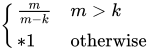
DF StartLayout Enlarged left-brace 1st Row 1st Column StartFraction m Over m minus k EndFraction 2nd Column m greater-than k 2nd Row 1st Column asterisk 1 2nd Column normal o normal t normal h normal e normal r normal w normal i normal s normal e EndLayout bold upper I bold upper I
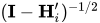
ROOT 1 bold upper I left-parenthesis bold upper I minus bold upper H prime Subscript i right-parenthesis Superscript negative 1 slash 2
FIRORES 1 bold upper I left-parenthesis bold upper I minus bold upper H prime Subscript i right-parenthesis Superscript negative 1
FIROEEQ(r) 1 normal upper D normal i normal a normal g StartSet left-parenthesis 1 minus normal m normal i normal n StartSet r comma left-bracket bold upper Q right-bracket Subscript j j Baseline EndSet right-parenthesis Superscript negative 1 slash 2 Baseline EndSet bold upper I


Computation of an empirical variance estimator requires that the data can be processed by independent sampling units. This is always the case in GLMs. In this case, m equals the sum of all frequencies. In GLMMs, the empirical estimators require that the data consist of multiple subjects. In that case, m equals the number of subjects as per the "Dimensions" table. The following section discusses how the GLIMMIX procedure determines whether the data can be processed by subjects. The section GLM Mode or GLMM Mode explains how PROC GLIMMIX determines whether a model is fit in GLM mode or in GLMM mode.

Last updated: December 09, 2022