The GAMPL Procedure

Model Evaluation Criteria

Given a fixed set of smoothing parameters bold-italic lamda in which each lamda Subscript i controls the smoothness of each spline term, you can fit a generalized additive model by the penalized likelihood estimation. There are infinitely many sets of smoothing parameters. In order to search optimum models, some model evaluation criteria need to be defined to quantify the model goodness-of-fit. The GAMPL procedure uses the following model evaluation criteria:

  • generalized cross validation (GCV), script upper V Subscript g (Craven and Wahba 1979)

  • unbiased risk estimator (UBRE), script upper V Subscript u (Craven and Wahba 1979)

  • generalized approximate cross validation (GACV), script upper V Subscript a (Xiang and Wahba 1996)

Consider the optimization problem

min left-parenthesis bold y minus bold upper X bold-italic beta right-parenthesis prime left-parenthesis bold y minus bold upper X bold-italic beta right-parenthesis plus bold-italic beta prime bold upper S Subscript bold-italic lamda Baseline bold-italic beta with respect to bold-italic beta

The parameter estimate for bold-italic beta can be represented as

ModifyingAbove bold-italic beta With caret equals left-parenthesis bold upper X prime bold upper X plus bold upper S Subscript bold-italic lamda Baseline right-parenthesis Superscript negative 1 Baseline bold upper X prime bold y

And the smoothing matrix (also called the influence matrix or hat matrix) is thus represented as

bold upper H Subscript bold-italic lamda Baseline equals bold upper X left-parenthesis bold upper X prime bold upper X plus bold upper S Subscript bold-italic lamda Baseline right-parenthesis Superscript negative 1 Baseline bold upper X prime

With the defined smoothing matrix, you can form the model evaluation criteria as follows:
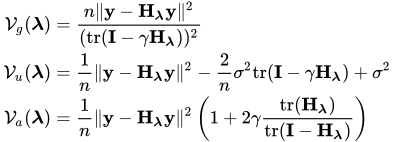
StartLayout 1st Row 1st Column script upper V Subscript g Baseline left-parenthesis bold-italic lamda right-parenthesis 2nd Column equals 3rd Column StartFraction n double-vertical-bar bold y minus bold upper H Subscript bold-italic lamda Baseline bold y double-vertical-bar squared Over left-parenthesis normal t normal r left-parenthesis bold upper I minus gamma bold upper H Subscript bold-italic lamda Baseline right-parenthesis right-parenthesis squared EndFraction 2nd Row 1st Column script upper V Subscript u Baseline left-parenthesis bold-italic lamda right-parenthesis 2nd Column equals 3rd Column StartFraction 1 Over n EndFraction double-vertical-bar bold y minus bold upper H Subscript bold-italic lamda Baseline bold y double-vertical-bar squared minus StartFraction 2 Over n EndFraction sigma squared normal t normal r left-parenthesis bold upper I minus gamma bold upper H Subscript bold-italic lamda Baseline right-parenthesis plus sigma squared 3rd Row 1st Column script upper V Subscript a Baseline left-parenthesis bold-italic lamda right-parenthesis 2nd Column equals 3rd Column StartFraction 1 Over n EndFraction double-vertical-bar bold y minus bold upper H Subscript bold-italic lamda Baseline bold y double-vertical-bar squared left-parenthesis 1 plus 2 gamma StartFraction normal t normal r left-parenthesis bold upper H Subscript bold-italic lamda Baseline right-parenthesis Over normal t normal r left-parenthesis bold upper I minus bold upper H Subscript bold-italic lamda Baseline right-parenthesis EndFraction right-parenthesis EndLayout

In the equations, gamma greater-than-or-equal-to 1 (which corresponds to the GAMMA= suboption of the CRITERION= option) is the tuning parameter that is sometimes used to enforce smoother models.

The GAMPL procedure uses fitting algorithms that involve minimizing the model evaluation criterion with respect to unknown smoothing parameters bold-italic lamda.

Last updated: December 09, 2022

