The HPPLS Procedure
Partial Least Squares
Partial least squares (PLS) works by extracting one factor at a time. Let  be the centered and scaled matrix of predictors, and let
  be the centered and scaled matrix of response values. The PLS method starts with a linear combination
  of the predictors, where
  is called a score vector and
  is its associated weight vector. The PLS method predicts both
  and
and  by regression on :

The vectors  and
and  are called the X- and Y-loadings, respectively.
The specific linear combination is the one that has maximum covariance  with some response linear combination
  . Another characterization is that the X-weight, , and the Y-weight,
  , are proportional to the first left and right singular vectors, respectively, of the covariance matrix
  or, equivalently, the first eigenvectors of
  and
and  , respectively.
This accounts for how the first PLS factor is extracted. The second factor is extracted in the same way by replacing and with the X- and Y-residuals from the first factor:
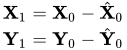
These residuals are also called the deflated  and
and  blocks. The process of extracting a score vector and deflating the data matrices is repeated for as many extracted factors as are wanted.