The HPQUANTSELECT Procedure
Quantile Regression
This section describes the basic concepts and notations for quantile regression and quantile regression model selection.
Let  denote a data set of observations, where
  are responses and
  are regressors. Koenker and Bassett (1978) define the regression quantile at quantile level
  as any solution to the minimization problem
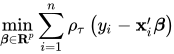
where  is a check loss function in which
  and
and  .
.
If you specify weights  , in the WEIGHT statement, then weighted quantile regression is carried out by solving

The HPQUANTSELECT procedure fits a quantile regression model by using a predictor-corrector interior point algorithm, which was originally designed to solve support vector machine classifiers for large data sets (Gertz and Griffin 2005, 2010).
Last updated: December 09, 2022