The LIFETEST Procedure

Analysis of Competing-Risks Data

Competing risks arise in studies in which individuals are exposed to two or more mutually exclusive failure events, denoted by delta element-of StartSet 1 comma ellipsis comma upper J EndSet. When a failure occurs, you observe the time T and the cause of failure delta. The cumulative incidence function (CIF), also known as the subdistribution function, for failures of cause j is the probability

upper F Subscript j Baseline left-parenthesis t right-parenthesis equals normal upper P normal r left-parenthesis upper T less-than-or-equal-to t comma delta equals j right-parenthesis

The nonparametric analysis of competing-risks data consists of estimating the CIF and comparing the CIFs of two or more groups.

Estimation of the CIF

For a set of competing-risks data with upper J greater-than-or-equal-to 2 causes of failure, let t 1 less-than t 2 less-than midline-horizontal-ellipsis less-than t Subscript upper L be the distinct uncensored times. For each l equals 1 comma ellipsis comma upper L, let upper Y Subscript l be the number of subjects at risk at t Subscript l, and let d Subscript j l be the number of failures of cause j at t Subscript l. Let ModifyingAbove upper S With caret left-parenthesis t right-parenthesis be the Kaplan-Meier estimator that would have been obtained by assuming that all failure causes are of the same type. Denote t 0 equals 0.

The nonparametric maximum likelihood estimator of the CIF of cause j is
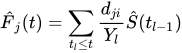
ModifyingAbove upper F With caret Subscript j Baseline left-parenthesis t right-parenthesis equals sigma-summation Underscript t Subscript l Baseline less-than-or-equal-to t Endscripts StartFraction d Subscript j i Baseline Over upper Y Subscript l Baseline EndFraction ModifyingAbove upper S With caret left-parenthesis t Subscript l minus 1 Baseline right-parenthesis

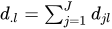
PROC LIFETEST provides two standard error estimators of the CIF estimator: one is based on the theory of counting processes (Aalen 1978), and the other is based on the delta method (Marubini and Valsecchi 1995). You use the ERROR= option in the PROC LIFETEST statement to choose the standard error estimator. The default is the Aalen estimator (ERROR=AALEN). Denote d Subscript period l Baseline equals sigma-summation Underscript j equals 1 Overscript upper J Endscripts d Subscript j l.
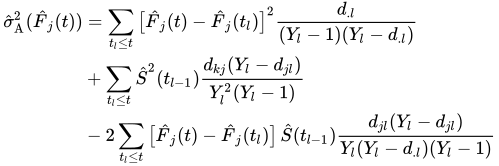
Aalen Estimator
StartLayout 1st Row 1st Column ModifyingAbove sigma With caret Subscript normal upper A Superscript 2 Baseline left-parenthesis ModifyingAbove upper F With caret Subscript j Baseline left-parenthesis t right-parenthesis right-parenthesis 2nd Column equals sigma-summation Underscript t Subscript l Baseline less-than-or-equal-to t Endscripts left-bracket ModifyingAbove upper F With caret Subscript j Baseline left-parenthesis t right-parenthesis minus ModifyingAbove upper F With caret Subscript j Baseline left-parenthesis t Subscript l Baseline right-parenthesis right-bracket squared StartFraction d Subscript period l Baseline Over left-parenthesis upper Y Subscript l Baseline minus 1 right-parenthesis left-parenthesis upper Y Subscript l Baseline minus d Subscript period l Baseline right-parenthesis EndFraction 2nd Row 1st Column Blank 2nd Column plus sigma-summation Underscript t Subscript l Baseline less-than-or-equal-to t Endscripts ModifyingAbove upper S With caret squared left-parenthesis t Subscript l minus 1 Baseline right-parenthesis StartFraction d Subscript k j Baseline left-parenthesis upper Y Subscript l Baseline minus d Subscript j l Baseline right-parenthesis Over upper Y Subscript l Superscript 2 Baseline left-parenthesis upper Y Subscript l Baseline minus 1 right-parenthesis EndFraction 3rd Row 1st Column Blank 2nd Column minus 2 sigma-summation Underscript t Subscript l Baseline less-than-or-equal-to t Endscripts left-bracket ModifyingAbove upper F With caret Subscript j Baseline left-parenthesis t right-parenthesis minus ModifyingAbove upper F With caret Subscript j Baseline left-parenthesis t Subscript l Baseline right-parenthesis right-bracket ModifyingAbove upper S With caret left-parenthesis t Subscript l minus 1 Baseline right-parenthesis StartFraction d Subscript j l Baseline left-parenthesis upper Y Subscript l Baseline minus d Subscript j l Baseline right-parenthesis Over upper Y Subscript l Baseline left-parenthesis upper Y Subscript l Baseline minus d Subscript period l Baseline right-parenthesis left-parenthesis upper Y Subscript l Baseline minus 1 right-parenthesis EndFraction EndLayout
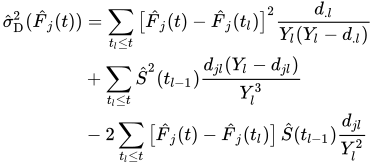
Delta Estimator
StartLayout 1st Row 1st Column ModifyingAbove sigma With caret Subscript normal upper D Superscript 2 Baseline left-parenthesis ModifyingAbove upper F With caret Subscript j Baseline left-parenthesis t right-parenthesis right-parenthesis 2nd Column equals sigma-summation Underscript t Subscript l Baseline less-than-or-equal-to t Endscripts left-bracket ModifyingAbove upper F With caret Subscript j Baseline left-parenthesis t right-parenthesis minus ModifyingAbove upper F With caret Subscript j Baseline left-parenthesis t Subscript l Baseline right-parenthesis right-bracket squared StartFraction d Subscript period l Baseline Over upper Y Subscript l Baseline left-parenthesis upper Y Subscript l Baseline minus d Subscript period l Baseline right-parenthesis EndFraction 2nd Row 1st Column Blank 2nd Column plus sigma-summation Underscript t Subscript l Baseline less-than-or-equal-to t Endscripts ModifyingAbove upper S With caret squared left-parenthesis t Subscript l minus 1 Baseline right-parenthesis StartFraction d Subscript j l Baseline left-parenthesis upper Y Subscript l Baseline minus d Subscript j l Baseline right-parenthesis Over upper Y Subscript l Superscript 3 Baseline EndFraction 3rd Row 1st Column Blank 2nd Column minus 2 sigma-summation Underscript t Subscript l Baseline less-than-or-equal-to t Endscripts left-bracket ModifyingAbove upper F With caret Subscript j Baseline left-parenthesis t right-parenthesis minus ModifyingAbove upper F With caret Subscript j Baseline left-parenthesis t Subscript l Baseline right-parenthesis right-bracket ModifyingAbove upper S With caret left-parenthesis t Subscript l minus 1 Baseline right-parenthesis StartFraction d Subscript j l Baseline Over upper Y Subscript l Superscript 2 Baseline EndFraction EndLayout
Comparison of the CIF of a Competing Risk for Two or More Groups

Let K be the number of groups. Consider failure of type 1 to be the failure type of interest. Let upper F Subscript 1 k be the cumulative incidence function of type 1 in group k. The null hypothesis to be tested is

upper H 0 colon upper F 11 equals upper F 12 equals midline-horizontal-ellipsis equals upper F Subscript 1 upper K Baseline identical-to upper F 1 Superscript 0

Gray (1988, Section 2) gives the following K-sample test procedure for testing upper H 0. Let left-parenthesis upper T Subscript i k Baseline comma delta Subscript i k Baseline right-parenthesis comma i equals 1 comma ellipsis comma n Subscript k Baseline be the observed data in the kth group. Without loss of generality, assume that there are only two types of failure (upper J equals 2). The number of failures of type j by t is

upper N Subscript j k Baseline left-parenthesis t right-parenthesis equals sigma-summation Underscript i equals 1 Overscript n Subscript k Baseline Endscripts upper I left-parenthesis upper T Subscript i k Baseline less-than-or-equal-to t comma delta Subscript i k Baseline equals j right-parenthesis comma j equals 1 comma 2

and the number of subjects at risk just before t in group k is
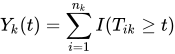
upper Y Subscript k Baseline left-parenthesis t right-parenthesis equals sigma-summation Underscript i equals 1 Overscript n Subscript k Baseline Endscripts upper I left-parenthesis upper T Subscript i k Baseline greater-than-or-equal-to t right-parenthesis

For group k, let ModifyingAbove upper S With caret Subscript k Baseline left-parenthesis t right-parenthesis be the Kaplan-Meier estimator of the survivor function that you obtain by assuming that all failure causes are of the same type. The cumulative incidence function upper F Subscript j k Baseline left-parenthesis t right-parenthesis of type j in the kth group is estimated by

ModifyingAbove upper F With caret Subscript j k Baseline left-parenthesis t right-parenthesis equals integral Subscript 0 Superscript t Baseline ModifyingAbove upper S With caret Subscript k Baseline left-parenthesis u minus right-parenthesis upper Y Subscript k Superscript negative 1 Baseline left-parenthesis u right-parenthesis d upper N Subscript j k Baseline left-parenthesis u right-parenthesis

Let tau Subscript k be the largest uncensored time in group k. Define
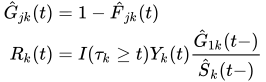
StartLayout 1st Row 1st Column ModifyingAbove upper G With caret Subscript j k Baseline left-parenthesis t right-parenthesis 2nd Column equals 1 minus ModifyingAbove upper F With caret Subscript j k Baseline left-parenthesis t right-parenthesis 2nd Row 1st Column upper R Subscript k Baseline left-parenthesis t right-parenthesis 2nd Column equals upper I left-parenthesis tau Subscript k Baseline greater-than-or-equal-to t right-parenthesis upper Y Subscript k Baseline left-parenthesis t right-parenthesis StartFraction ModifyingAbove upper G With caret Subscript 1 k Baseline left-parenthesis t minus right-parenthesis Over ModifyingAbove upper S With caret Subscript k Baseline left-parenthesis t minus right-parenthesis EndFraction EndLayout

The cumulative hazard of the subdistribution for group k, normal upper Gamma Subscript 1 k, is estimated by

ModifyingAbove normal upper Gamma With caret Subscript 1 k Baseline left-parenthesis t right-parenthesis equals integral Subscript 0 Superscript t Baseline StartFraction d ModifyingAbove upper F With caret Subscript 1 k Baseline left-parenthesis u right-parenthesis Over ModifyingAbove upper G With caret Subscript 1 k Baseline left-parenthesis u minus right-parenthesis EndFraction equals integral Subscript 0 Superscript t Baseline StartFraction d upper N Subscript 1 k Baseline left-parenthesis u right-parenthesis Over upper R Subscript k Baseline left-parenthesis u minus right-parenthesis EndFraction comma t less-than-or-equal-to tau Subscript k Baseline

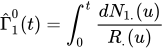
Under the null hypothesis upper H 0, you can estimate the null value of normal upper Gamma Subscript 1 k Baseline left-parenthesis t right-parenthesis, denoted by normal upper Gamma 1 Superscript 0 Baseline left-parenthesis t right-parenthesis, by

ModifyingAbove normal upper Gamma With caret Subscript 1 Superscript 0 Baseline left-parenthesis t right-parenthesis equals integral Subscript 0 Superscript t Baseline StartFraction d upper N 1 period left-parenthesis u right-parenthesis Over upper R Subscript period Baseline left-parenthesis u right-parenthesis EndFraction

The K-sample test is based on bold z equals left-parenthesis z 1 comma ellipsis comma z Subscript upper K Baseline right-parenthesis prime, where

z Subscript k Baseline equals integral Subscript 0 Superscript tau Subscript k Baseline Baseline upper R Subscript k Baseline left-parenthesis t right-parenthesis left-bracket d ModifyingAbove normal upper Gamma With caret Subscript 1 k Baseline left-parenthesis t right-parenthesis minus d ModifyingAbove normal upper Gamma With caret Subscript 1 Superscript 0 Baseline left-parenthesis t right-parenthesis right-bracket

You can estimate the asymptotic covariance matrix normal upper Sigma equals left-parenthesis sigma Subscript k k prime Baseline right-parenthesis as

ModifyingAbove sigma With caret Subscript k k prime Superscript 2 Baseline equals sigma-summation Underscript r equals 1 Overscript upper K Endscripts integral Subscript 0 Superscript tau Subscript k Baseline logical-and tau Subscript k prime Baseline Baseline StartFraction a Subscript k r Baseline left-parenthesis t right-parenthesis a Subscript k prime r Baseline left-parenthesis t right-parenthesis Over ModifyingAbove h With caret Subscript r Baseline left-parenthesis t right-parenthesis EndFraction d ModifyingAbove upper F With caret Subscript 1 Superscript 0 Baseline left-parenthesis t right-parenthesis plus sigma-summation Underscript r equals 1 Overscript upper K Endscripts integral Subscript 0 Superscript tau Subscript k Baseline logical-and tau Subscript k prime Baseline Baseline StartFraction b Subscript 2 k r Baseline left-parenthesis t right-parenthesis b Subscript 2 k prime r Baseline left-parenthesis t right-parenthesis Over ModifyingAbove h With caret Subscript r Baseline left-parenthesis t right-parenthesis EndFraction d ModifyingAbove upper F With caret Subscript 2 r Baseline left-parenthesis t right-parenthesis

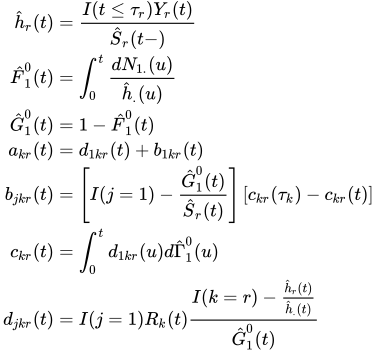
where

StartLayout 1st Row 1st Column ModifyingAbove h With caret Subscript r Baseline left-parenthesis t right-parenthesis 2nd Column equals 3rd Column StartFraction upper I left-parenthesis t less-than-or-equal-to tau Subscript r Baseline right-parenthesis upper Y Subscript r Baseline left-parenthesis t right-parenthesis Over ModifyingAbove upper S With caret Subscript r Baseline left-parenthesis t minus right-parenthesis EndFraction 2nd Row 1st Column ModifyingAbove upper F With caret Subscript 1 Superscript 0 Baseline left-parenthesis t right-parenthesis 2nd Column equals 3rd Column integral Subscript 0 Superscript t Baseline StartFraction d upper N 1 period left-parenthesis u right-parenthesis Over ModifyingAbove h With caret Subscript period Baseline left-parenthesis u right-parenthesis EndFraction 3rd Row 1st Column ModifyingAbove upper G With caret Subscript 1 Superscript 0 Baseline left-parenthesis t right-parenthesis 2nd Column equals 3rd Column 1 minus ModifyingAbove upper F With caret Subscript 1 Superscript 0 Baseline left-parenthesis t right-parenthesis 4th Row 1st Column a Subscript k r Baseline left-parenthesis t right-parenthesis 2nd Column equals 3rd Column d Subscript 1 k r Baseline left-parenthesis t right-parenthesis plus b Subscript 1 k r Baseline left-parenthesis t right-parenthesis 5th Row 1st Column b Subscript j k r Baseline left-parenthesis t right-parenthesis 2nd Column equals 3rd Column left-bracket upper I left-parenthesis j equals 1 right-parenthesis minus StartFraction ModifyingAbove upper G With caret Subscript 1 Superscript 0 Baseline left-parenthesis t right-parenthesis Over ModifyingAbove upper S With caret Subscript r Baseline left-parenthesis t right-parenthesis EndFraction right-bracket left-bracket c Subscript k r Baseline left-parenthesis tau Subscript k Baseline right-parenthesis minus c Subscript k r Baseline left-parenthesis t right-parenthesis right-bracket 6th Row 1st Column c Subscript k r Baseline left-parenthesis t right-parenthesis 2nd Column equals 3rd Column integral Subscript 0 Superscript t Baseline d Subscript 1 k r Baseline left-parenthesis u right-parenthesis d ModifyingAbove normal upper Gamma With caret Subscript 1 Superscript 0 Baseline left-parenthesis u right-parenthesis 7th Row 1st Column d Subscript j k r Baseline left-parenthesis t right-parenthesis 2nd Column equals 3rd Column upper I left-parenthesis j equals 1 right-parenthesis upper R Subscript k Baseline left-parenthesis t right-parenthesis StartStartFraction upper I left-parenthesis k equals r right-parenthesis minus StartFraction ModifyingAbove h With caret Subscript r Baseline left-parenthesis t right-parenthesis Over ModifyingAbove h With caret Subscript period Baseline left-parenthesis t right-parenthesis EndFraction OverOver ModifyingAbove upper G With caret Subscript 1 Superscript 0 Baseline left-parenthesis t right-parenthesis EndEndFraction EndLayout

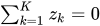
Because sigma-summation Underscript k equals 1 Overscript upper K Endscripts z Subscript k Baseline equals 0, only upper K minus 1 scores are linearly independent. The K-sample test statistic is formed as a quadratic form of the first upper K minus 1 components of bold z and the inverse of the estimated covariance matrix. Under the null hypothesis upper H 0, this K-sample test statistic has approximately a chi-square distribution with upper K minus 1 degrees of freedom.

If you specify the GROUP= option in the STRATA statement, you can obtain a stratified version of the test by computing the contributions to z Subscript k and sigma Subscript k k prime Superscript 2 for each stratum, summing the contributions over the strata, and proceeding as before.

Last updated: December 09, 2022