The LIFETEST Procedure
PROC LIFETEST Statement
PROC LIFETEST <options>;
The PROC LIFETEST statement invokes the LIFETEST procedure. Optionally, this statement identifies an input data set and an output data set, and specifies the computation details of the survivor function estimation. Table 1 summarizes the options available in the PROC LIFETEST statement. These options are described in alphabetic order.
ODS Graphics is the preferred method of creating graphs. Many new features have been added to the ODS Graphics plots. For example, you can display the number of subjects at risk in a survival plot. For information about ODS Graphics options, see the PLOTS= option.
If no plotting options are specified, PROC LIFETEST displays a table that shows the product-limit estimate of the survivor function. If ODS Graphics is enabled, PROC LIFETEST also displays a plot of the estimated survivor function. Other options for displaying the estimated survivor function are documented in the section Plot Options Superseded by ODS Graphics.
Table 1: Options Available in the PROC LIFETEST Statement
| Option | Description |
|---|---|
| Input and Output Data Sets | |
| DATA= | Specifies the input SAS data set |
| OUTCIF= | Names an output data set to contain cumulative incidence function (CIF) estimates |
| OUTSURV= | Names an output data set to contain survivor function estimates |
| OUTTEST= | Names an output data set to contain rank test statistics for association of survival time with covariates |
| Nonparametric Estimation | |
| ERROR= | Specifies the variance method of the CIF estimator |
| INTERVALS= | Specifies interval endpoints for life-table estimates |
| NELSON | Adds the Nelson-Aalen estimates |
| METHOD= | Specifies the method to compute survivor function |
| NINTERVAL= | Specifies the number of intervals for life-table estimates |
| RMST | Performs the restricted mean survival time (RMST) analysis |
| RMTL | Performs the restricted mean time lost (RMTL) analysis |
| WIDTH= | Specifies the width of intervals for life-table estimates |
| Confidence Limits for Survivorship | |
| ALPHA= | Sets the confidence level for interval estimation estimates |
| BANDMAXTIME= | Specifies the maximum time for confidence band |
| BANDMINTIME= | Specifies the minimum time for confidence band |
| CONFBAND= | Specifies the type of confidence band in the OUTSURV= data set |
| CONFTYPE= | Specifies the transformation applied to the survivor function to obtain confidence limits |
| ODS Graphics | |
| MAXTIME= | Specifies the maximum time value for plotting |
| PLOTS= | Specifies plots to display |
| Control Output | |
| ATRISK | Adds the number of subjects at risk to the survival estimate table |
| INTERVALS= | Displays only the estimate for the smallest time in each interval |
| NOLEFT | Suppresses the Number Left and Number Event columns in the survival estimate table |
| NOPRINT | Suppresses the display of printed output |
| NOTABLE | Suppresses the display of survival function estimates |
| REDUCEOUT | Lists only INTERVALS= or TIMELIST= observations in the OUTSURV= data set |
| TIMELIST= | Lists the time points at which to display the survival estimate |
| Miscellaneous | |
| ALPHAQT= | Sets the confidence level for survival time quartiles |
| CIFVAR | Displays the variance of the CIF estimator |
| MISSING | Allows missing values to be a stratum level |
| SINGULAR= | Sets the tolerance for testing singularity of covariance matrix of rank statistics |
| STDERR | Outputs the standard error for the survival estimators to the OUTSURV= data set |
| TIMELIM= | Specifies the time limit used to estimate the mean survival time and its standard error |
-
ALPHA=

specifies the level of significance
for the  % confidence intervals for the survivor, hazard, and density functions. For example, the option ALPHA=0.05 requests the 95% confidence limits for the survivor function. The default value is 0.05.
 -
ALPHAQT=
specifies the significance level
for the % confidence intervals for the quartiles of the survival time. For example, the option ALPHAQT=0.05 requests a 95% confidence interval for the quartiles of the survival time. The default value is 0.05. - ATRISK
adds a column that represents the number of subjects at risk to the survival estimate table. Also added is a column that represents the number of events at each observed time. This option has no effect for the life-table method.
-
BANDMAXTIME=value
BANDMAX=value specifies the maximum time for the confidence bands. The default is the largest observed event time. If the specified BANDMAX= time exceeds the largest observed event time, it is truncated to the largest observed event time.
-
BANDMINTIME=value
BANDMIN=value specifies the minimum time for the confidence bands. The default is the smallest observed event time. For the equal-precision band, if the BANDMIN= value is less than the smallest observed event time, it is defaulted to the smallest observed event time.
- CIFVAR
displays the variance of the cumulative incidence function (CIF) estimator for competing-risks data. By default, PROC LIFETEST displays the standard error of the CIF estimator.
- CONFBAND=keyword
-
specifies the confidence bands to be output to the OUTSURV= data set. Confidence bands are available for METHOD=KM, METHOD=BRESLOW, or METHOD=FH. You can use the following keywords:
- CONFTYPE=keyword
-
specifies the transformation applied to
 to obtain the pointwise confidence intervals and the confidence bands for the survivor function in addition to the confidence intervals for the quartiles of the survival times. The following keywords can be used; the default is CONFTYPE=LOGLOG.
 - ASINSQRT
-
the arcsine-square root transformation,

- LOGLOG
-

This is also referred to as the log cumulative hazard transformation since it applies the logarithmic function to the cumulative hazard function. Collett (1994) and Lachin (2000) refer to it as the complementary log-log transformation.
- LINEAR
-

- LOG
-
the logarithmic transformation,

- LOGIT
-
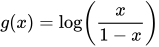
- DATA=SAS-data-set
names the SAS data set used by PROC LIFETEST. By default, the most recently created SAS data set is used.
- ERROR=AALEN | DELTA
specifies the method of calculating the variance of the CIF estimator. When ERROR=AALEN, the variance estimator is based on the theory of counting process (Aalen 1978). When ERROR=DELTA, the delta method is used to compute the variance. By default, ERROR=AALEN. For more information, see the section Estimation of the CIF.
- INTERVALS=values
-
specifies a list of interval endpoints for the life-table method. These endpoints must all be nonnegative numbers. The initial interval is assumed to start at zero whether or not zero is specified in the list. Each interval contains its lower endpoint but does not contain its upper endpoint. When this option is used with METHOD=KM, METHOD=BRESLOW, or METHOD=FH, it reduces the number of survival estimates displayed by showing only the estimates for the smallest time within each specified interval. The INTERVALS= option can be specified in any of the following ways:
 a list separated by blanks
 INTERVALS=1 3 5 7 a list separated by commas INTERVALS=1,3,5,7 x to y INTERVALS=1 to 7 x to y BY z INTERVALS=1 to 7 by 1 a combination of the above INTERVALS=1,3 to 5,7For example, the specification
intervals=5,10 to 30 by 10produces the set of intervals

- MAXTIME=value
specifies the maximum value of the time variable allowed on the plots so that outlying points do not determine the scale of the time axis of the plots. This option affects only the displayed plots and has no effect on any calculations.
- METHOD=type
-
specifies the method to be used to compute the survival function estimates. Valid values for type are as follows:
By default, METHOD=KM.
- MISSING
treats missing values as valid values for the stratum variables. By default, PROC LIFETEST does not use observations that have a missing value in any stratum variables. For more information, see the section Missing Values.
-
NELSON
AALEN produces the Nelson-Aalen estimates of the cumulative hazards and the corresponding standard errors. This option is ignored if METHOD=LT is specified.
- NINTERVAL=value
specifies the number of intervals used to compute the life-table estimates of the survivor function. This parameter is overridden by the WIDTH= option or the INTERVALS= option. When you specify the NINTERVAL= option, PROC LIFETEST tries to find an interval that results in round numbers for the endpoints. Consequently, the number of intervals can be different from the number requested. Use the INTERVALS= option to control the interval endpoints. The default is NINTERVAL=10.
- NOLEFT
suppresses the Number Left and Number Event columns in the survival estimate table. This option has no effect for the life-table estimate.
- NOPRINT
suppresses the display of output. This option is useful when only an output data set is needed. It temporarily disables the Output Delivery System (ODS); For more information about ODS, see Chapter 23, Using the Output Delivery System.
- NOTABLE
suppresses the display of survival function estimates. Only the number of censored and event times, plots, and test results is displayed.
- OUTCIF=SAS-data-set
creates an output SAS data set to contain the point and interval estimates for the cumulative incidence function (CIF). The data set also contains the number of subjects at risk, the number of events of interest, and the number of events of all types. For more information about the contents of the OUTCIF= data set, see the section OUTCIF= Data Set.
-
OUTSURV=SAS-data-set
OUTS=SAS-data-set creates an output SAS data set to contain the estimates of the survival function and corresponding confidence limits for all strata. For more information about the contents of the OUTSURV= data set, see the section OUTSURV= Data Set.
-
OUTTEST=SAS-data-set
OUTT=SAS-data-set creates an output SAS data set to contain the overall chi-square test statistic for association with failure time for the variables in the TEST statement, the values of the univariate rank test statistics for each variable in the TEST statement, and the estimated covariance matrix of the univariate rank test statistics. For more information about the contents of the OUTTEST= data set, see the section OUTTEST= Data Set.
- RMST<(options)>
-
performs the analysis of the restricted mean survival time (RMST). You can specify the following options:
- RMTL<(options)>
-
performs the analysis of the restricted mean time lost (RMTL). You can specify the following options:
-
PLOTS<(global-plot-options)>=plot-request <(options)>
PLOTS<(global-plot-options)>=(plot-request <(options)> <…plot-request <(options)>>) -
controls the plots produced using ODS Graphics. When you specify only one plot-request, you can omit the parentheses around the plot-request. Here are some examples:
plots=none
plots=(survival(atrisk=100 to 350 by 50) logsurv)
plots(only)=hazard
ODS Graphics must be enabled before plots can be requested. For example:
ods graphics on;

proc lifetest plots=survival(atrisk);
   time T*Status(0);
run;

ods graphics off;
For more information about enabling and disabling ODS Graphics, see the section Enabling and Disabling ODS Graphics in Chapter 24, Statistical Graphics Using ODS.
If ODS Graphics is enabled but you do not specify the PLOTS= option, PROC LIFETEST produces a plot of the survivor function estimates, unless you use the FAILCODE option in the TIME statement to stipulate a competing-risks analysis. In such a case, PROC LIFETEST creates a plot of the cumulative incidence function (CIF) estimates.
You can specify the following global-plot-option:
The plot-requests and plot-request options include the following.
- ALL
produces all appropriate plots. For METHOD=KM, METHOD=BRESLOW, or METHOD=FH, specifying PLOTS=ALL is equivalent to specifying PLOTS=(SURVIVAL LOGSURV LOGLOGS); for the life-table method, specifying PLOTS=ALL is equivalent to specifying PLOTS=(SURVIVAL LOGSURV LOGLOGS DENSITY HAZARD). For a competing-risks analysis, specifying PLOTS=ALL is equivalent to specifying PLOTS=CIF.
- CIF<(cif-options)>
-
plots the cumulative incidence function (CIF) estimates. If you specify a STRATA statement without the GROUP= option, PROC LIFETEST overlays the cumulative incidence curves of the strata in the same plot. If you specify a STRATA statement with the GROUP= option, PROC LIFETEST produces a panel plot, with one cell per stratum, and each cell contains the cumulative incidence curves for the groups within the given stratum.
You can specify the following cif-options:
-
HAZARD <(hazard-options)>
H <hazard-options> -
plots the estimated hazard functions. Kernel-smoothed estimates are produced for METHOD=KM, METHOD=BRESLOW, or METHOD=FH. You can specify the following hazard-options, but only the CL option can be used for the life-table method:
-
BANDWIDTH=bandwidth-option
BW=bandwidth-option -
specifies what bandwidth is chosen for the kernel-smoothing and how it is chosen. You can specify one of the following bandwidth-options.
See the section Optimal Bandwidth for details about the mean integrated squared error. If the BANDWIDTH= option is not specified, the default is BANDWIDTH= RANGE(0.2b,20b), where
 ,
,  and
and  are the values of the GRIDL= and GRIDU= options, respectively, and n is the total number of noncensored observations.
 - CL
displays the pointwise confidence limits for the smoothed hazard.
- GRIDL=number
specifies the lower grid limit for the kernel-smoothed estimate. The default value is the time origin.
- GRIDU=number
specifies the upper grid limit for the kernel-smoothed estimate. The default value equals the maximum event time.
- KERNEL=kernel-option
-
specifies the kernel used. You can specify the following kernel-options:
-
BIWEIGHT
BW 
-
EPANECHNIKOV
E 
-
UNIFORM
U 
By default, KERNEL=EPANECHNIKOV.
-
BIWEIGHT
- NGRID=number
specifies the number of grid points. By default, NGRID=101.
- NMINGRID=number
specifies the number of grid points that are used in determining the mean integrated square error (MISE). By default, NMINGRID=51.
-
BANDWIDTH=bandwidth-option
-
LOGLOGS
LLS plots the log of negative log of estimated survivor functions versus the log of time.
-
LOGSURV
LS plots the negative log of estimated survivor functions versus time.
- NONE
suppresses all plots.
-
PDF <(CL)>
P <(CL)> plots the estimated probability density functions (life-table method only). Pointwise confidence limits are displayed optionally by specifying the CL option.
- RMST<CL>
plots the restricted mean survival time (RMST) versus
 values. If you specify a STRATA statement without the GROUP= option, PROC LIFETEST overlays the RMST curves of the strata in the same plot. If you specify a STRATA statement with the GROUP= option, the procedure produces a panel plot that has one cell per stratum, and each cell contains the RMST curves for the groups within the given stratum. The CL option displays pointwise confidence limits for the RMST.
 - RMTL<CL>
plots the restricted mean survival time (RMTL) versus
values. If you specify a STRATA statement without the GROUP= option, PROC LIFETEST overlays the RMTL curves of the strata in the same plot. If you specify a STRATA statement with the GROUP= option, the procedure produces a panel plot that has one cell per stratum, and each cell contains the RMTL curves for the groups within the given stratum. The CL option displays pointwise confidence limits for the RMTL. -
SURVIVAL <(survival-options)>
S <(survival-options)> -
plots the estimated survivor functions. Censored times are plotted as a plus sign on the Kaplan-Meier, Breslow, or Fleming-Harrington survival curves unless the NOCENSOR option is specified. You can customize the display by using the following survival-options. If these options are not sufficient for your purposes, you can customize the survival plot by modifying its graph template. (For more information, see the section Modifying the Survival Plots.)
- REDUCEOUT
specifies that the OUTSURV= data set contain only those observations that are included in the INTERVALS= or TIMELIST= option. This option has no effect if the OUTSURV= option is not specified. It also has no effect if neither the INTERVALS= option nor the TIMELIST= option is specified.
- SINGULAR=value
specifies the tolerance for testing singularity of the covariance matrix for the rank test statistics. The test requires that a pivot for sweeping a covariance matrix be at least this number times a norm of the matrix. The default value is 1E–12.
- STDERR
specifies that the standard error of the survivor function (SDF_STDERR) be output to the OUTSURV= data set. If the life-table method is used, the standard error of the density function (PDF_STDERR) and the standard error of the hazard function (HAZ_STDERR) are also output.
- TIMELIM=time-limit
-
specifies the time limit used in the estimation of the mean survival time and its standard error. The mean survival time can be shown to be the area under the Kaplan-Meier survival curve. However, if the largest observed time in the data is censored, the area under the survival curve is not a closed area. In such a situation, you can choose a time limit L and estimate the mean survival curve limited to a time L (Lee 1992, pp. 72–76). This option is ignored if the largest observed time is an event time. Valid time-limit values are as follows:
- TIMELIST=number-list
specifies a list of time points at which the Kaplan-Meier estimates are displayed. The time points are listed in the column labeled
Timelist. Since the Kaplan-Meier survival curve is a decreasing step function, each given time point falls in an interval that has a constant survival estimate. The event time that corresponds to the beginning of the time interval is displayed along with its survival estimate.- WIDTH=value
sets the width of the intervals used in the life-table calculation of the survival function. This parameter is overridden by the INTERVALS= option.