The LOGISTIC Procedure
Confidence Intervals for Parameters
There are two methods of computing confidence intervals for the regression parameters. One is based on the profile-likelihood function, and the other is based on the asymptotic normality of the parameter estimators. The latter is not as time-consuming as the former, because it does not involve an iterative scheme; however, it is not thought to be as accurate as the former, especially with small sample size. You use the CLPARM= option to request confidence intervals for the parameters.
Likelihood Ratio-Based Confidence Intervals
The likelihood ratio-based confidence interval is also known as the profile-likelihood confidence interval. The construction of this interval is derived from the asymptotic  distribution of the generalized likelihood ratio test (Venzon and Moolgavkar 1988). Suppose that the parameter vector is
  and you want to compute a confidence interval for
  . The profile-likelihood function for
  is defined as
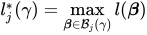
where  is the set of all
  with the jth element fixed at
  , and
, and  is the log-likelihood function for . (The penalized log-likelihood function is used when you specify the FIRTH option in the MODEL statement.) If
  is the log likelihood evaluated at the maximum likelihood estimate
  , then
 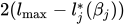 has a limiting chi-square distribution with one degree of freedom if is the true parameter value. Let
  , where
  is the
  th percentile of the chi-square distribution with one degree of freedom. A % confidence interval for is
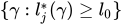
The endpoints of the confidence interval are found by solving numerically for values of that satisfy equality in the preceding relation. To obtain an iterative algorithm for computing the confidence limits, the log-likelihood function in a neighborhood of is approximated by the quadratic function

where  is the gradient vector and
  is the Hessian matrix. The increment
  for the next iteration is obtained by solving the likelihood equations

where  is the Lagrange multiplier,
  is the jth unit vector, and is an unknown constant. The solution is

By substituting this into the equation 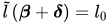 , you can estimate as
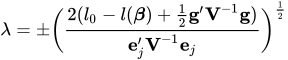
The upper confidence limit for  is computed by starting at the maximum likelihood estimate of and iterating with positive values of until convergence is attained. The process is repeated for the lower confidence limit by using negative values of .
Convergence is controlled by the value  specified with the PLCONV= option in the MODEL statement (the default value of is 1E–4). Convergence is declared on the current iteration if the following two conditions are satisfied:

and

Wald Confidence Intervals
Wald confidence intervals are sometimes called the normal confidence intervals. They are based on the asymptotic normality of the parameter estimators. The % Wald confidence interval for is given by
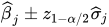
where  is the 100pth percentile of the standard normal distribution,
  is the maximum likelihood estimate of , and
  is the standard error estimate of .