The MI Procedure
Monotone and FCS Predictive Mean Matching Methods
The predictive mean matching method is also an imputation method available for continuous variables. It is similar to the regression method except that for each missing value, it imputes a value randomly from a set of observed values whose predicted values are closest to the predicted value for the missing value from the simulated regression model (Heitjan and Little 1991; Schenker and Taylor 1996).
Following the description of the model in the section Monotone and FCS Regression Methods, the following steps are used to generate imputed values:
-
New parameters
 and
and  are drawn from the posterior predictive distribution of the parameters. That is, they are simulated from
  ,
,  , and
, and  . The variance is drawn as
where g is a
 random variate and
  is the number of nonmissing observations for
  . The regression coefficients are drawn as
where
 is the upper triangular matrix in the Cholesky decomposition,
 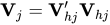 , and
, and  is a vector of
  independent random normal variates.
 -
For each missing value, a predicted value

is computed with the covariate values
 .
. A set of
 observations whose corresponding predicted values are closest to
  is generated. You can specify with the K= option.
 The missing value is then replaced by a value drawn randomly from these
observed values.
The predictive mean matching method requires the number of closest observations to be specified. A smaller tends to increase the correlation among the multiple imputations for the missing observation and results in a higher variability of point estimators in repeated sampling. On the other hand, a larger tends to lessen the effect from the imputation model and results in biased estimators (Schenker and Taylor 1996, p. 430).
The predictive mean matching method ensures that imputed values are plausible; it might be more appropriate than the regression method if the normality assumption is violated (Horton and Lipsitz 2001, p. 246).