The NPAR1WAY Procedure
Scores for Linear Rank and One-Way ANOVA Tests
For each score type that you specify, PROC NPAR1WAY computes a one-way ANOVA statistic and also a linear rank statistic for two-sample data. The following score types are used primarily to test for differences in location: Wilcoxon, median, Van der Waerden (normal), and Savage. The following scores types are used to test for scale differences: Siegel-Tukey, Ansari-Bradley, Klotz, and Mood. Conover scores can be used to test for differences in both location and scale. This section gives formulas for the score types available in PROC NPAR1WAY. For further information about the formulas and the applicability of each score, see Randles and Wolfe (1979), Gibbons and Chakraborti (2010), Conover (1999), and Hollander and Wolfe (1999).
In addition to the score types described in this section, you can specify the SCORES=DATA option to use the input data observations as scores. This enables you to produce a wide variety of tests. You can construct any scores by using the DATA step, and then you can use PROC NPAR1WAY to compute the corresponding linear rank and one-way ANOVA tests for these scores. You can also analyze raw (unscored) data by using the SCORES=DATA option; for two-sample data, the corresponding exact test is a permutation test that is known as Pitman’s test.
Wilcoxon Scores
Wilcoxon scores are the ranks of the observations, which can be written as

where  is the rank of observation j, and
  is the score of observation j.
Using Wilcoxon scores in the linear rank statistic for two-sample data produces the rank sum statistic of the Mann-Whitney-Wilcoxon test. Using Wilcoxon scores in the one-way ANOVA statistic produces the Kruskal-Wallis test. Wilcoxon scores are locally most powerful for location shifts of a logistic distribution.
When computing the asymptotic Wilcoxon two-sample test, PROC NPAR1WAY uses a continuity correction by default, as described in the section Continuity Correction. If you specify the CORRECT=NO option in the PROC NPAR1WAY statement, the procedure does not use a continuity correction.
Median Scores
Median scores equal 1 for observations greater than the median, and 0 otherwise. In terms of the observation ranks, median scores are defined as

Using median scores in the linear rank statistic for two-sample data produces the two-sample median test. Using median scores in the one-way ANOVA statistic for multisample data produces the Brown-Mood test. Median scores are particularly powerful for distributions that are symmetric and heavy-tailed.
Van der Waerden (Normal) Scores
Van der Waerden scores are the quantiles of a standard normal distribution and are also known as quantile normal scores. Van der Waerden scores are computed as
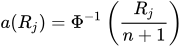
where  is the cumulative distribution function of a standard normal distribution. These scores are powerful for normal distributions.
Savage Scores
Savage scores are expected values of order statistics from the exponential distribution, with 1 subtracted to center the scores around 0. Savage scores are computed as
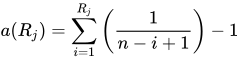
Savage scores are powerful for comparing scale differences in exponential distributions or location shifts in extreme value distributions (Hajek 1969, p. 83).
Siegel-Tukey Scores
Siegel-Tukey scores are defined as

where the score values continue to increase in this pattern toward the middle ranks until all observations have been assigned a score.
When computing the asymptotic Siegel-Tukey two-sample test, PROC NPAR1WAY uses a continuity correction by default, as described in the section Continuity Correction. If you specify the CORRECT=NO option in the PROC NPAR1WAY statement, the procedure does not use a continuity correction.
Ansari-Bradley Scores
Ansari-Bradley scores are similar to Siegel-Tukey scores, but Ansari-Bradley scoring assigns the same score value to corresponding extreme ranks. (Siegel-Tukey scores are a permutation of the ranks  .) Ansari-Bradley scores are defined as
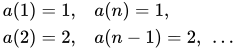
Equivalently, Ansari-Bradley scores are equal to

Klotz Scores
Klotz scores are the squares of the Van der Waerden (normal) scores. Klotz scores are computed as
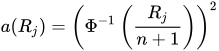
where is the cumulative distribution function of a standard normal distribution.
Mood Scores
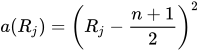
Mood scores are computed as the square of the difference between the observation rank and the average rank. Mood scores can be written as
Conover Scores
Conover scores are based on the squared ranks of the absolute deviations from the sample means. For observation j the absolute deviation from the mean is computed as

where  is the value of observation j, observation j belongs to sample i, and
  is the mean of sample i. The values of
  are ranked, and the Conover score for observation j is computed as

Following Conover (1999), when there are ties among the values of , PROC NPAR1WAY assigns the average rank to each of the tied observations. To compute the average rank, PROC NPAR1WAY first ranks the as if there were no ties and then averages the ranks of the tied observations.
The Conover score test is also known as the squared ranks test for variances. For more information, see Conover (1999).