The NPAR1WAY Procedure
Fligner-Policello Test
If you specify the FP option, PROC NPAR1WAY computes the Fligner-Policello location test for two-sample data (Fligner and Policello 1981). The null hypothesis for the test is  , where
  and
and  are the population medians of the two classes. The Fligner-Policello test assumes that the distribution in each class is symmetric around the class median, but it does not require that the two class distributions have the same form or that the class variances be equal. For more information, see Hollander and Wolfe (1999) and Juneau (2007).
The Fligner-Policello test is based on placement scores (Orban and Wolfe 1979).
The placement of an observation  from class X,
  , is defined as the number of observations in class Y that are less than . If there are ties, the placement of is adjusted by adding half the number of observations in class Y that are equal to . The placement of an observation
  from class Y,
  , is defined in the same way. The placements can be expressed as
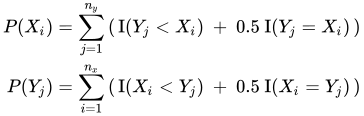
where  is an indicator function and
  and
and  denote the number of observations in class X and class Y, respectively.
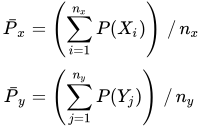
The average placements for class X and class Y are computed as
The Fligner-Policello test statistic is computed as

where
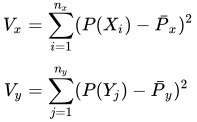
and the standard deviation of the placements is 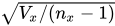 for class X and
 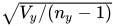 for class Y.
Under the null hypothesis, the Fligner-Policello statistic has an asymptotic standard normal distribution. PROC NPAR1WAY provides one- and two-sided asymptotic p-values for the Fligner-Policello test. For the one-sided test, PROC NPAR1WAY displays the right-sided p-value when the test statistic z is greater than its null hypothesis expected value of 0. PROC NPAR1WAY displays the left-sided p-value when the test statistic z is less than or equal to 0. The one-sided p-value  can be expressed as

where Z has a standard normal distribution. The two-sided p-value  is computed as Prob(|Z| > |z|).
When you specify the FP option, PROC NPAR1WAY displays a "Fligner-Policello Placements" table and a "Fligner-Policello Test" table. The "Fligner-Policello Placements" table contains the following information for each of the two classes: number of observations, sum of the placements, average placement, and standard deviation of the placements. The "Fligner-Policello Test" table contains the test statistic z and the corresponding one- and two-sided p-values. This table also displays the difference between the class placement sums, which is the numerator of the test statistic. When ODS Graphics is enabled and you specify the FP or PLOTS=FPBOXPLOT option, PROC NPAR1WAY provides a box plot of the Fligner-Policello placements.
PROC NPAR1WAY computes the Fligner-Policello difference (the numerator of the test statistic) as the placement sum for class Y minus the placement sum for class X (the reference class). By default, PROC NPAR1WAY uses the larger of the two classes as the reference class X. If both classes have the same number of observations, PROC NPAR1WAY uses the class that appears second in the "Fligner-Policello Placements" table as the reference class. (By default, the table displays class levels in the order in which they appear in the input data set. If you specify the ORDER=FORMATTED option, the table displays class levels in order of their formatted value.)
You can specify the reference class by using the FP(REFCLASS=) option. REFCLASS=1 specifies the first class that is listed in the "Fligner-Policello Placements" table, and REFCLASS=2 specifies the second class. REFCLASS='class-value' identifies the reference class by the formatted value of the CLASS variable.