The POWER Procedure

Analyses in the TWOSAMPLEMEANS Statement

Two-Sample t Test Assuming Equal Variances (TEST=DIFF)

The hypotheses for the two-sample t test are
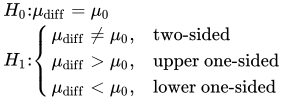
StartLayout 1st Row 1st Column upper H 0 colon 2nd Column mu Subscript normal d normal i normal f normal f Baseline equals mu 0 2nd Row 1st Column upper H 1 colon 2nd Column StartLayout Enlarged left-brace 1st Row 1st Column mu Subscript normal d normal i normal f normal f Baseline not-equals mu 0 comma 2nd Column two hyphen sided 2nd Row 1st Column mu Subscript normal d normal i normal f normal f Baseline greater-than mu 0 comma 2nd Column upper one hyphen sided 3rd Row 1st Column mu Subscript normal d normal i normal f normal f Baseline less-than mu 0 comma 2nd Column lower one hyphen sided EndLayout EndLayout

The test assumes normally distributed data and common standard deviation per group, and it requires upper N greater-than-or-equal-to 3, n 1 greater-than-or-equal-to 1, and n 2 greater-than-or-equal-to 1. The test statistics are

StartLayout 1st Row 1st Column t 2nd Column equals upper N Superscript one-half Baseline left-parenthesis w 1 w 2 right-parenthesis Superscript one-half Baseline left-parenthesis StartFraction x overbar Subscript 2 Baseline minus x overbar Subscript 1 Baseline minus mu 0 Over s Subscript p Baseline EndFraction right-parenthesis tilde t left-parenthesis upper N minus 2 comma delta right-parenthesis 2nd Row 1st Column t squared 2nd Column tilde upper F left-parenthesis 1 comma upper N minus 2 comma delta squared right-parenthesis EndLayout

where x overbar Subscript 1 and x overbar Subscript 2 are the sample means and s Subscript p is the pooled standard deviation, and

delta equals upper N Superscript one-half Baseline left-parenthesis w 1 w 2 right-parenthesis Superscript one-half Baseline left-parenthesis StartFraction mu Subscript normal d normal i normal f normal f Baseline minus mu 0 Over sigma EndFraction right-parenthesis

The test is

Reject upper H 0 if StartLayout Enlarged left-brace 1st Row 1st Column t squared greater-than-or-equal-to upper F Subscript 1 minus alpha Baseline left-parenthesis 1 comma upper N minus 2 right-parenthesis comma 2nd Column two hyphen sided 2nd Row 1st Column t greater-than-or-equal-to t Subscript 1 minus alpha Baseline left-parenthesis upper N minus 2 right-parenthesis comma 2nd Column upper one hyphen sided 3rd Row 1st Column t less-than-or-equal-to t Subscript alpha Baseline left-parenthesis upper N minus 2 right-parenthesis comma 2nd Column lower one hyphen sided EndLayout

Exact power computations for t tests are given in O’Brien and Muller (1993, Section 8.2.1):

StartLayout 1st Row 1st Column normal p normal o normal w normal e normal r 2nd Column equals StartLayout Enlarged left-brace 1st Row 1st Column upper P left-parenthesis upper F left-parenthesis 1 comma upper N minus 2 comma delta squared right-parenthesis greater-than-or-equal-to upper F Subscript 1 minus alpha Baseline left-parenthesis 1 comma upper N minus 2 right-parenthesis right-parenthesis comma 2nd Column two hyphen sided 2nd Row 1st Column upper P left-parenthesis t left-parenthesis upper N minus 2 comma delta right-parenthesis greater-than-or-equal-to t Subscript 1 minus alpha Baseline left-parenthesis upper N minus 2 right-parenthesis right-parenthesis comma 2nd Column upper one hyphen sided 3rd Row 1st Column upper P left-parenthesis t left-parenthesis upper N minus 2 comma delta right-parenthesis less-than-or-equal-to t Subscript alpha Baseline left-parenthesis upper N minus 2 right-parenthesis right-parenthesis comma 2nd Column lower one hyphen sided EndLayout EndLayout

Solutions for N, n 1, n 2, alpha, and delta are obtained by numerically inverting the power equation. Closed-form solutions for other parameters, in terms of delta, are as follows:

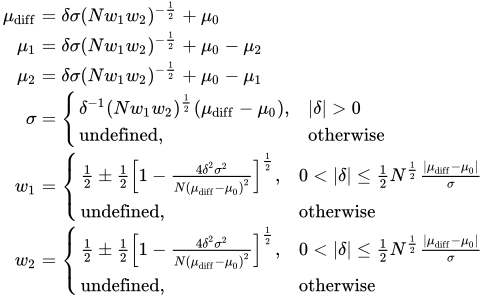
StartLayout 1st Row 1st Column mu Subscript normal d normal i normal f normal f 2nd Column equals delta sigma left-parenthesis upper N w 1 w 2 right-parenthesis Superscript negative one-half Baseline plus mu 0 2nd Row 1st Column mu 1 2nd Column equals delta sigma left-parenthesis upper N w 1 w 2 right-parenthesis Superscript negative one-half Baseline plus mu 0 minus mu 2 3rd Row 1st Column mu 2 2nd Column equals delta sigma left-parenthesis upper N w 1 w 2 right-parenthesis Superscript negative one-half Baseline plus mu 0 minus mu 1 4th Row 1st Column sigma 2nd Column equals StartLayout Enlarged left-brace 1st Row 1st Column delta Superscript negative 1 Baseline left-parenthesis upper N w 1 w 2 right-parenthesis Superscript one-half Baseline left-parenthesis mu Subscript normal d normal i normal f normal f Baseline minus mu 0 right-parenthesis comma 2nd Column StartAbsoluteValue delta EndAbsoluteValue greater-than 0 2nd Row 1st Column undefined comma 2nd Column otherwise EndLayout 5th Row 1st Column w 1 2nd Column equals StartLayout Enlarged left-brace 1st Row 1st Column one-half plus-or-minus one-half left-bracket 1 minus StartFraction 4 delta squared sigma squared Over upper N left-parenthesis mu Subscript normal d normal i normal f normal f Baseline minus mu 0 right-parenthesis squared EndFraction right-bracket Superscript one-half Baseline comma 2nd Column 0 less-than StartAbsoluteValue delta EndAbsoluteValue less-than-or-equal-to one-half upper N Superscript one-half Baseline StartFraction StartAbsoluteValue mu Subscript normal d normal i normal f normal f Baseline minus mu 0 EndAbsoluteValue Over sigma EndFraction 2nd Row 1st Column undefined comma 2nd Column otherwise EndLayout 6th Row 1st Column w 2 2nd Column equals StartLayout Enlarged left-brace 1st Row 1st Column one-half plus-or-minus one-half left-bracket 1 minus StartFraction 4 delta squared sigma squared Over upper N left-parenthesis mu Subscript normal d normal i normal f normal f Baseline minus mu 0 right-parenthesis squared EndFraction right-bracket Superscript one-half Baseline comma 2nd Column 0 less-than StartAbsoluteValue delta EndAbsoluteValue less-than-or-equal-to one-half upper N Superscript one-half Baseline StartFraction StartAbsoluteValue mu Subscript normal d normal i normal f normal f Baseline minus mu 0 EndAbsoluteValue Over sigma EndFraction 2nd Row 1st Column undefined comma 2nd Column otherwise EndLayout EndLayout

Finally, here is a derivation of the solution for w 1:

Solve the delta equation for w 1 (which requires the quadratic formula). Then determine the range of delta given w 1:

StartLayout 1st Row 1st Column min Underscript w 1 Endscripts left-parenthesis delta right-parenthesis 2nd Column equals StartLayout Enlarged left-brace 1st Row 1st Column 0 comma 2nd Column when w 1 equals 0 or 1 comma if left-parenthesis mu Subscript normal d normal i normal f normal f Baseline minus mu 0 right-parenthesis greater-than-or-equal-to 0 2nd Row 1st Column one-half upper N Superscript one-half Baseline StartFraction left-parenthesis mu Subscript normal d normal i normal f normal f Baseline minus mu 0 right-parenthesis Over sigma EndFraction comma 2nd Column when w 1 equals one-half comma if left-parenthesis mu Subscript normal d normal i normal f normal f Baseline minus mu 0 right-parenthesis less-than 0 EndLayout 2nd Row 1st Column max Underscript w 1 Endscripts left-parenthesis delta right-parenthesis 2nd Column equals StartLayout Enlarged left-brace 1st Row 1st Column 0 comma 2nd Column when w 1 equals 0 or 1 comma if left-parenthesis mu Subscript normal d normal i normal f normal f Baseline minus mu 0 right-parenthesis less-than 0 2nd Row 1st Column one-half upper N Superscript one-half Baseline StartFraction left-parenthesis mu Subscript normal d normal i normal f normal f Baseline minus mu 0 right-parenthesis Over sigma EndFraction comma 2nd Column when w 1 equals one-half comma if left-parenthesis mu Subscript normal d normal i normal f normal f Baseline minus mu 0 right-parenthesis greater-than-or-equal-to 0 EndLayout EndLayout

This implies

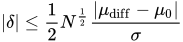
StartAbsoluteValue delta EndAbsoluteValue less-than-or-equal-to one-half upper N Superscript one-half Baseline StartFraction StartAbsoluteValue mu Subscript normal d normal i normal f normal f Baseline minus mu 0 EndAbsoluteValue Over sigma EndFraction
Two-Sample Satterthwaite t Test Assuming Unequal Variances (TEST=DIFF_SATT)

The hypotheses for the two-sample Satterthwaite t test are

StartLayout 1st Row 1st Column upper H 0 colon 2nd Column mu Subscript normal d normal i normal f normal f Baseline equals mu 0 2nd Row 1st Column upper H 1 colon 2nd Column StartLayout Enlarged left-brace 1st Row 1st Column mu Subscript normal d normal i normal f normal f Baseline not-equals mu 0 comma 2nd Column two hyphen sided 2nd Row 1st Column mu Subscript normal d normal i normal f normal f Baseline greater-than mu 0 comma 2nd Column upper one hyphen sided 3rd Row 1st Column mu Subscript normal d normal i normal f normal f Baseline less-than mu 0 comma 2nd Column lower one hyphen sided EndLayout EndLayout

The test assumes normally distributed data and requires upper N greater-than-or-equal-to 3, n 1 greater-than-or-equal-to 1, and n 2 greater-than-or-equal-to 1. The test statistics are

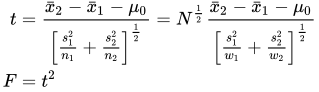
StartLayout 1st Row 1st Column t 2nd Column equals StartFraction x overbar Subscript 2 Baseline minus x overbar Subscript 1 Baseline minus mu 0 Over left-bracket StartFraction s 1 squared Over n 1 EndFraction plus StartFraction s 2 squared Over n 2 EndFraction right-bracket Superscript one-half Baseline EndFraction equals upper N Superscript one-half Baseline StartFraction x overbar Subscript 2 Baseline minus x overbar Subscript 1 Baseline minus mu 0 Over left-bracket StartFraction s 1 squared Over w 1 EndFraction plus StartFraction s 2 squared Over w 2 EndFraction right-bracket Superscript one-half Baseline EndFraction 2nd Row 1st Column upper F 2nd Column equals t squared EndLayout

where x overbar Subscript 1 and x overbar Subscript 2 are the sample means and s 1 and s 2 are the sample standard deviations.

DiSantostefano and Muller (1995, p. 585) state, the test is based on assuming that under upper H 0, F is distributed as upper F left-parenthesis 1 comma nu right-parenthesis, where nu is given by Satterthwaite’s approximation (Satterthwaite 1946),

nu equals StartStartFraction left-bracket StartFraction sigma 1 squared Over n 1 EndFraction plus StartFraction sigma 2 squared Over n 2 EndFraction right-bracket squared OverOver StartFraction left-bracket StartFraction sigma 1 squared Over n 1 EndFraction right-bracket squared Over n 1 minus 1 EndFraction plus StartFraction left-bracket StartFraction sigma 2 squared Over n 2 EndFraction right-bracket squared Over n 2 minus 1 EndFraction EndEndFraction equals StartStartFraction left-bracket StartFraction sigma 1 squared Over w 1 EndFraction plus StartFraction sigma 2 squared Over w 2 EndFraction right-bracket squared OverOver StartFraction left-bracket StartFraction sigma 1 squared Over w 1 EndFraction right-bracket squared Over upper N w 1 minus 1 EndFraction plus StartFraction left-bracket StartFraction sigma 2 squared Over w 2 EndFraction right-bracket squared Over upper N w 2 minus 1 EndFraction EndEndFraction

Since nu is unknown, in practice it must be replaced by an estimate
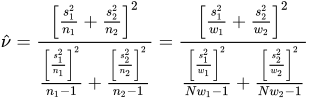
ModifyingAbove nu With caret equals StartStartFraction left-bracket StartFraction s 1 squared Over n 1 EndFraction plus StartFraction s 2 squared Over n 2 EndFraction right-bracket squared OverOver StartFraction left-bracket StartFraction s 1 squared Over n 1 EndFraction right-bracket squared Over n 1 minus 1 EndFraction plus StartFraction left-bracket StartFraction s 2 squared Over n 2 EndFraction right-bracket squared Over n 2 minus 1 EndFraction EndEndFraction equals StartStartFraction left-bracket StartFraction s 1 squared Over w 1 EndFraction plus StartFraction s 2 squared Over w 2 EndFraction right-bracket squared OverOver StartFraction left-bracket StartFraction s 1 squared Over w 1 EndFraction right-bracket squared Over upper N w 1 minus 1 EndFraction plus StartFraction left-bracket StartFraction s 2 squared Over w 2 EndFraction right-bracket squared Over upper N w 2 minus 1 EndFraction EndEndFraction

So the test is

Reject upper H 0 if StartLayout Enlarged left-brace 1st Row 1st Column upper F greater-than-or-equal-to upper F Subscript 1 minus alpha Baseline left-parenthesis 1 comma ModifyingAbove nu With caret right-parenthesis comma 2nd Column two hyphen sided 2nd Row 1st Column t greater-than-or-equal-to t Subscript 1 minus alpha Baseline left-parenthesis ModifyingAbove nu With caret right-parenthesis comma 2nd Column upper one hyphen sided 3rd Row 1st Column t less-than-or-equal-to t Subscript alpha Baseline left-parenthesis ModifyingAbove nu With caret right-parenthesis comma 2nd Column lower one hyphen sided EndLayout

Exact solutions for power for the two-sided and upper one-sided cases are given in Moser, Stevens, and Watts (1989). The lower one-sided case follows easily by using symmetry. The equations are as follows:
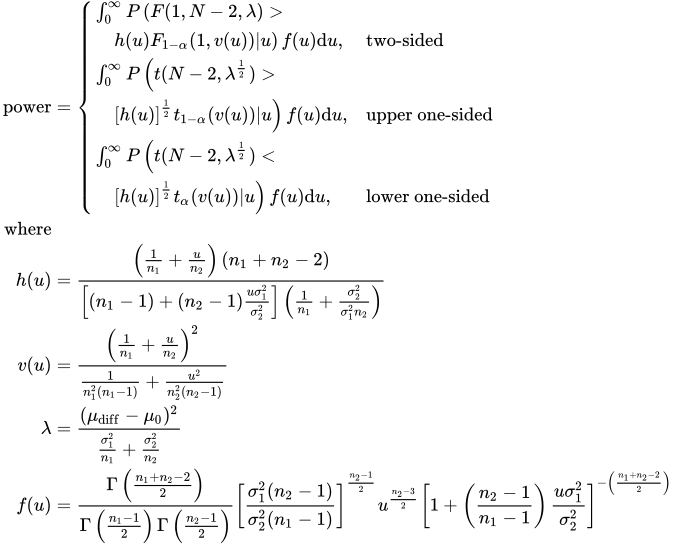
StartLayout 1st Row 1st Column normal p normal o normal w normal e normal r 2nd Column equals StartLayout Enlarged left-brace 1st Row 1st Column integral Subscript 0 Superscript normal infinity Baseline upper P left-parenthesis upper F left-parenthesis 1 comma upper N minus 2 comma lamda right-parenthesis greater-than 2nd Row 1st Column h left-parenthesis u right-parenthesis upper F Subscript 1 minus alpha Baseline left-parenthesis 1 comma v left-parenthesis u right-parenthesis right-parenthesis vertical-bar u right-parenthesis f left-parenthesis u right-parenthesis normal d u comma 2nd Column two hyphen sided 3rd Row 1st Column integral Subscript 0 Superscript normal infinity Baseline upper P left-parenthesis t left-parenthesis upper N minus 2 comma lamda Superscript one-half Baseline right-parenthesis greater-than 4th Row 1st Column left-bracket h left-parenthesis u right-parenthesis right-bracket Superscript one-half Baseline t Subscript 1 minus alpha Baseline left-parenthesis v left-parenthesis u right-parenthesis right-parenthesis vertical-bar u right-parenthesis f left-parenthesis u right-parenthesis normal d u comma 2nd Column upper one hyphen sided 5th Row 1st Column integral Subscript 0 Superscript normal infinity Baseline upper P left-parenthesis t left-parenthesis upper N minus 2 comma lamda Superscript one-half Baseline right-parenthesis less-than 6th Row 1st Column left-bracket h left-parenthesis u right-parenthesis right-bracket Superscript one-half Baseline t Subscript alpha Baseline left-parenthesis v left-parenthesis u right-parenthesis right-parenthesis vertical-bar u right-parenthesis f left-parenthesis u right-parenthesis normal d u comma 2nd Column lower one hyphen sided EndLayout 2nd Row 1st Column where 2nd Column Blank 3rd Row 1st Column h left-parenthesis u right-parenthesis 2nd Column equals StartStartFraction left-parenthesis StartFraction 1 Over n 1 EndFraction plus StartFraction u Over n 2 EndFraction right-parenthesis left-parenthesis n 1 plus n 2 minus 2 right-parenthesis OverOver left-bracket left-parenthesis n 1 minus 1 right-parenthesis plus left-parenthesis n 2 minus 1 right-parenthesis StartFraction u sigma 1 squared Over sigma 2 squared EndFraction right-bracket left-parenthesis StartFraction 1 Over n 1 EndFraction plus StartFraction sigma 2 squared Over sigma 1 squared n 2 EndFraction right-parenthesis EndEndFraction 4th Row 1st Column v left-parenthesis u right-parenthesis 2nd Column equals StartStartFraction left-parenthesis StartFraction 1 Over n 1 EndFraction plus StartFraction u Over n 2 EndFraction right-parenthesis squared OverOver StartFraction 1 Over n 1 squared left-parenthesis n 1 minus 1 right-parenthesis EndFraction plus StartFraction u squared Over n 2 squared left-parenthesis n 2 minus 1 right-parenthesis EndFraction EndEndFraction 5th Row 1st Column lamda 2nd Column equals StartStartFraction left-parenthesis mu Subscript normal d normal i normal f normal f Baseline minus mu 0 right-parenthesis squared OverOver StartFraction sigma 1 squared Over n 1 EndFraction plus StartFraction sigma 2 squared Over n 2 EndFraction EndEndFraction 6th Row 1st Column f left-parenthesis u right-parenthesis 2nd Column equals StartStartFraction normal upper Gamma left-parenthesis StartFraction n 1 plus n 2 minus 2 Over 2 EndFraction right-parenthesis OverOver normal upper Gamma left-parenthesis StartFraction n 1 minus 1 Over 2 EndFraction right-parenthesis normal upper Gamma left-parenthesis StartFraction n 2 minus 1 Over 2 EndFraction right-parenthesis EndEndFraction left-bracket StartFraction sigma 1 squared left-parenthesis n 2 minus 1 right-parenthesis Over sigma 2 squared left-parenthesis n 1 minus 1 right-parenthesis EndFraction right-bracket Superscript StartFraction n 2 minus 1 Over 2 EndFraction Baseline u Superscript StartFraction n 2 minus 3 Over 2 EndFraction Baseline left-bracket 1 plus left-parenthesis StartFraction n 2 minus 1 Over n 1 minus 1 EndFraction right-parenthesis StartFraction u sigma 1 squared Over sigma 2 squared EndFraction right-bracket Superscript minus left-parenthesis StartFraction n 1 plus n 2 minus 2 Over 2 EndFraction right-parenthesis EndLayout

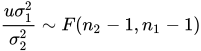
The density f left-parenthesis u right-parenthesis is obtained from the fact that

StartFraction u sigma 1 squared Over sigma 2 squared EndFraction tilde upper F left-parenthesis n 2 minus 1 comma n 1 minus 1 right-parenthesis

Because the test is biased, the achieved significance level might differ from the nominal significance level. The actual alpha is computed in the same way as the power, except that the mean difference mu Subscript normal d normal i normal f normal f is replaced by the null mean difference mu 0.

Two-Sample Pooled t Test of Mean Ratio with Lognormal Data (TEST=RATIO)

The lognormal case is handled by reexpressing the analysis equivalently as a normality-based test on the log-transformed data, by using properties of the lognormal distribution as discussed in Johnson, Kotz, and Balakrishnan (1994, Chapter 14). The approaches in the section Two-Sample t Test Assuming Equal Variances (TEST=DIFF) then apply.

In contrast to the usual t test on normal data, the hypotheses with lognormal data are defined in terms of geometric means rather than arithmetic means. The test assumes equal coefficients of variation in the two groups.

The hypotheses for the two-sample t test with lognormal data are
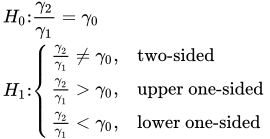
StartLayout 1st Row 1st Column upper H 0 colon 2nd Column StartFraction gamma 2 Over gamma 1 EndFraction equals gamma 0 2nd Row 1st Column upper H 1 colon 2nd Column StartLayout Enlarged left-brace 1st Row 1st Column StartFraction gamma 2 Over gamma 1 EndFraction not-equals gamma 0 comma 2nd Column two hyphen sided 2nd Row 1st Column StartFraction gamma 2 Over gamma 1 EndFraction greater-than gamma 0 comma 2nd Column upper one hyphen sided 3rd Row 1st Column StartFraction gamma 2 Over gamma 1 EndFraction less-than gamma 0 comma 2nd Column lower one hyphen sided EndLayout EndLayout

Let mu 1 Superscript star, mu 2 Superscript star, and sigma Superscript star be the (arithmetic) means and common standard deviation of the corresponding normal distributions of the log-transformed data. The hypotheses can be rewritten as follows:
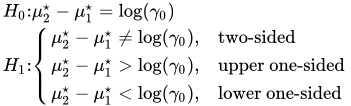
StartLayout 1st Row 1st Column upper H 0 colon 2nd Column mu 2 Superscript star Baseline minus mu 1 Superscript star Baseline equals log left-parenthesis gamma 0 right-parenthesis 2nd Row 1st Column upper H 1 colon 2nd Column StartLayout Enlarged left-brace 1st Row 1st Column mu 2 Superscript star Baseline minus mu 1 Superscript star Baseline not-equals log left-parenthesis gamma 0 right-parenthesis comma 2nd Column two hyphen sided 2nd Row 1st Column mu 2 Superscript star Baseline minus mu 1 Superscript star Baseline greater-than log left-parenthesis gamma 0 right-parenthesis comma 2nd Column upper one hyphen sided 3rd Row 1st Column mu 2 Superscript star Baseline minus mu 1 Superscript star Baseline less-than log left-parenthesis gamma 0 right-parenthesis comma 2nd Column lower one hyphen sided EndLayout EndLayout

where

StartLayout 1st Row 1st Column mu 1 Superscript star 2nd Column equals log gamma 1 2nd Row 1st Column mu 2 Superscript star 2nd Column equals log gamma 2 EndLayout

The test assumes lognormally distributed data and requires upper N greater-than-or-equal-to 3, n 1 greater-than-or-equal-to 1, and n 2 greater-than-or-equal-to 1.

The power is

normal p normal o normal w normal e normal r equals StartLayout Enlarged left-brace 1st Row 1st Column upper P left-parenthesis upper F left-parenthesis 1 comma upper N minus 2 comma delta squared right-parenthesis greater-than-or-equal-to upper F Subscript 1 minus alpha Baseline left-parenthesis 1 comma upper N minus 2 right-parenthesis right-parenthesis comma 2nd Column two hyphen sided 2nd Row 1st Column upper P left-parenthesis t left-parenthesis upper N minus 2 comma delta right-parenthesis greater-than-or-equal-to t Subscript 1 minus alpha Baseline left-parenthesis upper N minus 2 right-parenthesis right-parenthesis comma 2nd Column upper one hyphen sided 3rd Row 1st Column upper P left-parenthesis t left-parenthesis upper N minus 2 comma delta right-parenthesis less-than-or-equal-to t Subscript alpha Baseline left-parenthesis upper N minus 2 right-parenthesis right-parenthesis comma 2nd Column lower one hyphen sided EndLayout

where

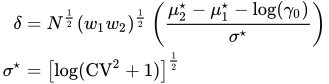
StartLayout 1st Row 1st Column delta 2nd Column equals upper N Superscript one-half Baseline left-parenthesis w 1 w 2 right-parenthesis Superscript one-half Baseline left-parenthesis StartFraction mu 2 Superscript star Baseline minus mu 1 Superscript star Baseline minus log left-parenthesis gamma 0 right-parenthesis Over sigma Superscript star Baseline EndFraction right-parenthesis 2nd Row 1st Column sigma Superscript star 2nd Column equals left-bracket log left-parenthesis normal upper C normal upper V squared plus 1 right-parenthesis right-bracket Superscript one-half EndLayout
Additive Equivalence Test for Mean Difference with Normal Data (TEST=EQUIV_DIFF)

The hypotheses for the equivalence test are

StartLayout 1st Row 1st Column upper H 0 colon 2nd Column mu Subscript normal d normal i normal f normal f Baseline less-than theta Subscript upper L Baseline or mu Subscript normal d normal i normal f normal f Baseline greater-than theta Subscript upper U Baseline 2nd Row 1st Column upper H 1 colon 2nd Column theta Subscript upper L Baseline less-than-or-equal-to mu Subscript normal d normal i normal f normal f Baseline less-than-or-equal-to theta Subscript upper U EndLayout

The analysis is the two one-sided tests (TOST) procedure of Schuirmann (1987). Two different hypothesis tests are carried out:
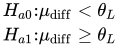
StartLayout 1st Row 1st Column upper H Subscript a Baseline 0 Baseline colon 2nd Column mu Subscript normal d normal i normal f normal f Baseline less than theta Subscript upper L Baseline 2nd Row 1st Column upper H Subscript a Baseline 1 Baseline colon 2nd Column mu Subscript normal d normal i normal f normal f Baseline greater than or equals theta Subscript upper L EndLayout

and

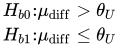
StartLayout 1st Row 1st Column upper H Subscript b Baseline 0 Baseline colon 2nd Column mu Subscript normal d normal i normal f normal f Baseline greater than theta Subscript upper U Baseline 2nd Row 1st Column upper H Subscript b Baseline 1 Baseline colon 2nd Column mu Subscript normal d normal i normal f normal f Baseline less than or equals theta Subscript upper U EndLayout

If upper H Subscript a Baseline 0 is rejected in favor of upper H Subscript a Baseline 1 and upper H Subscript b Baseline 0 is rejected in favor of upper H Subscript b Baseline 1, then upper H 0 is rejected in favor of upper H 1. Rejection of upper H 0 in favor of upper H 1 at significance level alpha occurs if and only if the 100(1 – 2 alpha)% confidence interval for mu Subscript normal d normal i normal f normal f is contained completely within left parenthesis theta Subscript upper L Baseline comma theta Subscript upper U Baseline right parenthesis.

The test assumes normally distributed data and requires upper N greater-than-or-equal-to 3, n 1 greater-than-or-equal-to 1, and n 2 greater-than-or-equal-to 1. Phillips (1990) derives an expression for the exact power assuming a balanced design; the results are easily adapted to an unbalanced design:

StartLayout 1st Row 1st Column normal p normal o normal w normal e normal r 2nd Column equals upper Q Subscript upper N minus 2 Baseline left-parenthesis left-parenthesis minus t Subscript 1 minus alpha Baseline left-parenthesis upper N minus 2 right-parenthesis right-parenthesis comma StartFraction mu Subscript normal d normal i normal f normal f Baseline minus theta Subscript upper U Baseline Over sigma upper N Superscript negative one-half Baseline left-parenthesis w 1 w 2 right-parenthesis Superscript negative one-half Baseline EndFraction semicolon 0 comma StartFraction left-parenthesis upper N minus 2 right-parenthesis Superscript one-half Baseline left-parenthesis theta Subscript upper U Baseline minus theta Subscript upper L Baseline right-parenthesis Over 2 sigma upper N Superscript negative one-half Baseline left-parenthesis w 1 w 2 right-parenthesis Superscript negative one-half Baseline left-parenthesis t Subscript 1 minus alpha Baseline left-parenthesis upper N minus 2 right-parenthesis right-parenthesis EndFraction right-parenthesis minus 2nd Row 1st Column Blank 2nd Column upper Q Subscript upper N minus 2 Baseline left-parenthesis left-parenthesis t Subscript 1 minus alpha Baseline left-parenthesis upper N minus 2 right-parenthesis right-parenthesis comma StartFraction mu Subscript normal d normal i normal f normal f Baseline minus theta Subscript upper L Baseline Over sigma upper N Superscript negative one-half Baseline left-parenthesis w 1 w 2 right-parenthesis Superscript negative one-half Baseline EndFraction semicolon 0 comma StartFraction left-parenthesis upper N minus 2 right-parenthesis Superscript one-half Baseline left-parenthesis theta Subscript upper U Baseline minus theta Subscript upper L Baseline right-parenthesis Over 2 sigma upper N Superscript negative one-half Baseline left-parenthesis w 1 w 2 right-parenthesis Superscript negative one-half Baseline left-parenthesis t Subscript 1 minus alpha Baseline left-parenthesis upper N minus 2 right-parenthesis right-parenthesis EndFraction right-parenthesis EndLayout

where upper Q Subscript dot Baseline left-parenthesis dot comma dot semicolon dot comma dot right-parenthesis is Owen’s Q function, defined in the section Common Notation.

Multiplicative Equivalence Test for Mean Ratio with Lognormal Data (TEST=EQUIV_RATIO)

The lognormal case is handled by reexpressing the analysis equivalently as a normality-based test on the log-transformed data, by using properties of the lognormal distribution as discussed in Johnson, Kotz, and Balakrishnan (1994, Chapter 14). The approaches in the section Additive Equivalence Test for Mean Difference with Normal Data (TEST=EQUIV_DIFF) then apply.

In contrast to the additive equivalence test on normal data, the hypotheses with lognormal data are defined in terms of geometric means rather than arithmetic means.

The hypotheses for the equivalence test are
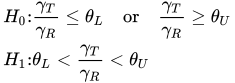
StartLayout 1st Row 1st Column upper H 0 colon 2nd Column StartFraction gamma Subscript upper T Baseline Over gamma Subscript upper R Baseline EndFraction less-than-or-equal-to theta Subscript upper L Baseline or StartFraction gamma Subscript upper T Baseline Over gamma Subscript upper R Baseline EndFraction greater-than-or-equal-to theta Subscript upper U Baseline 2nd Row 1st Column upper H 1 colon 2nd Column theta Subscript upper L Baseline less-than StartFraction gamma Subscript upper T Baseline Over gamma Subscript upper R Baseline EndFraction less-than theta Subscript upper U EndLayout
where 0 less-than theta Subscript upper L Baseline less-than theta Subscript upper U Baseline

The analysis is the two one-sided tests (TOST) procedure of Schuirmann (1987) on the log-transformed data. Two different hypothesis tests are carried out:
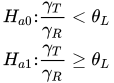
StartLayout 1st Row 1st Column upper H Subscript a Baseline 0 Baseline colon 2nd Column StartFraction gamma Subscript upper T Baseline Over gamma Subscript upper R Baseline EndFraction less than theta Subscript upper L Baseline 2nd Row 1st Column upper H Subscript a Baseline 1 Baseline colon 2nd Column StartFraction gamma Subscript upper T Baseline Over gamma Subscript upper R Baseline EndFraction greater than or equals theta Subscript upper L EndLayout

and

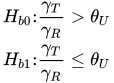
StartLayout 1st Row 1st Column upper H Subscript b Baseline 0 Baseline colon 2nd Column StartFraction gamma Subscript upper T Baseline Over gamma Subscript upper R Baseline EndFraction greater than theta Subscript upper U Baseline 2nd Row 1st Column upper H Subscript b Baseline 1 Baseline colon 2nd Column StartFraction gamma Subscript upper T Baseline Over gamma Subscript upper R Baseline EndFraction less than or equals theta Subscript upper U EndLayout

If upper H Subscript a Baseline 0 is rejected in favor of upper H Subscript a Baseline 1 and upper H Subscript b Baseline 0 is rejected in favor of upper H Subscript b Baseline 1, then upper H 0 is rejected in favor of upper H 1. Rejection of upper H 0 in favor of upper H 1 at significance level alpha occurs if and only if the 100(1 – 2 alpha)% confidence interval for gamma Subscript upper T Baseline divided by gamma Subscript upper R is contained completely within left parenthesis theta Subscript upper L Baseline comma theta Subscript upper U Baseline right parenthesis.

The test assumes lognormally distributed data and requires upper N greater-than-or-equal-to 3, n 1 greater-than-or-equal-to 1, and n 2 greater-than-or-equal-to 1. Diletti, Hauschke, and Steinijans (1991) derive an expression for the exact power assuming a crossover design; the results are easily adapted to an unbalanced two-sample design:
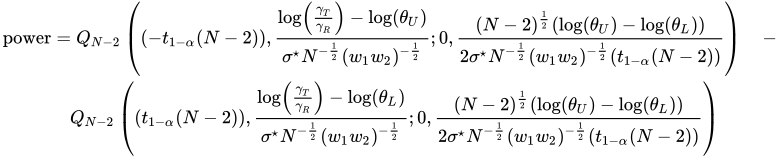
StartLayout 1st Row 1st Column normal p normal o normal w normal e normal r 2nd Column equals upper Q Subscript upper N minus 2 Baseline left-parenthesis left-parenthesis minus t Subscript 1 minus alpha Baseline left-parenthesis upper N minus 2 right-parenthesis right-parenthesis comma StartStartFraction log left-parenthesis StartFraction gamma Subscript upper T Baseline Over gamma Subscript upper R Baseline EndFraction right-parenthesis minus log left-parenthesis theta Subscript upper U Baseline right-parenthesis OverOver sigma Superscript star Baseline upper N Superscript negative one-half Baseline left-parenthesis w 1 w 2 right-parenthesis Superscript negative one-half Baseline EndEndFraction semicolon 0 comma StartFraction left-parenthesis upper N minus 2 right-parenthesis Superscript one-half Baseline left-parenthesis log left-parenthesis theta Subscript upper U Baseline right-parenthesis minus log left-parenthesis theta Subscript upper L Baseline right-parenthesis right-parenthesis Over 2 sigma Superscript star Baseline upper N Superscript negative one-half Baseline left-parenthesis w 1 w 2 right-parenthesis Superscript negative one-half Baseline left-parenthesis t Subscript 1 minus alpha Baseline left-parenthesis upper N minus 2 right-parenthesis right-parenthesis EndFraction right-parenthesis minus 2nd Row 1st Column Blank 2nd Column upper Q Subscript upper N minus 2 Baseline left-parenthesis left-parenthesis t Subscript 1 minus alpha Baseline left-parenthesis upper N minus 2 right-parenthesis right-parenthesis comma StartStartFraction log left-parenthesis StartFraction gamma Subscript upper T Baseline Over gamma Subscript upper R Baseline EndFraction right-parenthesis minus log left-parenthesis theta Subscript upper L Baseline right-parenthesis OverOver sigma Superscript star Baseline upper N Superscript negative one-half Baseline left-parenthesis w 1 w 2 right-parenthesis Superscript negative one-half Baseline EndEndFraction semicolon 0 comma StartFraction left-parenthesis upper N minus 2 right-parenthesis Superscript one-half Baseline left-parenthesis log left-parenthesis theta Subscript upper U Baseline right-parenthesis minus log left-parenthesis theta Subscript upper L Baseline right-parenthesis right-parenthesis Over 2 sigma Superscript star Baseline upper N Superscript negative one-half Baseline left-parenthesis w 1 w 2 right-parenthesis Superscript negative one-half Baseline left-parenthesis t Subscript 1 minus alpha Baseline left-parenthesis upper N minus 2 right-parenthesis right-parenthesis EndFraction right-parenthesis EndLayout

where

sigma Superscript star Baseline equals left-bracket log left-parenthesis normal upper C normal upper V squared plus 1 right-parenthesis right-bracket Superscript one-half

is the (assumed common) standard deviation of the normal distribution of the log-transformed data, and upper Q Subscript dot Baseline left-parenthesis dot comma dot semicolon dot comma dot right-parenthesis is Owen’s Q function, defined in the section Common Notation.

Confidence Interval for Mean Difference (CI=DIFF)

This analysis of precision applies to the standard t-based confidence interval:
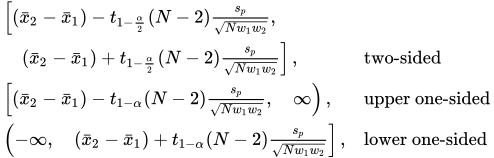
StartLayout 1st Row 1st Column left-bracket left-parenthesis x overbar Subscript 2 Baseline minus x overbar Subscript 1 Baseline right-parenthesis minus t Subscript 1 minus StartFraction alpha Over 2 EndFraction Baseline left-parenthesis upper N minus 2 right-parenthesis StartFraction s Subscript p Baseline Over StartRoot upper N w 1 w 2 EndRoot EndFraction comma 2nd Row 1st Column left-parenthesis x overbar Subscript 2 Baseline minus x overbar Subscript 1 Baseline right-parenthesis plus t Subscript 1 minus StartFraction alpha Over 2 EndFraction Baseline left-parenthesis upper N minus 2 right-parenthesis StartFraction s Subscript p Baseline Over StartRoot upper N w 1 w 2 EndRoot EndFraction right-bracket comma 2nd Column two hyphen sided 3rd Row 1st Column left-bracket left-parenthesis x overbar Subscript 2 Baseline minus x overbar Subscript 1 Baseline right-parenthesis minus t Subscript 1 minus alpha Baseline left-parenthesis upper N minus 2 right-parenthesis StartFraction s Subscript p Baseline Over StartRoot upper N w 1 w 2 EndRoot EndFraction comma normal infinity right-parenthesis comma 2nd Column upper one hyphen sided 4th Row 1st Column left-parenthesis negative normal infinity comma left-parenthesis x overbar Subscript 2 Baseline minus x overbar Subscript 1 Baseline right-parenthesis plus t Subscript 1 minus alpha Baseline left-parenthesis upper N minus 2 right-parenthesis StartFraction s Subscript p Baseline Over StartRoot upper N w 1 w 2 EndRoot EndFraction right-bracket comma 2nd Column lower one hyphen sided EndLayout

where x overbar Subscript 1 and x overbar Subscript 2 are the sample means and s Subscript p is the pooled standard deviation. The "half-width" is defined as the distance from the point estimate x overbar Subscript 2 Baseline minus x overbar Subscript 1 to a finite endpoint,

half hyphen width equals StartLayout Enlarged left-brace 1st Row 1st Column t Subscript 1 minus StartFraction alpha Over 2 EndFraction Baseline left-parenthesis upper N minus 2 right-parenthesis StartFraction s Subscript p Baseline Over StartRoot upper N w 1 w 2 EndRoot EndFraction comma 2nd Column two hyphen sided 2nd Row 1st Column t Subscript 1 minus alpha Baseline left-parenthesis upper N minus 2 right-parenthesis StartFraction s Subscript p Baseline Over StartRoot upper N w 1 w 2 EndRoot EndFraction comma 2nd Column one hyphen sided EndLayout

A "valid" conference interval captures the true mean. The exact probability of obtaining at most the target confidence interval half-width h, unconditional or conditional on validity, is given by Beal (1989):
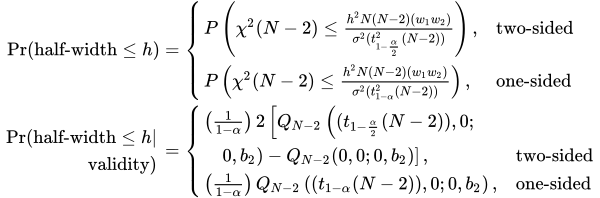
StartLayout 1st Row 1st Column probability left-parenthesis half hyphen width less-than-or-equal-to h right-parenthesis 2nd Column equals StartLayout Enlarged left-brace 1st Row 1st Column upper P left-parenthesis chi squared left-parenthesis upper N minus 2 right-parenthesis less-than-or-equal-to StartFraction h squared upper N left-parenthesis upper N minus 2 right-parenthesis left-parenthesis w 1 w 2 right-parenthesis Over sigma squared left-parenthesis t Subscript 1 minus StartFraction alpha Over 2 EndFraction Superscript 2 Baseline left-parenthesis upper N minus 2 right-parenthesis right-parenthesis EndFraction right-parenthesis comma 2nd Column two hyphen sided 2nd Row 1st Column upper P left-parenthesis chi squared left-parenthesis upper N minus 2 right-parenthesis less-than-or-equal-to StartFraction h squared upper N left-parenthesis upper N minus 2 right-parenthesis left-parenthesis w 1 w 2 right-parenthesis Over sigma squared left-parenthesis t Subscript 1 minus alpha Superscript 2 Baseline left-parenthesis upper N minus 2 right-parenthesis right-parenthesis EndFraction right-parenthesis comma 2nd Column one hyphen sided EndLayout 2nd Row 1st Column StartLayout 1st Row  probability left-parenthesis half hyphen width less-than-or-equal-to h vertical-bar 2nd Row  validity right-parenthesis EndLayout 2nd Column equals StartLayout Enlarged left-brace 1st Row 1st Column left-parenthesis StartFraction 1 Over 1 minus alpha EndFraction right-parenthesis 2 left-bracket upper Q Subscript upper N minus 2 Baseline left-parenthesis left-parenthesis t Subscript 1 minus StartFraction alpha Over 2 EndFraction Baseline left-parenthesis upper N minus 2 right-parenthesis right-parenthesis comma 0 semicolon 2nd Row 1st Column 0 comma b 2 right-parenthesis minus upper Q Subscript upper N minus 2 Baseline left-parenthesis 0 comma 0 semicolon 0 comma b 2 right-parenthesis right-bracket comma 2nd Column two hyphen sided 3rd Row 1st Column left-parenthesis StartFraction 1 Over 1 minus alpha EndFraction right-parenthesis upper Q Subscript upper N minus 2 Baseline left-parenthesis left-parenthesis t Subscript 1 minus alpha Baseline left-parenthesis upper N minus 2 right-parenthesis right-parenthesis comma 0 semicolon 0 comma b 2 right-parenthesis comma 2nd Column one hyphen sided EndLayout EndLayout

where

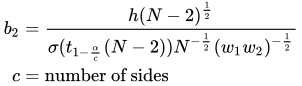
StartLayout 1st Row 1st Column b 2 2nd Column equals StartFraction h left-parenthesis upper N minus 2 right-parenthesis Superscript one-half Baseline Over sigma left-parenthesis t Subscript 1 minus StartFraction alpha Over c EndFraction Baseline left-parenthesis upper N minus 2 right-parenthesis right-parenthesis upper N Superscript negative one-half Baseline left-parenthesis w 1 w 2 right-parenthesis Superscript negative one-half Baseline EndFraction 2nd Row 1st Column c 2nd Column equals number of sides EndLayout

and upper Q Subscript dot Baseline left-parenthesis dot comma dot semicolon dot comma dot right-parenthesis is Owen’s Q function, defined in the section Common Notation.

A "quality" confidence interval is both sufficiently narrow (half-width less-than-or-equal-to h) and valid:

StartLayout 1st Row 1st Column probability left-parenthesis quality right-parenthesis 2nd Column equals probability left-parenthesis half hyphen width less-than-or-equal-to h and validity right-parenthesis 2nd Row 1st Column Blank 2nd Column equals probability left-parenthesis half hyphen width less-than-or-equal-to h vertical-bar validity right-parenthesis left-parenthesis 1 minus alpha right-parenthesis EndLayout
Last updated: December 09, 2022