The PSMATCH Procedure

Weighting after Stratification

The STRATA statement creates strata of observations that have similar propensity scores. The NSTRATA= option specifies the number of strata. The KEY=TOTAL option allocates approximately the same number of total units to each stratum, and the KEY=TREATED option allocates the same number of treated units to each stratum.

After stratification, you can use the weighted average of the stratum-specific treatment estimates to estimate the treatment effect in the outcome analysis. The particular weights that you use depend on the estimator (ATE or ATT). Two commonly used stratum weights are weighting by the total units and weighting by the treated units.

The PSMATCH procedure provides the following stratum weights to assess the variable balance after stratification:

  • STRATUMWGT=TOTAL (weighting by the number of total units in stratum), which is used to estimate the ATE

  • STRATUMWGT=TREATED (weighting by the number of treated units in stratum), which is used to estimate the ATT

Thus, a stratum weight is computed as
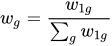
w Subscript g Baseline equals StartFraction w Subscript 1 g Baseline Over sigma-summation Underscript g Endscripts w Subscript 1 g Baseline EndFraction

where g is the stratum index and

w Subscript 1 g Baseline equals StartLayout Enlarged left-brace 1st Row 1st Column upper N Subscript t left-parenthesis g right-parenthesis Baseline plus upper N Subscript c left-parenthesis g right-parenthesis Baseline 2nd Column if STRATUMWGT equals TOTAL 2nd Row 1st Column upper N Subscript t left-parenthesis g right-parenthesis Baseline 2nd Column if STRATUMWGT equals TREATED EndLayout

where upper N Subscript t left-parenthesis g right-parenthesis is the number of treated units and upper N Subscript c left-parenthesis g right-parenthesis is the number of control units in the gth stratum.

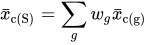
Let x overbar Subscript normal t left-parenthesis normal g right-parenthesis be the mean of treated units in the gth stratum and x overbar Subscript normal c left-parenthesis normal g right-parenthesis be the mean of control units in the gth stratum, with corresponding sample variances upper V left-parenthesis x Subscript normal t left-parenthesis normal g right-parenthesis Baseline right-parenthesis and upper V left-parenthesis x Subscript normal c left-parenthesis normal g right-parenthesis Baseline right-parenthesis. Then the weighted stratum means for the treated and control groups are
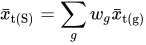
x overbar Subscript normal t left-parenthesis normal upper S right-parenthesis Baseline equals sigma-summation Underscript g Endscripts w Subscript g Baseline x overbar Subscript normal t left-parenthesis normal g right-parenthesis
x overbar Subscript normal c left-parenthesis normal upper S right-parenthesis Baseline equals sigma-summation Underscript g Endscripts w Subscript g Baseline x overbar Subscript normal c left-parenthesis normal g right-parenthesis

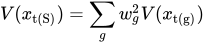
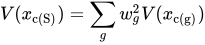
The variances of the weighted stratum means x overbar Subscript normal t left-parenthesis normal upper S right-parenthesis and x overbar Subscript normal c left-parenthesis normal upper S right-parenthesis are then given by

upper V left-parenthesis x Subscript normal t left-parenthesis normal upper S right-parenthesis Baseline right-parenthesis equals sigma-summation Underscript g Endscripts w Subscript g Superscript 2 Baseline upper V left-parenthesis x Subscript normal t left-parenthesis normal g right-parenthesis Baseline right-parenthesis
upper V left-parenthesis x Subscript normal c left-parenthesis normal upper S right-parenthesis Baseline right-parenthesis equals sigma-summation Underscript g Endscripts w Subscript g Superscript 2 Baseline upper V left-parenthesis x Subscript normal c left-parenthesis normal g right-parenthesis Baseline right-parenthesis

These stratum weights are displayed in the "Standardized Mean Differences within Strata" table (see Output 101.2.7). You can use these weights for estimation of the treatment effect in an outcome analysis.

Last updated: December 09, 2022