The SEQDESIGN Procedure

Fixed-Sample Clinical Trials

A clinical trial is a research study in consenting human beings to answer specific health questions. One type of trial is a treatment trial, which tests the effectiveness of an experimental treatment. An example is a planned experiment designed to assess the efficacy of a treatment in humans by comparing the outcomes in a group of patients who receive the test treatment with the outcomes in a comparable group of patients who receive a placebo control treatment, where patients in both groups are enrolled, treated, and followed over the same time period.

A clinical trial is conducted according to a plan called a protocol. The protocol provides detailed description of the study. For a fixed-sample trial, the study protocol contains detailed information such as the null hypothesis, the one-sided or two-sided test, and the Type I and II error probability levels. It also includes the test statistic and its associated critical values in the hypothesis testing.

Generally, the efficacy of a new treatment is demonstrated by testing a hypothesis upper H 0 colon theta equals 0 in a clinical trial, where theta is the parameter of interest. For example, to test whether a population mean mu is greater than a specified value mu 0, theta equals mu minus mu 0 can be used with an alternative theta greater-than 0.

A one-sided test is a test of the hypothesis with either an upper (greater) or a lower (lesser) alternative, and a two-sided test is a test of the hypothesis with a two-sided alternative. The drug industry often prefers to use a one-sided test to demonstrate clinical superiority based on the argument that a study should not be run if the test drug would be worse (Chow, Shao, and Wang 2003, p. 28). But in practice, two-sided tests are commonly performed in drug development (Senn 1997, p. 161). For a fixed Type I error probability alpha, the sample sizes required by one-sided and two-sided tests are different. See Senn (1997, pp. 161–167) for a detailed description of issues involving one-sided and two-sided tests.

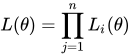
For independent and identically distributed observations y 1 comma y 2 comma ellipsis comma y Subscript n Baseline of a random variable, the likelihood function for theta is

upper L left-parenthesis theta right-parenthesis equals product Underscript j equals 1 Overscript n Endscripts upper L Subscript i Baseline left-parenthesis theta right-parenthesis

where theta is the population parameter and upper L Subscript i Baseline left-parenthesis theta right-parenthesis is the probability or probability density of y Subscript i. Using the likelihood function, two statistics can be derived that are useful for inference: the maximum likelihood estimator and the score statistic.

Maximum Likelihood Estimator

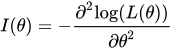
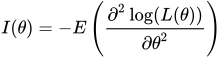
The maximum likelihood estimate (MLE) of theta is the value ModifyingAbove theta With caret that maximizes the likelihood function for theta. Under mild regularity conditions, ModifyingAbove theta With caret is an asymptotically unbiased estimate of theta with variance 1 slash upper E Subscript theta Baseline left-parenthesis upper I left-parenthesis theta right-parenthesis right-parenthesis, where upper I left-parenthesis theta right-parenthesis is the Fisher information

upper I left-parenthesis theta right-parenthesis equals minus StartFraction partial-differential squared normal l normal o normal g left-parenthesis upper L left-parenthesis theta right-parenthesis right-parenthesis Over partial-differential theta squared EndFraction

and upper E Subscript theta Baseline left-parenthesis upper I left-parenthesis theta right-parenthesis right-parenthesis is the expected Fisher information (Diggle et al. 2002, p. 340)
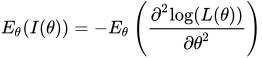
upper E Subscript theta Baseline left-parenthesis upper I left-parenthesis theta right-parenthesis right-parenthesis equals minus upper E Subscript theta Baseline left-parenthesis StartFraction partial-differential squared normal l normal o normal g left-parenthesis upper L left-parenthesis theta right-parenthesis right-parenthesis Over partial-differential theta squared EndFraction right-parenthesis

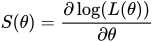
The score function for theta is defined as

upper S left-parenthesis theta right-parenthesis equals StartFraction partial-differential normal l normal o normal g left-parenthesis upper L left-parenthesis theta right-parenthesis right-parenthesis Over partial-differential theta EndFraction

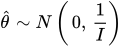
and usually, the MLE can be derived by solving the likelihood equation upper S left-parenthesis theta right-parenthesis equals 0. Asymptotically, the MLE is normally distributed (Lindgren 1976, p. 272):
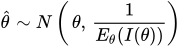
ModifyingAbove theta With caret tilde upper N left-parenthesis theta comma StartFraction 1 Over upper E Subscript theta Baseline left-parenthesis upper I left-parenthesis theta right-parenthesis right-parenthesis EndFraction right-parenthesis

If the Fisher information upper I left-parenthesis theta right-parenthesis does not depend on theta, then upper I left-parenthesis theta right-parenthesis is known. Otherwise, either the expected information evaluated at the MLE ModifyingAbove theta With caret (upper E Subscript theta equals ModifyingAbove theta With caret Baseline left-parenthesis upper I left-parenthesis theta right-parenthesis right-parenthesis) or the observed information upper I left-parenthesis ModifyingAbove theta With caret right-parenthesis can be used for the Fisher information (Cox and Hinkley 1974, p. 302; Efron and Hinkley 1978, p. 458), where the observed Fisher information
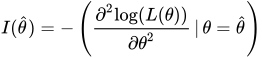
upper I left-parenthesis ModifyingAbove theta With caret right-parenthesis equals minus left-parenthesis StartFraction partial-differential squared normal l normal o normal g left-parenthesis upper L left-parenthesis theta right-parenthesis right-parenthesis Over partial-differential theta squared EndFraction vertical-bar theta equals ModifyingAbove theta With caret right-parenthesis

If the Fisher information upper I left-parenthesis theta right-parenthesis does depend on theta, the observed Fisher information is recommended for the variance of the maximum likelihood estimator (Efron and Hinkley 1978, p. 457).

Thus, asymptotically, for large n,
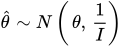
ModifyingAbove theta With caret tilde upper N left-parenthesis theta comma StartFraction 1 Over upper I EndFraction right-parenthesis

where I is the information, either the expected Fisher information upper E Subscript theta equals 0 Baseline left-parenthesis upper I left-parenthesis theta right-parenthesis right-parenthesis or the observed Fisher information upper I ModifyingAbove theta With caret right-parenthesis.

So to test upper H 0 colon theta equals 0 versus upper H 1 colon theta not-equals 0, you can use the standardized Z test statistic
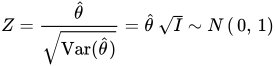
upper Z equals StartFraction ModifyingAbove theta With caret Over StartRoot normal upper V normal a normal r left-parenthesis ModifyingAbove theta With caret right-parenthesis EndRoot EndFraction equals ModifyingAbove theta With caret StartRoot upper I EndRoot tilde upper N left-parenthesis 0 comma 1 right-parenthesis

and the two-sided p-value is given by

normal upper P normal r normal o normal b left-parenthesis StartAbsoluteValue upper Z EndAbsoluteValue greater-than StartAbsoluteValue z 0 EndAbsoluteValue right-parenthesis equals 1 minus 2 normal upper Phi left-parenthesis StartAbsoluteValue z 0 EndAbsoluteValue right-parenthesis

where normal upper Phi is the cumulative standard normal distribution function and z 0 is the observed Z statistic.

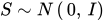
If the BOUNDARYSCALE=SCORE is specified in the SEQDESIGN procedure, the boundary values for the test statistic are displayed in the score statistic scale. With the standardized Z statistic, the score statistic upper S equals upper Z StartRoot upper I EndRoot equals ModifyingAbove theta With caret upper I and

upper S tilde upper N left-parenthesis 0 comma upper I right-parenthesis

Score Statistic

The score statistic is based on the score function for theta,

upper S left-parenthesis theta right-parenthesis equals StartFraction partial-differential normal l normal o normal g left-parenthesis upper L left-parenthesis theta right-parenthesis right-parenthesis Over partial-differential theta EndFraction

Under the null hypothesis upper H 0 colon theta equals 0, the score statistic upper S left-parenthesis 0 right-parenthesis is the first derivative of the log likelihood evaluated at the null reference 0:
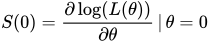
upper S left-parenthesis 0 right-parenthesis equals StartFraction partial-differential normal l normal o normal g left-parenthesis upper L left-parenthesis theta right-parenthesis right-parenthesis Over partial-differential theta EndFraction vertical-bar theta equals 0

Under regularity conditions, upper S left-parenthesis 0 right-parenthesis is asymptotically normally distributed with mean zero and variance upper E Subscript theta equals 0 Baseline left-parenthesis upper I left-parenthesis theta right-parenthesis right-parenthesis, the expected Fisher information evaluated at the null hypothesis theta equals 0 (Kalbfleisch and Prentice 1980, p. 45), where upper I left-parenthesis theta right-parenthesis is the Fisher information

upper I left-parenthesis theta right-parenthesis equals minus upper E left-parenthesis StartFraction partial-differential squared normal l normal o normal g left-parenthesis upper L left-parenthesis theta right-parenthesis right-parenthesis Over partial-differential theta squared EndFraction right-parenthesis

That is, for large n,

upper S left-parenthesis 0 right-parenthesis tilde upper N left-parenthesis 0 comma upper E Subscript theta equals 0 Baseline left-parenthesis upper I left-parenthesis theta right-parenthesis right-parenthesis right-parenthesis

Asymptotically, the variance of the score statistic upper S left-parenthesis 0 right-parenthesis, upper E Subscript theta equals 0 Baseline left-parenthesis upper I left-parenthesis theta right-parenthesis right-parenthesis, can also be replaced by the expected Fisher information evaluated at the MLE theta equals ModifyingAbove theta With caret (upper E Subscript theta equals ModifyingAbove theta With caret Baseline left-parenthesis upper I left-parenthesis theta right-parenthesis right-parenthesis), the observed Fisher information evaluated at the null hypothesis theta equals 0 (upper I left-parenthesis 0 right-parenthesis right-parenthesis, or the observed Fisher information evaluated at the MLE theta equals ModifyingAbove theta With caret (upper I left-parenthesis ModifyingAbove theta With caret right-parenthesis) (Kalbfleisch and Prentice 1980, p. 46), where
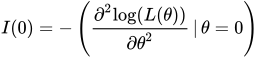
upper I left-parenthesis 0 right-parenthesis equals minus left-parenthesis StartFraction partial-differential squared normal l normal o normal g left-parenthesis upper L left-parenthesis theta right-parenthesis right-parenthesis Over partial-differential theta squared EndFraction vertical-bar theta equals 0 right-parenthesis
upper I left-parenthesis ModifyingAbove theta With caret right-parenthesis equals minus left-parenthesis StartFraction partial-differential squared normal l normal o normal g left-parenthesis upper L left-parenthesis theta right-parenthesis right-parenthesis Over partial-differential theta squared EndFraction vertical-bar theta equals ModifyingAbove theta With caret right-parenthesis

Thus, asymptotically, for large n,

upper S left-parenthesis 0 right-parenthesis tilde upper N left-parenthesis 0 comma upper I right-parenthesis

where I is the information, either an expected Fisher information (upper E Subscript theta equals 0 Baseline left-parenthesis upper I left-parenthesis theta right-parenthesis right-parenthesis or upper E Subscript theta equals ModifyingAbove theta With caret Baseline left-parenthesis upper I left-parenthesis theta right-parenthesis right-parenthesis) or a observed Fisher information (upper I left-parenthesis 0 right-parenthesis or upper I left-parenthesis ModifyingAbove theta With caret right-parenthesis).

So to test upper H 0 colon theta equals 0 versus upper H 1 colon theta not-equals 0, you can use the standardized Z test statistic

upper Z equals StartFraction upper S left-parenthesis 0 right-parenthesis Over StartRoot upper I EndRoot EndFraction

If the BOUNDARYSCALE=MLE is specified in the SEQDESIGN procedure, the boundary values for the test statistic are displayed in the MLE scale. With the standardized Z statistic, the MLE statistic ModifyingAbove theta With caret equals upper Z slash StartRoot upper I EndRoot equals upper U left-parenthesis 0 right-parenthesis slash upper I and

ModifyingAbove theta With caret tilde upper N left-parenthesis 0 comma StartFraction 1 Over upper I EndFraction right-parenthesis

One-Sample Test for Mean

The following one-sample test for mean is used to demonstrate fixed-sample clinical trials in the section One-Sided Fixed-Sample Tests in Clinical Trials and the section Two-Sided Fixed-Sample Tests in Clinical Trials.

Suppose y 1 comma y 2 comma ellipsis comma y Subscript n Baseline are n observations of a response variable Y from a normal distribution

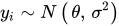
y Subscript i Baseline tilde upper N left-parenthesis theta comma sigma squared right-parenthesis

where theta is the unknown mean and sigma squared is the known variance.

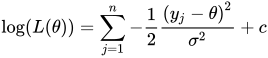
Then the log likelihood function for theta is

normal l normal o normal g left-parenthesis upper L left-parenthesis theta right-parenthesis right-parenthesis equals sigma-summation Underscript j equals 1 Overscript n Endscripts minus one-half StartFraction left-parenthesis y Subscript j Baseline minus theta right-parenthesis squared Over sigma squared EndFraction plus c

where c is a constant. The first derivative is

StartFraction partial-differential normal l normal o normal g left-parenthesis upper L left-parenthesis theta right-parenthesis right-parenthesis Over partial-differential theta EndFraction equals StartFraction 1 Over sigma squared EndFraction sigma-summation Underscript j equals 1 Overscript n Endscripts left-parenthesis y Subscript j Baseline minus theta right-parenthesis equals StartFraction n Over sigma squared EndFraction left-parenthesis y overbar minus theta right-parenthesis

where y overbar is the sample mean.

Setting the first derivative to zero, the MLE of theta is ModifyingAbove theta With caret equals y overbar, the sample mean. The variance for ModifyingAbove theta With caret can be derived from the Fisher information
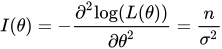
upper I left-parenthesis theta right-parenthesis equals minus StartFraction partial-differential squared normal l normal o normal g left-parenthesis upper L left-parenthesis theta right-parenthesis right-parenthesis Over partial-differential theta squared EndFraction equals StartFraction n Over sigma squared EndFraction

Since the Fisher information upper I 0 equals upper I left-parenthesis theta right-parenthesis does not depend on theta in this case, 1 slash upper I 0 is used as the variance for ModifyingAbove theta With caret. Thus the sample mean y overbar has a normal distribution with mean theta and variance sigma squared slash n:

ModifyingAbove theta With caret equals y overbar tilde upper N left-parenthesis theta comma StartFraction 1 Over upper I 0 EndFraction right-parenthesis equals upper N left-parenthesis theta comma StartFraction sigma squared Over n EndFraction right-parenthesis

Under the null hypothesis upper H 0 colon theta equals 0, the score statistic

upper S left-parenthesis 0 right-parenthesis equals StartFraction partial-differential normal l normal o normal g left-parenthesis upper L left-parenthesis theta right-parenthesis right-parenthesis Over partial-differential theta EndFraction vertical-bar theta equals 0 equals StartFraction n Over sigma squared EndFraction y overbar

has a mean zero and variance

upper I left-parenthesis theta right-parenthesis equals minus StartFraction partial-differential squared normal l normal o normal g left-parenthesis upper L left-parenthesis theta right-parenthesis right-parenthesis Over partial-differential theta squared EndFraction equals StartFraction n Over sigma squared EndFraction

With the MLE ModifyingAbove theta With caret, the corresponding standardized statistic is computed as upper Z equals ModifyingAbove theta With caret StartRoot upper I 0 EndRoot equals y overbar slash left-parenthesis sigma slash StartRoot n EndRoot right-parenthesis, which has a normal distribution with variance 1:

upper Z tilde upper N left-parenthesis theta StartRoot upper I 0 EndRoot comma 1 right-parenthesis equals upper N left-parenthesis StartFraction theta Over sigma slash StartRoot n EndRoot EndFraction comma 1 right-parenthesis

Also, the corresponding score statistic is computed as upper S equals ModifyingAbove theta With caret upper I 0 equals n y overbar slash sigma squared and

upper S tilde upper N left-parenthesis theta upper I 0 comma upper I 0 right-parenthesis equals upper N left-parenthesis StartFraction n theta Over sigma squared EndFraction comma StartFraction n Over sigma squared EndFraction right-parenthesis

which is identical to upper S left-parenthesis 0 right-parenthesis computed under the null hypothesis upper H 0 colon theta equals 0.

Note that if the variable Y does not have a normal distribution, then it is assumed that the sample size n is large such that the sample mean has an approximately normal distribution.

Last updated: December 09, 2022