The SPP Procedure
Statistics Based on Second-Order Characteristics
Statistics that are based on second-order characteristics include Ripley’s K function, Besag’s L function, and the pair correlation function (also called the g function). To understand why these functions are based on second-order characteristics, see Illian et al. (2008, p. 223-243). These functions usually involve computation of pairwise distances between points.
The K function of a stationary point process is defined such that  is the expected number of points within a distance of r from an arbitrary point of the process. The empirical K function of a set of points is the weighted and renormalized empirical distribution function of the set of pairwise distances between points. The empirical K function can be written as

where  is the border edge correction that is described in the section Border Edge Correction for Distance Functions.
For a homogeneous Poisson process,  can be written as
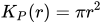
Exploratory analysis usually involves computing both the empirical K function,  , and the K function for a Poisson process, . A comparison of
  and might indicate clustering or regularity depending on whether
 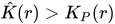 or
or 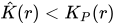 .
.
Besag’s L function is a transformation of the K function and is defined as
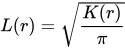
For a homogeneous Poisson process,  .
.
The pair correlation function, g(r), can also be expressed as a transformation of the K function:
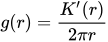
Illian et al. (2008), Stoyan (1987), and Fiksel (1988) suggest an alternative expression for  :
:

where  is the second-order product density function. Cressie and Collins (2001) provides an expression for as
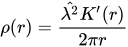
where  can be written as a kernel estimate,

where a is the area,  , and
, and  is a kernel such as the uniform kernel or the Epanechnikov kernel (Silverman 1986). PROC SPP uses the version that is based on the uniform kernel; for more information about the uniform kernel, see the section Nonparametric Intensity Estimation. Based on the formula for the second-order product density in terms of the kernel estimate, Stoyan (1987) gives an edge-corrected kernel estimate for as

Dividing by  gives the pair correlation function as

where  indicates the translation of the study area window W by the distance
  from its origin. The above expression for was given by Stoyan and Stoyan (1994) using the translation edge correction.
A border-edge-corrected version of can be written as

where and  are points within the boundary at a distance greater than or equal to r; where
  is the distance of to the boundary of W,
  ; and where
  for a kernel , such as the uniform kernel or the Epanechnikov kernel. For more information about the uniform kernel, see the section Nonparametric Intensity Estimation. For a homogeneous Poisson process,
  . For any point pattern, values of greater than 1 indicate clustering or attraction at distance r, whereas values of less than 1 indicate regularity.