The SURVEYPHREG Procedure

Taylor Series Linearization

The Taylor series linearization method is the default variance estimation method used by PROC SURVEYPHREG. See the section Notation and Estimation for definitions of the notation used in this section. Let

upper S Superscript left-parenthesis r right-parenthesis Baseline left-parenthesis bold-italic beta comma t right-parenthesis equals sigma-summation Underscript upper A Endscripts w Subscript h i j Baseline y Subscript h i j Baseline left-parenthesis t right-parenthesis exp left-parenthesis bold-italic beta prime bold upper Z Subscript h i j Baseline left-parenthesis t right-parenthesis right-parenthesis bold upper Z Subscript h i j Superscript circled-times r Baseline left-parenthesis t right-parenthesis

where r equals 0 comma 1. Let A be the set of indices in the selected sample. Let
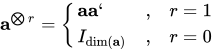
bold a Superscript circled-times r Baseline equals StartLayout Enlarged left-brace 1st Row 1st Column bold a bold a single-turned-comma-quotation-mark 2nd Column comma 3rd Column r equals 1 2nd Row 1st Column upper I Subscript dimension left-parenthesis bold a right-parenthesis Baseline 2nd Column comma 3rd Column r equals 0 EndLayout

and let upper I Subscript dimension left-parenthesis bold a right-parenthesis be the identity matrix of appropriate dimension.

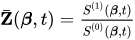
Let ModifyingAbove bold upper Z With bar left-parenthesis bold-italic beta comma t right-parenthesis equals StartFraction upper S Superscript left-parenthesis 1 right-parenthesis Baseline left-parenthesis bold-italic beta comma t right-parenthesis Over upper S Superscript left-parenthesis 0 right-parenthesis Baseline left-parenthesis bold-italic beta comma t right-parenthesis EndFraction. The score residual for the left-parenthesis h comma i comma j right-parenthesis subject is
StartLayout 1st Row 1st Column bold upper L Subscript h i j Baseline left-parenthesis bold-italic beta right-parenthesis 2nd Column equals 3rd Column normal upper Delta Subscript h i j Baseline StartSet bold upper Z Subscript h i j Baseline left-parenthesis t Subscript h i j Baseline right-parenthesis minus ModifyingAbove bold upper Z With bar left-parenthesis bold-italic beta comma t Subscript h i j Baseline right-parenthesis EndSet 2nd Row 1st Column Blank 2nd Column Blank 3rd Column minus sigma-summation Underscript left-parenthesis h prime comma i prime comma j prime right-parenthesis element-of upper A Endscripts normal upper Delta Subscript h prime i prime j prime Baseline StartFraction w Subscript h prime i prime j prime Baseline upper Y Subscript h i j Baseline left-parenthesis t Subscript h prime i prime j prime Baseline right-parenthesis exp left-parenthesis bold-italic beta prime bold upper Z Subscript h i j Baseline left-parenthesis t Subscript h prime i prime j prime Baseline right-parenthesis right-parenthesis Over upper S Superscript left-parenthesis 0 right-parenthesis Baseline left-parenthesis bold-italic beta comma t Subscript h prime i prime j prime Baseline right-parenthesis EndFraction StartSet bold upper Z Subscript h i j Baseline left-parenthesis t Subscript h prime i prime j prime Baseline right-parenthesis minus ModifyingAbove bold upper Z With bar left-parenthesis bold-italic beta comma t Subscript h prime i prime j prime Baseline right-parenthesis EndSet EndLayout

For TIES=EFRON, the computation of the score residuals is modified to comply with the Efron partial likelihood. See the section Residuals for more information.

The Taylor series estimate of the covariance matrix of ModifyingAbove bold-italic beta With caret is

ModifyingAbove bold upper V With caret left-parenthesis ModifyingAbove bold-italic beta With caret right-parenthesis equals script upper I Superscript negative 1 Baseline left-parenthesis ModifyingAbove bold-italic beta With caret right-parenthesis bold upper G script upper I Superscript negative 1 Baseline left-parenthesis ModifyingAbove bold-italic beta With caret right-parenthesis

where script upper I left-parenthesis ModifyingAbove bold-italic beta With caret right-parenthesis is the observed information matrix and the p times p matrix bold upper G is defined as

bold upper G equals StartFraction n minus 1 Over n minus p EndFraction sigma-summation Underscript h equals 1 Overscript upper H Endscripts StartFraction n Subscript h Baseline left-parenthesis 1 minus f Subscript h Baseline right-parenthesis Over n Subscript h Baseline minus 1 EndFraction sigma-summation Underscript i equals 1 Overscript n Subscript h Baseline Endscripts left-parenthesis bold e Subscript h i plus Baseline minus bold e overbar Subscript h dot dot Baseline right-parenthesis prime left-parenthesis bold e Subscript h i plus Baseline minus bold e overbar Subscript h dot dot Baseline right-parenthesis

The observed residuals, their sums and means are defined as follows:
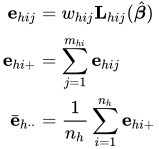
StartLayout 1st Row 1st Column bold e Subscript h i j 2nd Column equals 3rd Column w Subscript h i j Baseline bold upper L Subscript h i j Baseline left-parenthesis ModifyingAbove bold-italic beta With caret right-parenthesis 2nd Row 1st Column bold e Subscript h i plus 2nd Column equals 3rd Column sigma-summation Underscript j equals 1 Overscript m Subscript h i Endscripts bold e Subscript h i j 3rd Row 1st Column bold e overbar Subscript h dot dot 2nd Column equals 3rd Column StartFraction 1 Over n Subscript h Baseline EndFraction sigma-summation Underscript i equals 1 Overscript n Subscript h Endscripts bold e Subscript h i plus EndLayout

The factor left-parenthesis n minus 1 right-parenthesis slash left-parenthesis n minus p right-parenthesis in the computation of the matrix bold upper G reduces the small sample bias that is associated with using the estimated function to calculate deviations (Fuller et al. (1989), pp. 77–81). For simple random sampling, this factor contributes to the degrees of freedom correction applied to the residual mean square for ordinary least squares in which p parameters are estimated. By default, the procedure uses this adjustment in the variance estimation. If you do not want to use this multiplier in the variance estimator, then specify the VADJUST=NONE option in the MODEL statement.

Last updated: December 09, 2022



