The SURVEYPHREG Procedure
Hazard Ratios
The hazard ratio for a quantitative effect with regression coefficient  is defined as exp
 , where
  denotes the jth unit vector. In general, a log-hazard ratio can be written as
  , a linear combination of the regression coefficients, and the hazard ratio exp
 is obtained by replacing
  with
with  .
.
The confidence intervals for hazard ratios are obtained by exponentiating the confidence limits of the corresponding linear combination. Thus, the  confidence limits are

where  is the
 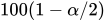 percentile point of the t distribution with df degrees of freedom. For more information about hazard ratios see the section Hazard Ratios, and for more information about df see the section Degrees of Freedom. If you use the DF=NONE option in the MODEL statement, then the procedure uses the percentile point of the standard normal distribution.