The BGLIMM Procedure
RANDOM Statement
RANDOM random-effects </ options>;
Using notation from the section Notation for the Generalized Linear Mixed Model, the RANDOM statement defines the  matrix of the mixed model, the random effects in the
  vector, and the covariance structure of
  .
.
The matrix is constructed exactly like the  matrix for the fixed effects, and the matrix is constructed to correspond to the effects that constitute . The covariance structure of is defined by using the TYPE= option. The random effects can be classification or continuous effects, and you can specify multiple RANDOM statements.
You can specify INTERCEPT (or INT) as a random effect to indicate the intercept. PROC BGLIMM does not include the intercept in the RANDOM statement by default as it does in the MODEL statement.
Table 9 summarizes the options available in the RANDOM statement. All options are then discussed in alphabetical order.
Table 9: RANDOM Statement Options
| Option | Description |
|---|---|
| Construction and Sampling of Covariance Structure | |
| COVPRIOR= | Specifies the prior for the matrix |
| GROUP= | Varies the covariance matrix by group |
| NUTS | Specifies options for the No-U-Turn Sampler of the Hamiltonian |
| Monte Carlo algorithm for the matrix |
|
| RESIDUAL | Designates a covariance structure as R-side |
| SUBJECT= | Identifies the subjects in the model |
| TYPE= | Specifies the type of the matrix |
| Statistical Output | |
| G | Displays the estimated matrix |
| GCORR | Displays the correlation matrix that corresponds to the estimated matrix |
| MONITOR | Displays the summary, diagnostic statistics, and plots |
| of individual random effects | |
| NOOUTPOST | Suppresses storing the posterior samples of |
| individual random effects in the OUTPOST= data set | |
You can specify the following options in the RANDOM statement after a slash (/).
- COVPRIOR=prior-distribution
-
specifies a prior distribution for the covariance matrix,
 , of the random effects, when the matrix is of the UN, UN(1), VC, or TOEP(1) type, where a conjugate sampler is used to sample the covariance matrix. This option is ignored for other covariance types, because you assign a flat prior to the matrix if its type is not UN, UN(1), VC, or TOEP(1). For more information, see the section Prior for the G-Side Covariance.
 You can specify one of the following prior-distributions:
-
HALFCAUCHY <(SCALE=a)>
HCAUCHY <(SCALE=a)>
HC <(SCALE=a)> -
specifies the prior to be a half-Cauchy distribution. The half-Cauchy prior is applied only to the diagonal terms (variances) of the
matrix. The off-diagonal terms of the matrix are assumed to have a flat prior. You can specify the scale parameter a of the half-Cauchy distribution. The scale parameter a must be positive. By default, SCALE=25.
-
HALFNORMAL <(VAR=a)>
HNORMAL <(VAR=a)>
HN <(VAR=a)> -
specifies the prior to be a half-normal distribution. The half-normal prior is applied only to the diagonal terms (variances) of the
matrix. The off-diagonal terms of the matrix are assumed to have a flat prior. You can specify the variance a of the half-normal distribution. The variance a must be positive. By default, VAR=25.
- IGAMMA <(options)>
-
specifies an inverse gamma prior,
 , with the density
  for each diagonal term of the matrix. It is the default prior for the covariance types UN(1), VC, and TOEP(1).
 You can set the parameters of the inverse gamma distribution by specifying one or both of the following options, separated by a comma or a space:
-
IWISHART <(options)>
IWISH <(options)>
IW <(options)> -
specifies an inverse Wishart prior,
 , for the matrix of the random effects. The hyperparameters a and
  are the degrees of freedom and scale matrix of an inverse Wishart distribution, respectively. The inverse Wishart prior is the default prior for the UN covariance type. The following examples show several ways to specify an inverse Wishart prior distribution:
 covprior=iwishartcovprior=iwishart(scale=25)covprior=iwishart(df=6, diagonal=(1 4 9))You can set the parameters of the inverse Wishart distribution by specifying one or more of the following options, separated by a comma or a space:
- DF=a
specifies the degrees of freedom of the inverse Wishart distribution. The default is the dimension of the
matrix plus 3. - SCALE=b
specifies
 as the scale matrix of the inverse Wishart distribution, where
  is the identity matrix. The default is the dimension of the matrix plus 3. You can set the scale matrix by specifying one of these options: SCALE=, DIAGONAL=, or COV=.
 - DIAGONAL=numeric-list
specifies a list of positive values for the diagonal terms in the scale matrix
of the inverse Wishart distribution. The default value of each diagonal term is the dimension of the matrix plus 3. You can set the scale matrix by specifying one of these options: SCALE=, DIAGONAL=, or COV=. - COV=numeric-list
specifies a list of values for the entries in the lower-triangle portion of the scale matrix
for the inverse Wishart distribution. The specified values of the diagonal terms must be positive, and the whole matrix must be positive definite. The order of the list is rowwise. The default setting is , where b is the dimension of the matrix plus 3. You can set the scale matrix by specifying one of these options: SCALE=, DIAGONAL=, or COV=.
-
SIWISHART <(options)>
SIWISH <(options)>
SIW <(options)> -
specifies a scaled inverse Wishart prior for the
matrix of the random effects. You can set the parameters of the scaled inverse Wishart distribution by specifying one or more of the following options, separated by a comma or a space:
- DF=a
specifies the degrees of freedom a of the scaled inverse Wishart distribution. The default is the dimension of the
matrix of the random effects plus 3. - SCALE=b
specifies
 as the scale matrix of the scaled inverse Wishart distribution, where is the identity matrix. The default is the dimension of the matrix of the random effects plus 3.
 - VAR=c
specifies the variance parameter c of the normal prior for
 . By default, VAR=1.
-
UNIFORM <(options)>
UNIF <(options)> -
specifies a uniform prior,
 , for the matrix of the random effects. The uniform prior is applied to standard deviations (the square root of the diagonal terms) of the matrix.
 You can set the lower and upper bounds of the uniform distribution by specifying one or both of the following options, separated by a comma or a space:
-
HALFCAUCHY <(SCALE=a)>
- G
displays the estimated
matrix for G-side
random effects that are associated with this RANDOM statement. PROC BGLIMM displays blanks for values that are 0. The ODS table name is G. - GCORR
displays the correlation matrix that corresponds to the estimated
matrix for G-side
random effects that are associated with this RANDOM statement. PROC BGLIMM displays blanks for values that are 0. The ODS table name is GCORR. -
GROUP=effect
GRP=effect -
identifies groups by which to vary the covariance parameters. All observations that have the same level of the effect have the same covariance parameters. Each new level of the grouping effect produces a new set of covariance parameters. You should exercise caution in properly defining the effect, because strange covariance patterns can result when it is misused. Also, the effect can greatly increase the number of estimated covariance parameters, which can adversely affect the sampling process.
The GROUP= effect must be specified in the CLASS statement.
-
MONITOR<=(numeric-list | RANDOM (number))>
SOLUTION<=(numeric-list | RANDOM (number))>
S<=(numeric-list | RANDOM (number))> -
displays results (summary, diagnostic statistics, and plots) for the individual-level random-effects parameters. By default, to save time and space, PROC BGLIMM does not print results for individual-level random-effects parameters. In models that have a large number of individual random effects (for example, tens of thousands), it can take a long time to display the summary, diagnostic statistics, and plots for all the individual-level parameters, so be cautious when using this option.
You can monitor a subset of the random-effects parameters. You can provide a numeric list of the SUBJECT indexes, or PROC BGLIMM can randomly choose a subset of all subjects for you.
To monitor a list of random-effects parameters for certain subjects, you can provide their indexes as follows:
random x / subject=index monitor=(1 to 5 by 2 23 57);In this case, PROC BGLIMM outputs results of random effects for subjects 1, 3, 5, 23, and 57. If the number of items in the list is greater than the number of subjects, the extra list items are ignored.
PROC BGLIMM can also randomly choose a subset of all the subjects to monitor, if you submit a statement such as the following:
random x / subject=index monitor=(random(12));In this case, PROC BGLIMM outputs results of random effects for 12 randomly selected subjects. You control the sequence of the random indexes by specifying the SEED= option in the PROC BGLIMM statement.
When you specify the MONITOR option, it uses the values that you specify in the STATISTICS= and PLOTS= options in the PROC BGLIMM statement.
- NOOUTPOST
-
suppresses storing the posterior samples of individual random-effects parameters in the OUTPOST= data set. By default, PROC BGLIMM outputs the posterior samples of all random-effects parameters to the OUTPOST= data set. You can use this option to avoid saving the random-effects parameters. In models that have a large number of individual random effects (for example, tens of thousands), PROC BGLIMM can run faster if it does not save the posterior samples of all the individual random effects.
When you specify both the NOOUTPOST option and the MONITOR option, PROC BGLIMM outputs the list of variables that are monitored.
There is a limit on the maximum number of variables that you can save to an OUTPOST= data set. If you run a large-scale random-effects model in which the number of parameters exceeds that limit, the NOOUTPOST option is invoked automatically and PROC BGLIMM does not save the individual random-effects draws to the output data set. You can use the MONITOR option to select a subset of the parameters to store in the OUTPOST= data set.
- NUTS<(nuts-options)>
-
specifies options for the No-U-Turn Sampler (NUTS) of the Hamiltonian algorithm that is used to sample the parameters in the
matrix of the corresponding RANDOM statement. The NUTS algorithm is a version of the adaptive Hamiltonian Monte Carlo algorithm with automatic tuning of the step size and number of steps in each iteration. For more information, see the section Hamiltonian Monte Carlo Sampler. You can specify the following nuts-options: - DELTA=value
specifies the target acceptance rate during the tuning process of the NUTS algorithm. Increasing the value can often improve mixing, but it can also significantly slow down the sampling. By default, DELTA=0.6.
- MAXHEIGHT=value
specifies the maximum height of the NUTS algorithm tree. The taller the tree, the more gradient evaluations per iteration the procedure calculates. The number of evaluations is
 . Usually, the height of a tree should be no more than 10 during the sampling stage, but it can go higher during the tuning stage. A larger number indicates that the algorithm is having difficulty converging. By default, MAXHEIGHT=10.
 - NTU=value
specifies the number of tuning iterations for the NUTS algorithm to use. By default, NTU=1000.
- STEPSIZE=value
specifies the initial step size in the NUTS algorithm. By default, STEPSIZE=0.1.
-
RESIDUAL
RSIDE -
specifies that the random effects listed in this statement be R-side effects. You use this option in the RANDOM statement if the covariance matrix is for the R-side. Specifying this option is equivalent to using the REPEATED statement. For example, if it is necessary to order the columns of the R-side AR(1) covariance structure by the
Timevariable, you can use the RESIDUAL option as in the following statements:class time id; random time / subject=id type=ar(1) residual; -
SUBJECT=effect
SUB=effect -
identifies the subjects in the model for the random effects.
A set of random effects is estimated for each subject. All variables in the effect must be declared as categorical variables in the CLASS statement. PROC BGLIMM assumes independence across subjects, conditional on other parameters in the model. Specifying a subject effect is equivalent to nesting all other effects in the RANDOM statement within the subject effect. Thus, for the RANDOM statement, the SUBJECT= option produces a block-diagonal structure that has identical blocks.
For more information about specifying a random effect with or without the SUBJECT= variable, see the section Treatment of Subjects in the RANDOM Statement.
- TYPE=covariance-structure
-
specifies the covariance structure of the
matrix for G-side effects.
Although a variety of structures are available, many applications call for either simple diagonal (TYPE=VC) or unstructured covariance matrices. The default structure is TYPE=VC (variance components), which models a different variance component for each random effect.
If you want different covariance structures in different parts of
, you must use multiple RANDOM statements with different TYPE= options. Valid values for covariance-structure and their descriptions are provided in Table 10.
Table 10: Covariance Structures
Structure Description Parms  Element
 ANTE(1) Antedependence 
AR(1) Autoregressive(1) 2 
ARH(1) Heterogeneous AR(1) 

ARMA(1,1) ARMA(1,1) 3 
CS Compound symmetry 2 
CSH Heterogeneous compound symmetry 
FA(1) Factor analytic 

HF Huynh-Feldt 
TOEP Toeplitz t 
TOEP(q) Banded Toeplitz q 
TOEPH Heterogeneous Toeplitz 
TOEPH(q) Banded heterogeneous Toeplitz 

UN Unstructured 

UN(q) Banded 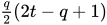

VC Variance components q 
and i corresponds to kth effect
In Table 10, Parms refers to the number of covariance parameters in the structure, t is the overall dimension of the covariance matrix, q is the order parameter, and
 equals 1 when A is true and 0 otherwise. For example, 1
 equals 1 when
  and 0 otherwise, and 1
 equals 1 when
  and 0 otherwise. For the TYPE=TOEPH structures,
  .
. - ANTE(1)
-
specifies a first-order antedependence structure (Kenward 1987; Patel 1991) parameterized in terms of variances and correlation parameters. If t ordered random variables
 have a first-order antedependence structure, then each
  ,
,  , is independent of all other
  , given
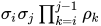
  . This Markovian structure is characterized by its inverse variance matrix, which is tridiagonal. Parameterizing an ANTE(1) structure for a random vector of size t requires 2t – 1 parameters: variances
  and t – 1 correlation parameters
  . The covariances among random variables
  and are then constructed as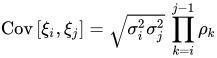
PROC BGLIMM constrains the correlation parameters to satisfy
 . For variable-order antedependence models see Macchiavelli and Arnold (1994).
 - AR(1)
-
specifies a first-order autoregressive structure,

The values
 and
and  are derived for the ith and jth observations, respectively, and are not necessarily the observation numbers. For example, in the following statements, the values correspond to the class levels for the
 Timeeffect of the ith and jth observation within a particular subject:proc bglimm; class time patient; model y = x x*x; random time / sub=patient type=ar(1); run;PROC BGLIMM imposes the constraint
 for stationarity.
 - ARH(1)
-
specifies a heterogeneous first-order autoregressive structure,

where
. This covariance structure has the same correlation pattern as the TYPE=AR(1) structure, but the variances are allowed to differ. - ARMA(1,1)
-
specifies the first-order autoregressive moving average structure,

Here,
 is the autoregressive parameter,
  models a moving average component, and
  is a scale parameter. In the notation of Fuller (1976, p. 68),
  and
and 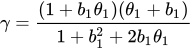
The example in Table 11 and
 imply that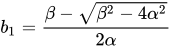
where
 and
and  . PROC BGLIMM imposes the constraints and
  for stationarity, although for some values of and in this region, the resulting covariance matrix is not positive definite.
 - CS
-
specifies the compound symmetry structure, which has constant variance and constant covariance

The compound symmetry structure arises naturally with nested random effects, such as when subsampling error is nested within experimental error. Hierarchical random assignments or selections, such as subsampling or split-plot designs, give rise to compound symmetric covariance structures. This implies exchangeability of the observations in the subunit, leading to constant correlations between the observations. Compound symmetry structures are thus usually not appropriate for processes in which correlations decline according to some metric, such as spatial and temporal processes.
- CSH
-
specifies the heterogeneous compound symmetry structure, which is an equicorrelation structure but allows for different variances,
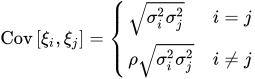
- FA(1)
specifies the factor-analytic structure with one factor (Jennrich and Schluchter 1986). This structure is of the form
 , where
  is a
is a  vector and
  is a
is a  diagonal matrix with t different parameters.
 - HF
-
specifies a covariance structure that satisfies the general Huynh-Feldt condition (Huynh and Feldt 1970). For a random vector that has t elements, this structure has
positive parameters and covariances 
A covariance matrix
 generally satisfies the Huynh-Feldt condition if it can be written as
  . The preceding parameterization chooses
  . Several simpler covariance structures give rise to covariance matrices that also satisfy the Huynh-Feldt condition. For example, TYPE=CS, VC, and UN(1) are nested within TYPE=HF. Note also that the HF structure is nested within an unstructured covariance matrix.
 - TOEP
-
models a Toeplitz covariance structure. This structure can be viewed as an autoregressive structure whose order is equal to the dimension of the matrix,
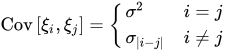
- TOEP(q)
-
specifies a banded Toeplitz structure,

This can be viewed as a moving average structure whose order is equal to q – 1. The specification TYPE=TOEP(1) is the same as
 , and it can be useful for specifying the same variance component for several effects.
 - TOEPH<(q)>
-
models a Toeplitz covariance structure. The correlations of this structure are banded as in the TOEP or TOEP(q) structures, but the variances are allowed to vary:
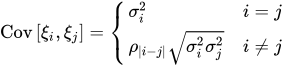
The correlation parameters satisfy
 . If you specify the optional value q, the correlation parameters with
  are set to 0, creating a banded correlation structure. The specification TYPE=TOEPH(1) results in a diagonal covariance matrix with heterogeneous variances.
 - UN<(q)>
-
specifies a completely general (unstructured) covariance matrix that is parameterized directly in terms of variances and covariances,

The variances are constrained to be nonnegative, and the covariances are unconstrained. This structure is constrained to be nonnegative definite. If you specify the order parameter q, then PROC BGLIMM estimates only the first q bands of the matrix, setting elements in all higher bands equal to 0.
- VC
specifies standard variance components and is the default structure for both G-side and R-side covariance structures. In a G-side covariance structure, a distinct variance component is assigned to each effect. In an R-side structure, TYPE=VC is usually used only to add overdispersion effects or, with the GROUP= option, to specify a heterogeneous variance model.
Table 11 lists some examples of the structures in Table 10.
Table 11: Covariance Structure Examples
Description Structure Example First-order
antedependenceANTE(1) 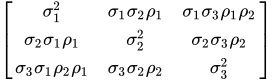
First-order
autoregressiveAR(1) 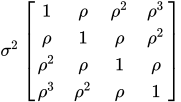
Heterogeneous
AR(1)ARH(1) 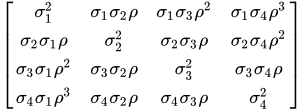
First-order
autoregressive
moving averageARMA(1,1) 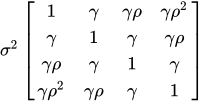
Compound
symmetryCS 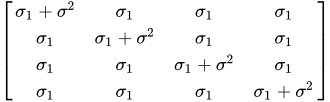
Heterogeneous
compound symmetryCSH 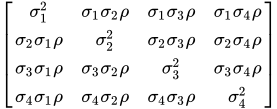
First-order
factor
analyticFA(1) 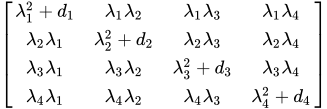
Huynh-Feldt HF 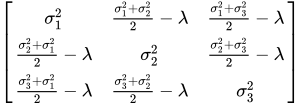
Toeplitz TOEP 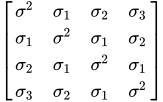
Toeplitz with
two bandsTOEP(2) 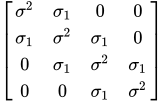
Heterogeneous
ToeplitzTOEPH 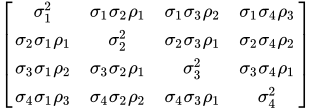
Unstructured UN 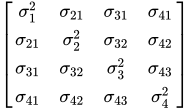
Banded main
diagonalUN(1) 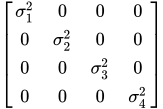
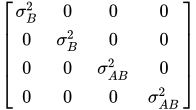
Variance
componentsVC (default)