The LOGISTIC Procedure
Iterative Algorithms for Model Fitting
This section describes the two iterative maximum likelihood algorithms that are available in PROC LOGISTIC for fitting an unconditional logistic regression. For information about available optimization techniques for conditional logistic regression and models that specify the EQUALSLOPES or UNEQUALSLOPES options, see the section NLOPTIONS Statement. Exact logistic regression uses a special algorithm, which is described in the section Exact Conditional Logistic Regression.
The default maximum likelihood algorithm is the Fisher scoring method, which is equivalent to fitting by iteratively reweighted least squares. The alternative algorithm is the Newton-Raphson method. For generalized logit models, adjacent-category logit models, and models that specify the EQUALSLOPES or UNEQUALSLOPES options, only the Newton-Raphson technique is available. Both algorithms produce the same parameter estimates. However, the estimated covariance matrix of the parameter estimators can differ slightly because Fisher scoring is based on the expected information matrix whereas the Newton-Raphson method is based on the observed information matrix. For a binary logit model, the observed and expected information matrices are identical, resulting in identical estimated covariance matrices for both algorithms. You can specify the TECHNIQUE= option to select a fitting algorithm, and you can specify the FIRTH option to perform a bias-reducing penalized maximum likelihood fit.
Iteratively Reweighted Least Squares Algorithm (Fisher Scoring)
Consider the multinomial variable  such that

With  denoting the probability that the jth observation has response value i, the expected value of
  is
is  where
where  . The covariance matrix of is
  , which is the covariance matrix of a multinomial random variable for one trial with parameter vector
  . Let
. Let  be the vector of regression parameters; in other words,
  . Let
. Let  be the matrix of partial derivatives of with respect to . The estimating equation for the regression parameters is
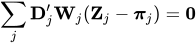
where 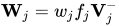 ,
,  and
and  are the weight and frequency of the jth observation, and
  is a generalized inverse of
  . PROC LOGISTIC chooses as the inverse of the diagonal matrix with as the diagonal.
With a starting value of  , the maximum likelihood estimate of is obtained iteratively as

where ,  , and are evaluated at
  . The expression after the plus sign is the step size. If the likelihood evaluated at
  is less than that evaluated at , then is recomputed by step-halving or ridging as determined by the value of the RIDGING= option. The iterative scheme continues until convergence is obtained—that is, until is sufficiently close to . Then the maximum likelihood estimate of is
  .
.
The covariance matrix of  is estimated by

where  and
and  are, respectively, and evaluated at .
  is the information matrix, or the negative expected Hessian matrix, evaluated at .
By default, starting values are zero for the slope parameters, and for the intercept parameters, starting values are the observed cumulative logits (that is, logits of the observed cumulative proportions of response). Alternatively, the starting values can be specified with the INEST= option.
Newton-Raphson Algorithm
For cumulative models, let the parameter vector be  , and for the generalized logit model let
  . The gradient vector and the Hessian matrix are given, respectively, by
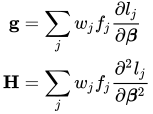
where  is the log likelihood for the jth observation. With a starting value of , the maximum likelihood estimate of is obtained iteratively until convergence is obtained:

where  and
and  are evaluated at . If the likelihood evaluated at is less than that evaluated at , then is recomputed by step-halving or ridging.
The covariance matrix of is estimated by
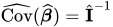
where the observed information matrix  is computed by evaluating at .
Firth’s Bias-Reducing Penalized Likelihood
Firth’s bias-reducing penalized likelihood method is available for binary response models. The log likelihood  is penalized by the determinant of the information matrix
  ,
,
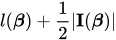
and the components of the gradient  are computed as

The Hessian matrix is not modified by this penalty, and the optimization is performed in the usual manner.
Note that for the probit and complementary log-log links, the penalty for the Fisher scoring method is based on the expected information matrix, but the penalty for the Newton-Raphson algorithm is based on the observed information matrix. Because these are noncanonical links, the resulting parameter estimates will be different.