The SURVEYPHREG Procedure
Jackknife Method
The jackknife method of variance estimation deletes one PSU at a time from the full sample to create replicates. This method is also known as the delete-1 jackknife method because it deletes exactly one PSU in every replicate. The total number of replicates R is the same as the total number of PSUs. In each replicate, the sampling weights of the remaining PSUs are modified by the jackknife coefficient  . The modified weights are called replicate weights.
Let PSU i in stratum  be omitted for the rth replicate; then the jackknife coefficient and replicate weights are computed as

and

You can use the VARMETHOD=JACKKNIFE(OUTJKCOEFS=) method-option to store the jackknife coefficients in a SAS data set and use the VARMETHOD=JACKKNIFE(OUTWEIGHTS=) method-option to store the replicate weights in a SAS data set.
If you provide your own replicate weights with a REPWEIGHTS statement, then you can also provide corresponding jackknife coefficients with the JKCOEFS= option. If you provide replicate weights with a REPWEIGHTS statement but do not provide jackknife coefficients, then the procedure uses  as the default jackknife coefficient for every replicate, where R is the total number of replicates.
Let  be the estimated proportional hazards regression coefficients from the full sample, and let
  be the estimated regression coefficients for the rth replicate. PROC SURVEYPHREG estimates the covariance matrix of by

with  degrees of freedom, where R is the number of replicates and H is the number of strata, or R – 1 when there is no stratification.
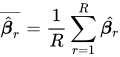
If you specify the CENTER=REPLICATES method-option, then PROC SURVEYPHREG computes the covariance matrix of by

where  is the average of the replicate estimates as follows:
If one or more components of  cannot be calculated for some replicates, then the variance estimator uses only the replicates for which the proportional hazards regression coefficients can be estimated. Estimability and nonconvergence are two common reasons why might not be available for a replicate sample even if
  is defined for the full sample. Let
  be the number of replicates where are available, and let
  be the number of replicates where are not available. Without loss of generality, assume that
  is available only for the first replicates; then the jackknife variance estimator is

with  degrees of freedom, where H is the number of strata. Alternatively, you can use the VADJUST=AVGREPSS option in the MODEL statement to use the average sum of squares for the invalid replicate samples. See Variance Adjustment Factors for details.