The SURVEYPHREG Procedure
Testing the Global Null Hypothesis
The following statistics are available to test the global null hypothesis  . Let d be the usual degrees of freedom computed from the survey data by using the number of strata, clusters, or replicate weights; and let p be the number of estimable parameters in the null hypothesis
  . For more information about computing d, see the section Degrees of Freedom.
The unadjusted likelihood ratio test statistic is expressed as

where L( ) denotes the partial pseudo-likelihood that is described in the section Partial Likelihood Function for the Cox Model and
  denotes the estimated regression parameters. The p-value for the unadjusted test is computed by using a chi-square distribution with p degrees of freedom.
The unadjusted likelihood ratio statistic is sensitive to the scaling of the weights. PROC SURVEYPHREG computes an adjusted likelihood ratio test statistic that is invariant to the scaling of the weights. The adjusted test is similar to the second-order adjusted Rao-Scott chi-square tests. For more information, see Rao, Scott, and Skinner (1998), and Lumley and Scott (2013). The adjusted likelihood ratio test statistic is expressed as
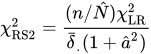
where  ,
,  , …,
, …,  are the positive eigenvalues from the generalized design effect matrix (Variance Ratios and Standard Error Ratios),
  is the mean of the positive eigenvalues,
  is the squared coefficient of variations of the positive eigenvalues, n is the number of observation units, and
 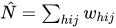 is the sum of the weights over all observation units. The p-value for the adjusted test is computed by using a chi-square distribution with
  degrees of freedom.
The usual assumptions that are required for a likelihood ratio test do not hold for the pseudo-likelihood that is used by PROC SURVEYPHREG (Rao, Scott, and Skinner 1998), leading to other methods of testing the global null hypothesis, such as the Wald test discussed in the following paragraph.
The Wald test uses the variance estimator that accounts for complex sampling such as stratification, clustering, and unequal weighting. Let 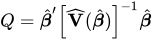 , where is the estimated regression parameters and
  is the estimated covariance matrix for . You can request the Wald tests that are described in the following table by using the DF= option in the MODEL statement.
| Numerator | Denominator | |||
|---|---|---|---|---|
| Value of DF= | Test Request | Test Statistic | Degrees of Freedom | Degrees of Freedom |
| NONE | Chi-square | Q | p |  |
| v | Customized F | vQ/pd | p | v |
| DESIGN | Unadjusted F | Q/p | p | d |
| DESIGN (v) | Unadjusted F | Q/p | p | v |
| PARMADJ | Adjusted F | (d–p+1)Q/pd | p | d–p+1 |
| PARMADJ (v) | Adjusted F | (v-p+1)Q/pv | p | v-p+1 |
| DESIGNADJ | Adjusted F | (d–p+1)Q/pd | p | d |