The SURVEYREG Procedure
Variance Estimation
PROC SURVEYREG uses the Taylor series method or replication (resampling) methods to estimate sampling errors of estimators based on complex sample designs (Fuller 2009; Woodruff 1971; Fuller 1975; Fuller et al. 1989; Särndal, Swensson, and Wretman 1992; Wolter 2007; Rust 1985; Dippo, Fay, and Morganstein 1984; Rao and Shao 1999; Rao, Wu, and Yue 1992; Rao and Shao 1996). You can use the VARMETHOD= option to specify a variance estimation method to use. By default, the Taylor series method is used. However, replication methods have recently gained popularity for estimating variances in complex survey data analysis. One reason for this popularity is the relative simplicity of replication-based estimates, especially for nonlinear estimators; another is that modern computational capacity has made replication methods feasible for practical survey analysis.
Replication methods draw multiple replicates (also called subsamples) from a full sample according to a specific resampling scheme. The most commonly used resampling schemes are the balanced repeated replication (BRR) method, the jackknife method, and the bootstrap method. For each replicate, the original weights are modified for the PSUs in the replicates to create replicate weights. The parameters of interest are estimated by using the replicate weights for each replicate. Then the variances of parameters of interest are estimated by the variability among the estimates derived from these replicates. You can use the REPWEIGHTS statement to provide your own replicate weights for variance estimation.
The following sections provide details about how the variance-covariance matrix of the estimated regression coefficients is estimated for each variance estimation method.
Taylor Series (Linearization)
The Taylor series (linearization) method is the most commonly used method to estimate the covariance matrix of the regression coefficients for complex survey data. It is the default variance estimation method used by PROC SURVEYREG.
Use the notation described in the section Notation to denote the residuals from the linear regression as

with  as its elements. Let the
  matrix
  be defined as

where
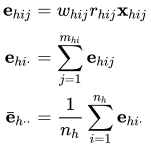
The Taylor series estimate of the covariance matrix of  is
is

The factor  in the computation of the matrix reduces the small sample bias associated with using the estimated function to calculate deviations (Hidiroglou, Fuller, and Hickman 1980). For simple random sampling, this factor contributes to the degrees of freedom correction applied to the residual mean square for ordinary least squares in which p parameters are estimated. By default, the procedure use this adjustment in the variance estimation. If you do not want to use this multiplier in variance estimation, you can specify the VADJUST=NONE option in the MODEL statement to suppress this factor.
Bootstrap Method
The VARMETHOD=BOOTSTRAP option in the PROC SURVEYREG statement requests the bootstrap method for variance estimation. This method can be used for stratified sample designs and for designs that have no stratification. If your design is stratified, the bootstrap method requires at least two PSUs in each stratum. You can provide your own bootstrap replicate weights for the analysis by using a REPWEIGHTS statement, or the procedure can construct bootstrap replicate weights for the analysis.
PROC SURVEYREG estimates the parameter of interest (or requested statistics) from each replicate, and then uses the variability among replicate estimates to estimate the overall variance of these statistics.
This bootstrap method for complex survey data is similar to the method of Rao, Wu, and Yue (1992) and is also known as the bootstrap weights method (Mashreghi, Haziza, and Léger 2016). For more information, see Lohr (2010, Section 9.3.3), Wolter (2007, Chapter 5), Beaumont and Patak (2012), Fuller (2009, Section 4.5), and Shao and Tu (1995, Section 6.2.4). McCarthy and Snowden (1985), Rao and Wu (1988), Sitter (1992b), and Sitter (1992a) provide several adjusted bootstrap variance estimators that are consistent for complex survey data. The naive bootstrap variance estimator that is suitable for infinite populations is not consistent for complex survey data.
Replicate Weight Construction
If you do not provide replicate weights by using a REPWEIGHTS statement, PROC SURVEYREG constructs bootstrap replicate weights for the analysis. The procedure selects replicate bootstrap samples by with-replacement random sampling of PSUs within strata. You can specify the number of bootstrap replicates in the REPS= method-option; by default, the number of replicates is 250. (Increasing the number of replicates can improve the estimation precision but also increases the computation time.) You can specify the bootstrap sample sizes  in the MH= method-option; by default,
  , where
  is the number of PSUs in stratum h.
In each replicate sample, the original sampling weights of the selected units are adjusted to reflect the full sample. These adjusted weights are the bootstrap replicate weights. In replicate r, the bootstrap replicate weight for observation j in PSU i in stratum h is computed as

where  is the number of times PSU i is selected for replicate r, and
  is the sampling fraction in stratum h that you can input by using either the RATE= or TOTAL= option in the PROC SURVEYREG statement.
You can use the OUTWEIGHTS=SAS-data-set method-option to store the bootstrap replicate weights in a SAS data set. For information about the contents of the OUTWEIGHTS= data set, see the section Replicate Weights Output Data Set. You can provide these replicate weights to the procedure for subsequent analyses by using a REPWEIGHTS statement.
Variance Estimation
Let R be the total number of bootstrap replicates weights. Denote  as the replicate coefficient for the rth replicate (
 ).
).
When the procedure generates the bootstrap replicate weights,  .
.
If you provide your own bootstrap replicate weights by including a REPWEIGHTS statement, you can specify in the REPCOEFS= option. By default, .
Let be the estimated regression coefficients from the full sample for  , and let
  be the estimated regression coefficient when the rth set of bootstrap replicate weights is used. PROC SURVEYREG estimates the covariance matrix of by the following equation

Here, the degrees of freedom is the number of clusters minus the number of strata. If there are no clusters, then the degrees of freedom equals the number of observations minus the number of strata. If the design is not stratified, then the degrees of freedom equals the number of PSUs minus one.
If you provide your own replicate weights without specifying the DF= option, the degrees of freedom is set to be the number of replicates R.
If you specify the CENTER=REPLICATES method-option, then PROC SURVEYREG computes the covariance matrix of by

where  is the average of the replicate estimates and is calculated as follows:
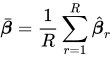
If a parameter cannot be computed from one or more replicates, then the procedure computes the variance estimate by using those replicates from which the parameter can be estimated, and the number of those replicates,  , replaces the original number of replicates, R, in the variance estimation.
If you do not provide your own value for the degrees of freedom and if is less than the number of PSUs minus the number of strata, then the degrees of freedom is set to .
Balanced Repeated Replication (BRR) Method
The balanced repeated replication (BRR) method requires that the full sample be drawn by using a stratified sample design with two primary sampling units (PSUs) per stratum. Let H be the total number of strata. The total number of replicates R is the smallest multiple of 4 that is greater than H. However, if you prefer a larger number of replicates, you can specify the REPS=number option. If a number  number Hadamard matrix cannot be constructed, the number of replicates is increased until a Hadamard matrix becomes available.
Each replicate is obtained by deleting one PSU per stratum according to the corresponding Hadamard matrix and adjusting the original weights for the remaining PSUs. The new weights are called replicate weights.
Replicates are constructed by using the first H columns of the  Hadamard matrix. The rth () replicate is drawn from the full sample according to the rth row of the Hadamard matrix as follows:
If the
 element of the Hadamard matrix is 1, then the first PSU of stratum h is included in the rth replicate and the second PSU of stratum h is excluded.
 If the
element of the Hadamard matrix is –1, then the second PSU of stratum h is included in the rth replicate and the first PSU of stratum h is excluded.
Note that the "first" and "second" PSUs are determined by data order in the input data set. Thus, if you reorder the data set and perform the same analysis by using BRR method, you might get slightly different results, because the contents in each replicate sample might change.
The replicate weights of the remaining PSUs in each half-sample are then doubled to their original weights. For more information about the BRR method, see Wolter (2007) and Lohr (2010).
By default, an appropriate Hadamard matrix is generated automatically to create the replicates. You can request that the Hadamard matrix be displayed by specifying the VARMETHOD=BRR(PRINTH) method-option. If you provide a Hadamard matrix by specifying the VARMETHOD=BRR(HADAMARD=) method-option, then the replicates are generated according to the provided Hadamard matrix.
You can use the VARMETHOD=BRR(OUTWEIGHTS=) method-option to save the replicate weights into a SAS data set.
Let be the estimated regression coefficients from the full sample for , and let be the estimated regression coefficient from the rth replicate by using replicate weights. PROC SURVEYREG estimates the covariance matrix of by

with H degrees of freedom, where H is the number of strata. If you provide your own replicate weights without specifying the DF= option, the degrees of freedom is set to be the number of replicates R.
If you specify the CENTER=REPLICATES method-option, then PROC SURVEYREG computes the covariance matrix of by

where is the average of the replicate estimates and is calculated as follows:
If a parameter cannot be computed from one or more replicates, then the procedure computes the variance estimate by using those replicates from which the parameter can be estimated, and the number of those replicates, , replaces the original number of replicates, R, in the variance estimation.
If you do not provide your own value for the degrees of freedom, then the degrees of freedom equals the minimum between and the number of strata, H.
Fay’s BRR Method
Fay’s method is a modification of the BRR method, and it requires a stratified sample design with two primary sampling units (PSUs) per stratum. The total number of replicates R is the smallest multiple of 4 that is greater than the total number of strata H. However, if you prefer a larger number of replicates, you can specify the REPS= method-option.
For each replicate, Fay’s method uses a Fay coefficient  to impose a perturbation of the original weights in the full sample that is gentler than using only half-samples, as in the traditional BRR method. The Fay coefficient can be set by specifying the FAY =
  method-option. By default,
  if the FAY method-option is specified without providing a value for (Judkins 1990; Rao and Shao 1999). When
  , Fay’s method becomes the traditional BRR method. For more information, see Dippo, Fay, and Morganstein (1984); Fay (1984, 1989); Judkins (1990).
Let H be the number of strata. Replicates are constructed by using the first H columns of the Hadamard matrix, where R is the number of replicates,  . The rth () replicate is created from the full sample according to the rth row of the Hadamard matrix as follows:
If the
element of the Hadamard matrix is 1, then the full sample weight of the first PSU in stratum h is multiplied by and the full sample weight of the second PSU is multiplied by  to obtain the rth replicate weights.
 If the
element of the Hadamard matrix is –1, then the full sample weight of the first PSU in stratum h is multiplied by and the full sample weight of the second PSU is multiplied by to obtain the rth replicate weights.
You can use the VARMETHOD=BRR(OUTWEIGHTS=) method-option to save the replicate weights into a SAS data set.
By default, an appropriate Hadamard matrix is generated automatically to create the replicates. You can request that the Hadamard matrix be displayed by specifying the VARMETHOD=BRR(PRINTH) method-option. If you provide a Hadamard matrix by specifying the VARMETHOD=BRR(HADAMARD=) method-option, then the replicates are generated according to the provided Hadamard matrix.
Let be the estimated regression coefficients from the full sample for . Let be the estimated regression coefficient obtained from the rth replicate by using replicate weights. PROC SURVEYREG estimates the covariance matrix of by

with H degrees of freedom, where H is the number of strata. If you provide your own replicate weights without specifying the DF= option, the degrees of freedom is set to be the number of replicates R.
If you specify the CENTER=REPLICATES method-option, then PROC SURVEYREG computes the covariance matrix of by

where is the average of the replicate estimates and is calculated as follows:
If a parameter cannot be computed from one or more replicates, then the procedure computes the variance estimate by using those replicates from which the parameter can be estimated, and the number of those replicates, , replaces the original number of replicates, R, in the variance estimation.
If you do not provide your own value for the degrees of freedom, then the degrees of freedom equals the minimum between and the number of strata, H.
Jackknife Method
The jackknife method of variance estimation deletes one PSU at a time from the full sample to create replicates. The total number of replicates R is the same as the total number of PSUs. In each replicate, the sample weights of the remaining PSUs are modified by the jackknife coefficient . The modified weights are called replicate weights.
The jackknife coefficient and replicate weights are described as follows.
Without Stratification
If there is no stratification in the sample design (no STRATA statement), the jackknife coefficients are the same for all replicates:

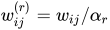
Denote the original weight in the full sample for the jth member of the ith PSU as  . If the ith PSU is included in the rth replicate (), then the corresponding replicate weight for the jth member of the ith PSU is defined as
With Stratification
If the sample design involves stratification, each stratum must have at least two PSUs to use the jackknife method.
Let stratum  be the stratum from which a PSU is deleted for the rth replicate. Stratum is called the donor stratum. Let
  be the total number of PSUs in the donor stratum
  . The jackknife coefficients are defined as

Denote the original weight in the full sample for the jth member of the ith PSU as . If the ith PSU is included in the rth replicate (), then the corresponding replicate weight for the jth member of the ith PSU is defined as

You can use the VARMETHOD=JACKKNIFE(OUTJKCOEFS=) method-option to save the jackknife coefficients into a SAS data set and use the VARMETHOD=JACKKNIFE(OUTWEIGHTS=) method-option to save the replicate weights into a SAS data set.
If you provide your own replicate weights in a REPWEIGHTS statement, then you can also provide corresponding jackknife coefficients in the JKCOEFS= or REPCOEFS= option. If you provide replicate weights but do not provide jackknife coefficients, PROC SURVEYREG uses  as the jackknife coefficient for all replicates by default.
Let be the estimated regression coefficients from the full sample for . Let be the estimated regression coefficient obtained from the rth replicate by using replicate weights. PROC SURVEYREG estimates the covariance matrix of by
with R–H degrees of freedom, where R is the number of replicates and H is the number of strata, or R–1 when there is no stratification. If you provide your own replicate weights without specifying the DF= option, the degrees of freedom is set to be the number of replicates R.
If you specify the CENTER=REPLICATES method-option, then PROC SURVEYREG computes the covariance matrix of by
where is the average of the replicate estimates and is calculated as follows:
If a parameter cannot be computed from one or more replicates, then the procedure computes the variance estimate by using those replicates from which the parameter can be estimated, and the number of those replicates, , replaces the original number of replicates, R, in the variance estimation.
If you do not provide your own value for the degrees of freedom, then the degrees of freedom equals  .
.
Hadamard Matrix
A Hadamard matrix  is a square matrix whose elements are either 1 or –1 such that

where k is the dimension of and  is the identity matrix of order k. The order k is necessarily 1, 2, or a positive integer that is a multiple of 4.
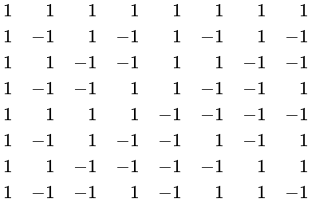
For example, the following matrix is a Hadamard matrix of dimension k = 8:
Degrees of Freedom
PROC SURVEYREG produces tests for the significance of model effects, regression parameters, estimable functions specified in the ESTIMATE statement, and contrasts specified in the CONTRAST statement. It computes all these tests taking into account the sample design. The degrees of freedom for these tests differ from the degrees of freedom for the ANOVA table, which does not consider the sample design.
Denominator Degrees of Freedom
The denominator df refers to the denominator degrees of freedom for F tests and to the degrees of freedom for t tests in the analysis.
For the Taylor series method, the denominator df equals the number of clusters minus the actual number of strata. If there are no clusters, the denominator df equals the number of observations minus the actual number of strata. The actual number of strata equals the following:
one, if there is no STRATA statement
the number of strata in the sample, if there is a STRATA statement but the procedure does not collapse any strata
the number of strata in the sample after collapsing, if there is a STRATA statement and the procedure collapses strata that have only one sampling unit
For replication variance estimation methods that include a REPWEIGHTS statement, the denominator df equals the number of REPWEIGHTS variables, unless you specify an alternative in the DF= option in the REPWEIGHTS statement.
When the BRR method (including Fay’s method) is specified but no REPWEIGHTS statement is included, the denominator df equals the number of strata.
When the jackknife method or bootstrap method is specified but no REPWEIGHTS statement is included, the denominator df is the same as the Taylor series method described earlier.
Alternatively, you can specify your own denominator df by using the DF= option in the MODEL statement.
Numerator Degrees of Freedom
The numerator df refers to the numerator degrees of freedom for the Wald F statistic associated with an effect or with a contrast. The procedure computes the Wald F statistic for an effect as a Type III test; that is, the test has the following properties:
The hypothesis for an effect does not involve parameters of other effects except for containing effects (which it must involve to be estimable).
The hypotheses to be tested are invariant to the ordering of effects in the model.
See the section Testing Effects for more information. The numerator df for the Wald F statistic for a contrast is the rank of the  matrix that defines the contrast.